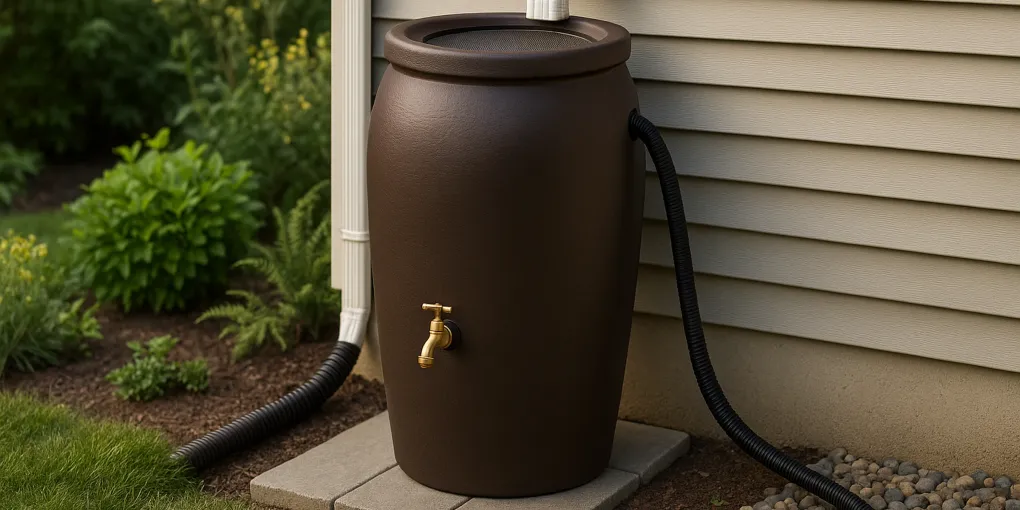
Algreen Athena 80-Gallon Rain Barrel
Best for tall, narrow capacityCapacity: 80 US gallons
Quick picks
Algreen Athena 80-Gallon Rain Barrel
★ Top pick Best for tall, narrow capacity- Capacity: 80 US gallons
- Footprint: 24-inch diameter; 49 inches high
- Included Hardware: Screen guard, brass spigot, bottom drain, and two rear overflow ports
- Best For: A visible garden location where height fits better than a wide tank
The Algreen Athena stores 80 gallons in a 24-inch-wide, 49-inch-tall resin body. That combination is its reason to buy: it holds about 60% more water than a nominal 50-gallon barrel without becoming a broad horizontal tank. It is not automatically a small-space barrel, though. Its height changes the downspout cut, its full water load approaches 670 pounds, and its rear overflow ports still need working clearance.
Algreen’s current product page documents a corrosion-resistant screen guard, two rear overflow ports, a brass spigot in a reinforced threaded fitting, a lower threaded drain, UV-resistant roto-molded resin, and a two-year manufacturer warranty. This is a documentation-based review of those published features.
Quick verdict
Buy the Athena when you want a decorative high-capacity barrel, have a level base at least 24 inches across, and can align a downspout or compatible diverter with a 49-inch-tall body. The screen, separate lower drain, and two overflow/linking ports make it more complete than a decorative vessel with only a faucet.
Choose a shorter 45- to 55-gallon barrel if a window, low downspout outlet, or eave limits inlet height. Choose a wider cistern or two linked barrels if a tall, narrow load feels awkward at your site. An 80-gallon label is useful only when the inlet, overflow, and watering outlet are all reachable after installation.
Check Algreen Athena 80 gallon rain barrel on Amazon. Use the manufacturer model name and 80-gallon capacity to avoid confusing it with Algreen’s other barrel sizes. Confirm the seller, color, included parts, and return terms on the listing.
Athena specifications that affect the installation
| Published feature | What Algreen lists | What to check in your yard |
|---|---|---|
| Capacity | 80 US gallons | A full water load of about 667 pounds before the barrel is counted |
| Size | 24 inches across by 49 inches high | Downspout cut height, eave and window clearance, plus room above the screen |
| Body | UV-resistant roto-molded resin with reinforced back panel | Full bottom support and a location where the tall shell will not be bumped |
| Inlet | Recessed top channel and corrosion-resistant screen guard | Downspout alignment, screen removal clearance, and leaf-cleaning access |
| Watering outlet | Brass spigot with shutoff nozzle in a reinforced fitting | Watering-can clearance and usable hose flow as the water level falls |
| Lower outlet | Threaded bottom drain | Access for seasonal draining and the correct cap or hose fitting |
| Rear ports | Two overflow or linking ports | Hose diameter, discharge route, wall clearance, and linking hardware |
| Compatibility | Algreen diverter kits and rain-barrel pump kit | Exact kit model and current seller’s included-parts list |
| Warranty | Two years, according to the manufacturer | Receipt retention and the current warranty terms for your seller and country |
The table exposes the main tradeoff: the Athena saves width by adding height. Mark a 24-inch circle at the downspout, then mark the 49-inch top. Add the base thickness and any stand height before deciding that it fits.
Where the tall 80-gallon shape works
A 24-inch diameter can fit beside a house where two linked 50-gallon barrels would consume too much wall length. The pottery-style profile is also less industrial-looking than an IBC tote or horizontal tank, which matters in a visible side garden or patio bed.
Capacity is meaningful for hand watering. One inch of water over 100 square feet is about 62 gallons, so 80 nominal gallons can cover a small bed more usefully than a compact 40-gallon barrel. Usable water will be lower because the working spigot sits above the bottom and the barrel may not start every dry spell completely full.
The barrel is not slim in every direction. A 24-inch body plus spigot, hose bend, rear overflow fittings, and hand clearance can occupy substantially more than two feet. Tape the entire working envelope on the ground rather than measuring the shell alone.
The base is the first purchase decision
Water weighs about 8.34 pounds per US gallon. Eighty gallons therefore weigh about 667 pounds. Add the barrel and fittings, and design the base for more than that water-only number.
Use a compacted, level surface that supports the complete circular bottom. A properly prepared paver pad can work when it does not rock or settle. Do not balance the barrel on separated blocks, a narrow decorative stand, soft mulch, or a sloped strip beside the foundation. The reinforced back panel does not make an uneven base acceptable.
The Athena’s 49-inch body may already put the spigot at a convenient can-filling height. Do not add a tall stand until you measure the downspout inlet relationship and assess stability. If you need more gravity head for a hose, compare the extra elevation against the higher center of mass and the manufacturer’s installation instructions.
Use the rain barrel stand-height and stable-base guide before buying blocks or a stand.
Screened top: useful, but it needs access
Algreen describes a recessed channel that directs water toward a screen guard. This is useful when the downspout terminates above the barrel: leaves remain visible, the inlet can be inspected, and the top does not depend on a small fill hose.
Measure vertical access before placing the barrel under an eave. You need to position the downspout over the inlet without crushing the screen, then lift or clean the screen later. A barrel that barely fits beneath a gutter elbow may be impossible to service.
A compatible side-fill diverter may be better when the barrel must sit away from the downspout or when you want full-barrel water returned through the original downspout. Compatibility is not proof that the kit comes in the box. Compare the current Algreen kit instructions with your downspout dimensions before cutting metal or vinyl.
Spigot and bottom drain serve different jobs
The brass working spigot is for watering cans and hoses. The bottom threaded drain is for removing water below the spigot and may support another connection. Keeping those jobs separate is valuable on an 80-gallon barrel because sediment and several gallons of water can remain below a raised faucet.
Before filling, hand-start every threaded part and use only the gasket or sealant method named in the instructions. Support a connected hose so it does not pull sideways on the spigot. Gravity flow will decline as the water level drops; a brass nozzle does not create household water pressure.
For can filling, put the can in place before opening the valve and verify that the handle clears the barrel body. For irrigation, use short, large-diameter hose and equipment intended for low pressure. Read the rain barrel pump and drip-pressure setup before adding a pump simply because a long hose runs slowly.
Dual rear ports need a plan, not a wall
Two rear ports give the Athena a practical route for overflow or linking. They also create an installation constraint: the back cannot be pressed so tightly against siding that fittings and hoses kink.
For one barrel, route an overflow hose downhill to an allowed discharge point away from the foundation, doors, paths, and neighboring property. Confirm the fitting and hose size from the current instructions rather than buying a generic kit by photograph.
For two barrels, use compatible linking hardware and place both on the same level base. Mismatched heights can leave one barrel carrying more water or overflowing first. Linking two 80-gallon barrels also doubles the stored-water load, so extend the prepared base for the complete system rather than adding a second barrel on soil.
Who should buy the Athena
The Athena is a strong fit when:
- 49 inches of barrel height fits below the downspout and eave;
- a 24-inch circular base plus working clearance fits the site;
- you want 80 gallons without a wide horizontal tank;
- you can route at least one rear port to a safe overflow point;
- screen access and a separate bottom drain matter; and
- a decorative pottery-style shell is worth more than the lowest cost per gallon.
Choose another design when:
- a window or low diverter cut limits barrel height;
- the only base is narrow, sloped, or likely to settle;
- rear fittings would be trapped against a wall;
- you need a sealed, included diverter rather than a screened top setup;
- you need high-pressure irrigation without adding compatible pump equipment; or
- you cannot drain and manage an 80-gallon system before freezing weather.
Pre-order checklist
- Mark a 24-inch circle and add clearance for the front spigot and rear hoses.
- Mark 49 inches plus the finished base height on the wall.
- Confirm that the downspout can reach the screened inlet or an explicitly compatible diverter.
- Plan a level full-bottom base for more than 667 pounds of water load.
- Identify the exact overflow discharge point before ordering hose parts.
- Confirm whether the current listing includes a diverter, linking parts, or only the barrel hardware.
- Save the model, receipt, warranty, and installation instructions.
- Check local rebate, HOA, mosquito-control, and drainage rules before purchase.
Final recommendation
The Algreen Athena is best understood as a tall-capacity barrel, not merely a decorative one. Its documented screen, brass spigot, bottom drain, and dual rear ports cover the core jobs of collection, watering, draining, and overflow. The 80-gallon capacity is genuinely useful for a compact bed, but it brings a roughly 667-pound water load and a 49-inch inlet height.
Buy it after the height, base, and rear-hose route all work on paper. If any one of those fails, a shorter barrel or two smaller linked barrels will be easier to install and maintain, even if the Athena fits the visual style of the yard.
Sources
- Algreen: Athena Rain Barrel, 80 Gallon
- U.S. EPA: Soak Up the Rain, rain barrels
- Virginia Cooperative Extension: Stormwater Management for Homeowners, Rain Barrels
Frequently Asked Questions
- Algreen lists it at 24 inches across and 49 inches high. Measure the complete downspout location, including eaves, window clearance, base, inlet alignment, spigot access, and rear overflow hoses.
- The manufacturer says the barrel is compatible with Algreen diverter kits, but compatibility does not mean a diverter is included. Confirm the current seller's box contents before ordering.
- Algreen describes the two rear ports as overflow or linking points. Confirm the required connector and hose diameter, and place linked barrels on the same level base before filling.
- Eighty US gallons of water weigh about 667 pounds. The filled installation will weigh more after adding the barrel, fittings, and any water retained below the working spigot.