We may earn a commission if you buy through our links.
Quick picks
Anivia Rain Barrel Diverter Kit
Fits 2 x 3 and 3 x 4-inch rectangular downspouts- Stated fit: Standard 2 x 3 and 3 x 4-inch residential downspouts
- Flow control: Off, Medium, or High — selected by hand
- Kit includes: Diverter, 39-inch hose, two set screws; paintable PVC
- Watch For: A full-barrel plan is on you: the listing describes a manual valve, not an automatic shutoff
This kit suits standard 2x3 or 3x4-inch rectangular downspouts feeding a barrel you check by eye; round downspouts, automatic bypass valves, and winter-storm diversion are different formats, covered in the roundups linked below.
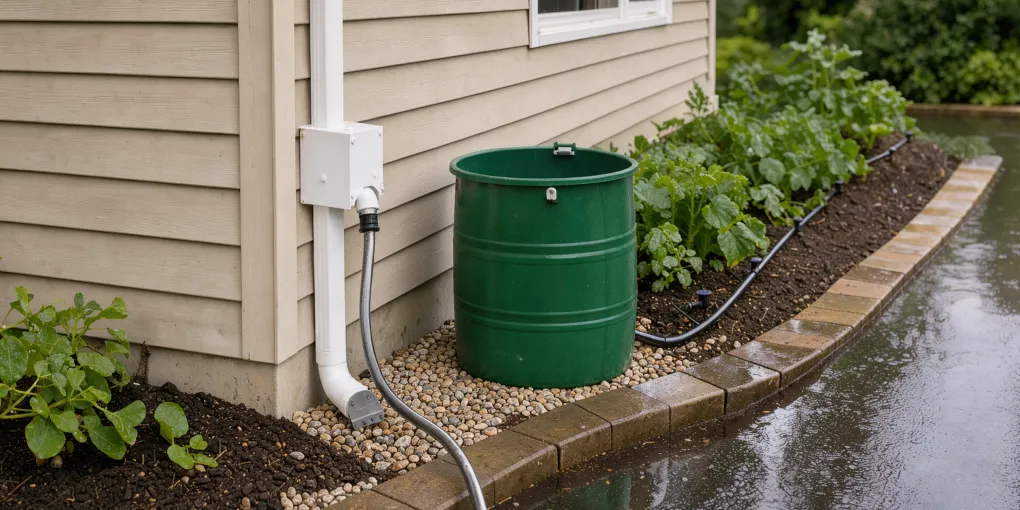
It’s an inch into a steady rain and your downspout is pouring a creek along the foundation. A barrel would catch a useful share of that, but the thought of rebuilding the gutter joint makes the project sit untouched in the garage for another season. Anivia’s diverter kit is an inexpensive answer to exactly that standoff: a set-screw diverter box that replaces a short section of your existing downspout, hands most of the water back down the tube, and sends a share sideways to the barrel. It fits the two standard rectangular downspout sizes.
The honest summary before the details: this is a complete, small, mechanical kit — diverter, 39-inch hose, two set screws — with a hand-set Off/Medium/High valve and a removable leaf filter, and no full-barrel automation anywhere in the listing’s description. Buy it if your downspout measures 2 x 3 or 3 x 4 inches and you will live with a manual valve. Plan something else if your downspout is round or you want the barrel to manage itself.
Inside the kit, exactly as listed
The listing calls this a complete connection kit, and the parts are what a simple diverter install needs: the diverter body, a 39-inch hose, and two set screws. The body is paintable PVC, sold in white, and the seller states it supports year-round outdoor use. A filter window with a removable filter net sits in the water path to catch leaves and debris before they reach the barrel. Those details come from the seller’s five listing bullets. The product information table adds only a 4.3 x 3.5 x 6.3-inch listing size and model number FLQ-03, so treat the bullets as the complete documented story of what the kit does.
Two of those details matter more than they look. The 39-inch hose fixes your geometry: the barrel has to sit within that reach of the diverter, on ground level front-to-back and side-to-side so it sits even, as Rutgers Cooperative Extension’s installation guide advises for any barrel. And the two set screws mean this is a cut-in install, not a clamp-on tray: you cut a short section out of the downspout and bolt the diverter into the gap. Rutgers describes exactly this fork — buy a diverter kit or shorten the downspout and fit an elbow — so the kit route is mainstream guidance, not a hack.
The size check: 2x3, 3x4, or neither
The listing states fit for standard 2 x 3-inch and 3 x 4-inch residential downspouts. Those are the two sizes this listing documents, and “documented” is not “yours,” so the three-minute measure decides the purchase before any tool comes out.
Take a tape to the downspout where the diverter would sit and measure the opening in both directions — the 2 x 3 and 3 x 4 naming refers to that rectangular mouth, width by depth. Two inches by three inches or three by four, you are inside the stated range. Anything else — round tube, oval, a four-inch square on an older home with commercial gutters — is outside what this listing documents, and forcing a rectangular diverter against a round wall is how leaks start. The round and odd-gutter adapter roundup exists for those houses.
What the three-position valve does — and does not — do
The valve is the kit’s one piece of active control, and the listing is straightforward about it: Off, Medium, High, chosen by hand to manage how much runoff enters the barrel as rain and watering needs change. Off is genuinely useful — a full barrel, a storm you want to skip, a neighbor’s drainage day. Medium and High let you decide how eagerly the barrel competes with the downspout during a wet spell.
What the listing does not claim is an automatic bypass at full barrel, and that shapes the ownership model of this kit: you are the level sensor. The water math says the full moment is routine, not hypothetical. Rutgers notes a home with an 800-square-foot roof area drains roughly 600 gallons in a 1.25-inch storm, while an average rain barrel holds about 50 gallons — so one ordinary rain can deliver twelve barrels’ worth. When the barrel fills mid-shower and you are inside, the water finds the barrel’s overflow, which is why extension guidance puts a screened overflow hose draining to a pervious area away from the house on the mandatory list. Do that plumbing and the manual valve stops being a chore: High while you can check it, Off when you notice it’s full, and the overflow protects the times you can’t.
Filter, hose, and the year’s real maintenance
The filter window and net are the difference between a barrel you actually use and one you end up scooping by hand. The net intercepts leaves and debris in the diverter — the listing pitches it as making seasonal cleanup easier, and the honest version of that promise is that you still clean it, you just do it at a window near your hands instead of in the barrel. The net is not mosquito protection, though. Rutgers’ guidance puts that job on the barrel itself: keep screens over every opening, inlets and the overflow hose alike, because mosquitoes enter through any unprotected water path. Rinse the net after big leaf-fall storms, and check the 39-inch hose for a sag or uphill run that holds water and debris against the fitting.
The paintable PVC is a smaller nicety with a real use: a white box on a cream downspout disappears with one coat of the trim color, which matters if the downspout crosses a front-facing wall.
Price, warranty, and who should actually buy this
Check the current price on the listing, and compare it against other complete kits that include a hose and filter rather than against a hard-plumbed diverter, which is a different job. The listing states a 90-day warranty: a season-and-a-half of recourse, short but stated. This review makes no star-rating or review-count claims; judge the kit on its documented parts.
Buy it if: your downspout measures 2 x 3 or 3 x 4 inches, the barrel can sit within about three feet of the downspout on level ground, and checking a full barrel is a habit you’ll keep. Keep shopping if: your downspout is round or nonstandard, you want hands-off bypass when the barrel fills, or you need the diverter to double as a winter storm route — the winter and storm-bypass roundup covers valves built for those jobs. See the diverter kit roundup before you cut, and check the current price on the Anivia kit listing on Amazon.
Bottom line
The Anivia kit is a basic, honest diverter: a diverter, 39-inch hose and two set screws, a manual three-position valve, a removable filter, and fit for the two standard rectangular sizes. It asks for two things in return — a measured fit before you cut, and an overflow plan you trust, because the valve is manual and the barrel fills faster than you’ll notice. Give it both and it does the job extension services describe.
Sources
- Anivia Rain Barrel Diverter Kit: Amazon price and listing page for ASIN B0CY7GCW2F, consulted November 19, 2026 — product title, the five listing bullets (stated 2 x 3 / 3 x 4-inch downspout fit, Off/Medium/High flow adjustment, removable filter window and net — the filter bullet’s only extra promise is “making seasonal cleanup easier” — 39-inch hose, two set screws, paintable PVC, year-round outdoor use, 90-day warranty), and the Product Information table entries (4.3 x 3.5 x 6.3-inch product dimensions, model number FLQ-03).
- Rutgers Cooperative Extension, Rain Barrels Part II: Installation and Use (FS1118), consulted November 19, 2026 — diverter-kit-versus-cut-and-elbow installation guidance, the ~600-gallons-from-800-square-feet-in-a-1.25-inch-storm figure against ~50-gallon barrels, level-base advice, overflow to pervious areas away from the house, and screening all barrel openings against mosquitoes.
Frequently Asked Questions
- Measure the rectangular opening of your downspout — width by depth, top to bottom, at the spot where the kit will sit. The listing states fit for standard 2 x 3-inch and 3 x 4-inch residential downspouts, so if your tube measures either of those, you are in the stated range. Round downspouts, older nonstandard tubes, and decorative profiles need a different insert, which is why our [diverter kit roundup for common downspouts](/blog/best-rain-barrel-diverter-kits-common-downspouts/) separates kits by measured shape before anything else.
- The listing does not claim an automatic full-barrel shutoff. What it describes is a three-position valve — Off, Medium, High — that you set by hand to manage how much runoff enters the barrel. So the full-barrel moment is yours to handle: flip the valve to Off when the barrel is full, and keep a barrel overflow hose routed to a pervious area as backup for the storms you miss. Rutgers Cooperative Extension's installation guide is explicit that overflow should drain away from the house, and our [overflow routing guide](/blog/rain-barrel-overflow-away-from-foundation-guide/) walks through the foundation-safe layouts.
- No. The filter window and net catch leaves and debris before they enter the hose and barrel, which is a strainer job. A first-flush diverter does a different job: it sends the dirtiest opening minutes of each storm to waste instead of into storage. If you want that layer too, our [first-flush diverter setup guide](/blog/rain-barrel-first-flush-diverter-setup/) explains where it sits relative to this kind of kit.
- The listing says the paintable PVC construction supports year-round outdoor use. That is the seller's stated durability, not a freeze rating, and nothing on the page describes a winter bypass mode. In climates that freeze, the cautious pattern is to drain the barrel, disconnect and cap the 39-inch hose before the first hard freeze, and let the downspout run normally — or install a dedicated winter bypass valve, which our [winter and storm-bypass roundup](/blog/best-rain-barrel-downspout-diverter-valves-winter-storm-bypass/) compares.