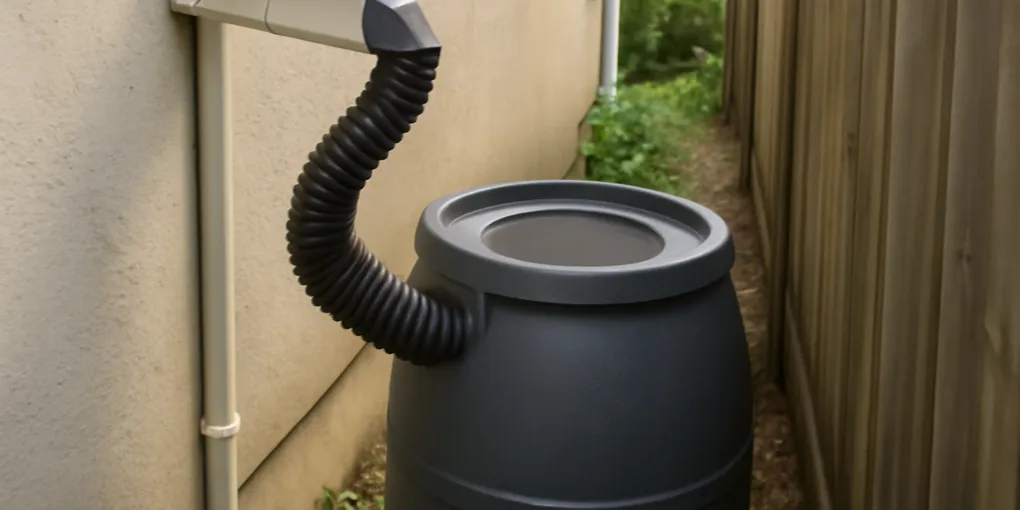
Rain barrel diverter kit for rectangular downspout
Best controlled fillUse Case: Sending water to a nearby barrel while preserving downspout overflow
Varies
Quick picks
| Product | Key Specs |
|---|---|
| See price on Amazon |
|
| See price on Amazon |
|
| See price on Amazon |
|
Product availability, certifications, and retailer details can change; check the current Amazon page before buying.
A downspout adapter looks like a small part, but it decides whether a rain barrel fills cleanly or becomes a maintenance headache. Tight spaces make the choice harder. The barrel may sit between a wall and walkway, the gutter outlet may point the wrong direction, or the downspout may be too close to the siding for a standard elbow. The best adapter is not the fanciest one; it is the one that fits your downspout size, sends water into a screened inlet, and still lets excess water escape safely when the barrel is full.
This guide focuses on residential rain barrel adapters, diverters, elbows, and flexible extensions for awkward downspout layouts. It does not recommend fake universal parts. Measure first, keep overflow in the plan, and choose the simplest adapter that leaves the system easy to clean.
For multi-barrel overflow planning, pair this guide with our rain barrel overflow and linking kit guide. If debris is the bigger problem, read the first-flush diverter and downspout prefilter guide.
Quick picks for tight downspout layouts
- Search Amazon for rectangular downspout rain barrel diverter kits when you want controlled filling and a cleaner overflow path back through the original downspout.
- Search Amazon for flexible downspout extension adapters when a rigid elbow cannot make the offset without hitting siding, trim, or the barrel lid.
- Search Amazon for downspout elbow adapter assortments when you can build a neat rigid route with standard gutter parts.
How to choose before you buy
Measure the downspout, the barrel height, and the offset. Most residential downspouts are rectangular, but the exact dimensions matter. A part sold for one common size can fit poorly on another, especially if the downspout is older, crimped, painted thickly, or slightly out of square. Measure both width and depth at the cut point, not just at the bottom outlet, and write those dimensions down before comparing listings.
Next, measure the vertical relationship between the downspout cut and the barrel inlet. A diverter usually needs to sit at a specific height relative to the barrel’s fill level so water can stop entering the barrel when it is full. A flexible extension may tolerate more placement error, but it can also overfill the barrel if overflow is not handled separately.
Finally, check access. The best-looking adapter can still be a poor choice if you cannot remove leaves, disconnect it for winter, or inspect the connection after a storm. Tight side-yard installs need maintenance room, not just installation room, because cramped fittings are the first place leaves and grit hide.
Pick 1: Rectangular downspout diverter kit
A diverter kit is the most controlled option for many tight spaces. Instead of dumping the full downspout into an open barrel lid, the kit taps the downspout and sends a smaller side flow to the barrel. When installed correctly, some designs let excess water continue down the original downspout after the barrel is full.
Choose this route when the original downspout already drains to a safe location and you want the barrel tucked close to the wall. Look for a kit that clearly matches your downspout size, includes a template or hole saw guidance, and provides a winter bypass or easy disconnect. The connection hose should have a smooth path from the diverter to the barrel port without sagging below the entry point.
Watch the installation height. If the diverter is too low, the barrel may not fill well. If it is too high or the hose route rises, water can back up or spill where you do not want it. Follow the manufacturer’s height guidance rather than guessing from a product photo.
Pick 2: Flexible downspout extension adapter
A flexible adapter is useful when the downspout outlet and barrel inlet do not line up. It can make a short offset around trim, a stand leg, or the edge of a lid. It is also easier to remove for cleaning than a complicated rigid assembly.
The weakness is support. Flexible plastic can kink, sag, crack from sun exposure, or detach during a heavy storm if it is stretched or loosely fastened. Use it for short, visible runs where you can see whether it is carrying water. Avoid burying it in mulch or forcing it into a sharp bend behind the barrel.
For tight walkways, keep the adapter inside the barrel footprint as much as possible. A hose loop that sticks into a path can become a trip hazard. If the route cannot be made cleanly, move the barrel or use a different style of diverter.
Pick 3: Rigid elbow adapter assembly
Rigid elbows and short downspout sections make sense when appearance, durability, and a predictable path matter. They can look cleaner on a visible wall than a loose flexible tube and may be easier to secure with screws. Standard gutter parts also let you choose A-style or B-style turns to match the direction of the offset.
The tradeoff is precision. Rigid parts need more exact measuring and may transmit movement if the barrel shifts or the stand settles. Leave enough clearance so the barrel can be removed for cleaning. Do not screw a rigid route so tightly that the only way to service the barrel is to dismantle the downspout.
Rigid parts still need screening at the barrel inlet. If the elbow sends leaves directly into an open lid, the barrel will clog faster and mosquito control gets harder. Pair the adapter with a screened inlet or a separate prefilter.
Fit checks that prevent returns
Bring four measurements to the product page: downspout width, downspout depth, distance from downspout face to barrel inlet, and vertical drop from adapter outlet to inlet. Also note the downspout shape. Rectangular, round, and decorative outlets are not interchangeable without specific adapters.
Check the barrel lid before buying. Some barrels have a centered mesh screen. Others use a side inlet, sealed threaded port, or removable top. A part that works for an open screen may not work for a sealed side port. If the barrel already has a molded overflow and fill connection, use that design instead of cutting a new hole.
Read recent buyer photos for your downspout size, but treat them as fit clues rather than proof. Small installation differences matter. A kit that works on a 2x3 downspout mounted on flat siding may be awkward on a 3x4 downspout beside brick trim.
Overflow and winter details
Adapter choice is incomplete without overflow. A diverter that returns water to the downspout can be excellent if the downspout outlet is safe. A top-fill adapter needs a separate overflow hose or linked-barrel plan. A flexible extension aimed into the lid must not be the only water path during a storm.
Winter matters in freezing climates. Water trapped in a sagging adapter can freeze, split plastic, or push fittings apart. Choose parts that can be disconnected, drained, or bypassed. If you already follow our winterizing rain barrel guide, include the adapter in the same seasonal checklist.
How we score downspout adapters
| Criterion | Weight | How to apply it here |
|---|---|---|
| Research | 30% | Match the adapter to measured downspout dimensions, barrel inlet style, and manufacturer installation height. |
| Evidence Quality | 25% | Prefer parts with clear sizing, templates, and visible installation photos for the same downspout shape. |
| Value | 20% | Buy the simplest part that creates a clean fill path and safe overflow; do not pay for universal claims you cannot verify. |
| User Signals | 15% | Treat leaks, sagging hose, lid splash, and difficult cleanout access as signs the adapter is wrong for the layout. |
| Transparency | 10% | Keep the connection visible enough that anyone can see whether the barrel is filling, bypassing, or clogging. |
FAQ
What downspout size do I need for a rain barrel diverter?
Measure the actual downspout width and depth where the diverter will install. Many kits target common rectangular sizes, but older or decorative downspouts can vary. Do not rely on the barrel size alone; the adapter must match the downspout.
Is a flexible downspout adapter better than a rigid elbow?
Flexible adapters are better for short awkward offsets and easy removal. Rigid elbows are better when the path is simple, visible, and needs a cleaner finished look. If the flexible part has to kink or cross a walkway, it is not the better choice.
Can I just aim the downspout into the open top of the barrel?
You can on some simple setups, but it usually needs a screened inlet, stable alignment, and a separate overflow route. An open, unscreened top invites leaves, mosquito access, and splash problems.
Why did my diverter stop filling the rain barrel?
Common causes include clogged screens, wrong installation height, a hose that slopes upward, trapped debris in the downspout, or a barrel inlet that is already at the diverter’s fill level. Disconnect and inspect the route before replacing the whole kit.
Sources
- Clemson Cooperative Extension, rainwater harvesting basics: https://hgic.clemson.edu/factsheet/rainwater-harvesting/
- Penn State Extension, rain barrels overview: https://extension.psu.edu/rain-barrels
- University of Georgia Extension, rainwater harvesting for homeowners: https://extension.uga.edu/publications/detail.html?number=B1372