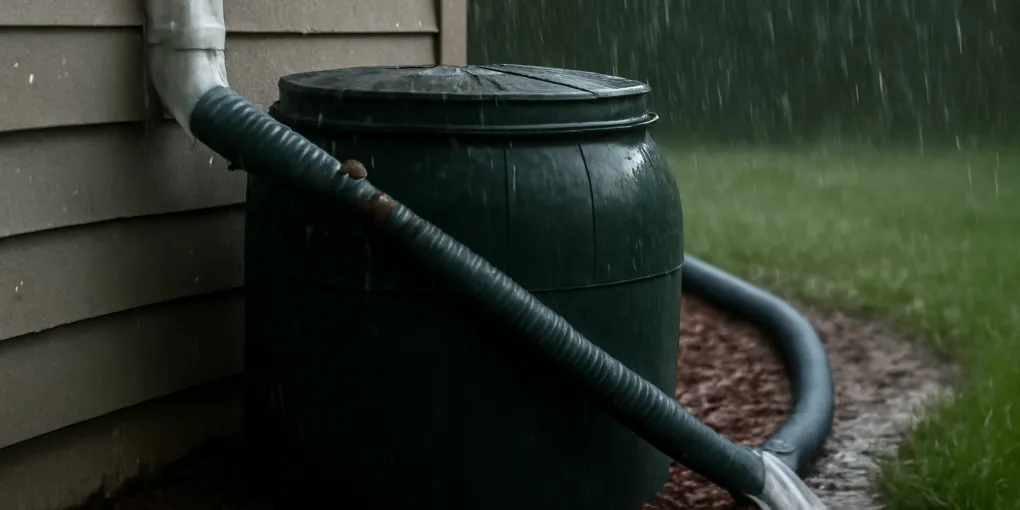
Rain Barrel Heavy-Storm Bypass: How to Keep Overflow From Becoming a Flood Problem
ProtocolQuick picks
| Product | Key Specs |
|---|---|
| See price on Amazon |
|
| See price on Amazon |
|
| See price on Amazon |
|
Product availability, certifications, and retailer details can change; check the current Amazon page before buying.
A 50-gallon rain barrel can fill surprisingly fast in a real storm. One inch of rain on 100 square feet of roof produces about 62 gallons of runoff before losses. That means a modest roof section can fill a barrel early in the event, then every additional gallon needs a safe bypass path. If that path is a tiny hose, clogged screen, low diverter, or muddy discharge point beside the wall, the barrel can turn a normal downspout problem into a concentrated foundation problem.
Heavy-storm bypass is different from everyday overflow. Everyday overflow asks, “Where does water go after the barrel is full?” Storm bypass asks, “What happens when the barrel is full, the inlet screen is collecting debris, the rain is still intense, and nobody wants to stand outside adjusting hoses?” The answer should be visible, downhill, unclogged, and reversible.
If your current problem is ordinary overflow placement, start with rain barrel overflow away from the foundation. If freezing weather is part of the decision, pair this with winterizing a rain barrel. This guide focuses on severe-rain setup: when to collect, when to bypass, and which parts are worth buying before the next warning arrives.
Storm bypass quick picks
Use these as product categories, not universal fixes:
- Search Amazon for oversized rain barrel overflow hose when your barrel already has a dedicated overflow port but the stock line is short, kinked, or too small for the roof area.
- Search Amazon for rain barrel diverters with overflow return if the original downspout outlet is reliable and you want a full barrel to stop accepting water automatically.
- Search Amazon for flexible downspout storm bypass extensions when you sometimes need to take the barrel offline and send the downspout directly to a safe discharge point.
Step 1: Estimate whether the barrel will fill early
You do not need engineering software for the first pass. Multiply roof catchment area by expected rainfall and remember that roughly one inch of rain on 100 square feet of roof produces about 62 gallons. A 50-gallon barrel under a 200-square-foot roof section can fill before a one-inch storm is over. Under a larger roof face, it may fill during the first burst.
That math matters because a full barrel no longer reduces runoff. It becomes a junction box with a limited outlet. If the forecast calls for repeated thunderstorms, tropical moisture, or several inches over saturated soil, plan as though the barrel will be full and bypassing for most of the event.
Look at the roof area feeding the downspout, not the whole house unless the whole house drains to that point. A narrow porch roof may be manageable with a short overflow hose. A main roof valley feeding one downspout can overwhelm small fittings quickly.
Step 2: Decide collection mode before the storm starts
Choose one of three modes before rain arrives:
- Normal collection: the barrel is partly empty, the inlet screen is clean, and the overflow route has already passed a hose test.
- Managed overflow: the barrel can fill, but a large, downhill overflow hose or diverter return will carry excess water away from the house.
- Full bypass: the barrel is disconnected or the diverter is set so roof water skips the barrel entirely.
Full bypass is not failure. It is the right choice when the barrel sits near a basement wall, the stand base is soft, the overflow hose crosses a walkway, or the storm is bigger than the system was built to handle. A rain barrel should help garden watering; it should not be asked to manage flood risk.
Step 3: Make the overflow path boring and obvious
A storm path should be easy to inspect in ten seconds. Water should leave the barrel through a large fitting or diverter, travel downhill without a sagging pocket, and discharge where you can see it. Avoid buried mystery routes unless they were designed for roof drainage and have a clear outlet.
The first weak point is often behind the barrel. Short hoses kink when the barrel shifts. Smooth plastic outlets can let hoses pop off if they are not clamped. Mulch can hide a hose that has flattened. Before a storm, tug the fitting gently, clear leaves from the screen, and confirm that the discharge end has not been buried or pointed back at the wall.
If the barrel uses a return-to-downspout diverter, inspect the original downspout extension. The diverter can only be as safe as the downspout it returns water to. If the downspout dumps beside the foundation, a return diverter simply moves the problem from one opening to another.
Step 4: Add a temporary bypass when the forecast is unusual
A temporary bypass is useful when the permanent system is good for ordinary rain but not for a rare event. That may mean disconnecting the barrel hose and extending the downspout, switching the diverter to a closed or winter setting, or routing a larger overflow line to a lawn swale for one storm.
Keep temporary parts simple. A flexible extension should slope away from the house and end where water will not cross steps, driveways, or a neighbor’s lot. Weigh or stake the end only if that does not crush the opening. Do not tape over openings in a way that creates a hidden backup inside the downspout.
After the storm, remove temporary parts that create mowing, tripping, or freezing hazards. Write down what worked. A phone photo of the bypass route can save time before the next warning.
Step 5: Watch for clog signals after the first burst
The inlet screen is the highest-risk storm component because heavy rain moves leaves, pollen mats, shingle grit, and seed pods all at once. If water spills over the screen while the barrel is not full, the problem is not overflow capacity; it is inlet blockage. Clean the screen only when it is safe to do so. Do not climb, reach into active downspouts, or stand in lightning conditions.
At ground level, look for muddy water around the stand, splash marks on siding, pooling near a window well, or a hose that has lifted from the outlet. Those signals mean the bypass route needs to be simplified or enlarged before the next event.
How we judge a storm-ready setup
| Criterion | Weight | What it means for heavy rain |
|---|---|---|
| Research | 30% | Use roof-area math, local stormwater guidance, and product manuals before trusting a small stock hose. |
| Evidence Quality | 25% | Give more weight to a hose-fill test and observed storm flow than to a listing that calls a fitting universal. |
| Value | 20% | Upgrade the limiting part first: clean inlet, secure fitting, larger overflow hose, or safer downspout extension. |
| User Signals | 15% | Treat wet siding, stand-base erosion, water crossing paths, and repeated screen overflow as failure signs. |
| Transparency | 10% | Keep the bypass route visible enough that another household member can confirm it before a storm. |
FAQ
Should I disconnect a rain barrel before a major storm?
Disconnect or bypass it when the planned overflow route cannot keep water away from the house, when the barrel is already full, or when the forecast includes unusually intense rain. A rain barrel is storage, not flood control.
Is a larger overflow hose enough for cloudbursts?
It helps only if the hose is the limiting point and the discharge end is safe. If the roof area is large, the inlet clogs, or the yard slopes back toward the foundation, a bigger hose alone will not solve the storm problem.
Where should emergency bypass water go?
Route it to a visible downhill area such as a lawn, swale, splash block, or rain garden that can accept roof runoff without sending it toward the foundation, a neighbor’s property, or a walkway.
Can a rain barrel overflow into a storm drain?
Local rules vary. Many homes should keep roof runoff on site where it can soak in safely, while some properties have approved stormwater connections. Check municipal guidance before tying overflow into any pipe or drain.
Sources
- U.S. EPA, Soak Up the Rain stormwater education: https://www.epa.gov/soakuptherain
- University of Georgia Extension, rainwater harvesting for homeowners: https://extension.uga.edu/publications/detail.html?number=B1372
- University of Minnesota Extension, rain gardens and residential runoff guidance: https://extension.umn.edu/landscape-design/rain-gardens
- National Weather Service flood safety guidance: https://www.weather.gov/safety/flood