Quick picks
| Product | Key Specs |
|---|---|
| See price on Amazon |
|
| See price on Amazon |
|
| See price on Amazon |
|
Product availability, certifications, and retailer details can change; check the current Amazon page before buying.
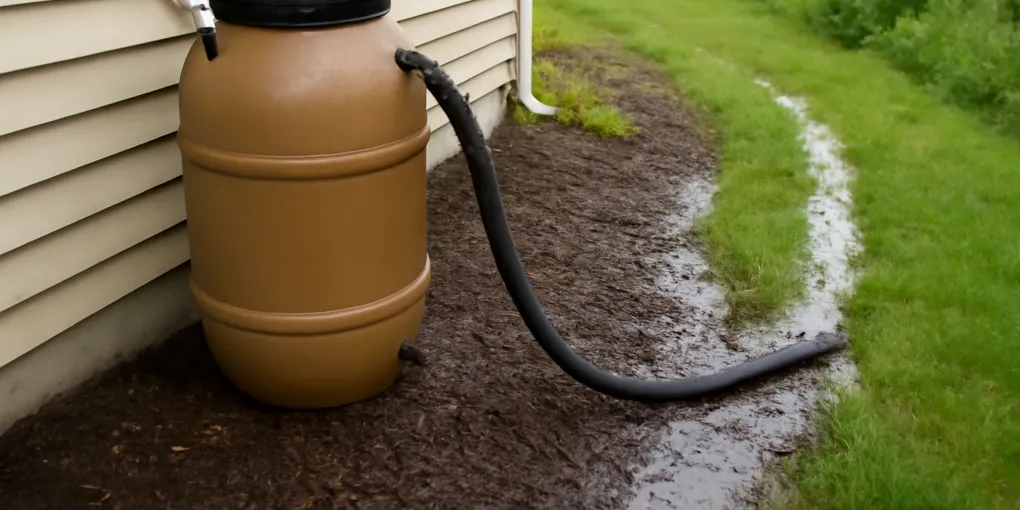
A rain barrel does not make roof runoff disappear. When the barrel is full, every new gallon entering the downspout has to leave somewhere. If the overflow outlet is short, loose, undersized, or pointed back at the house, the system can concentrate water exactly where you were trying to avoid it: against the foundation, under a deck, across a walkway, or into a basement window well.
The safe target is simple: overflow should leave the barrel through an open, unobstructed route and discharge onto a surface that slopes away from the house. The route should be easy to inspect after storms, large enough for roof runoff, and protected from kinks, mulch burial, ice, and foot traffic. This guide walks through the practical setup decisions for homeowners using one or more residential rain barrels.
If your issue is linking multiple barrels before overflow leaves the system, start with our guide to rain barrel overflow and linking kits. If your first barrel is still sending dirty water into the inlet screen, pair this overflow setup with a first-flush diverter or downspout prefilter.
Quick overflow picks
Use the structured picks above as starting points, then match the part to your actual discharge path:
- Search Amazon for rain barrel overflow hose kits if the barrel already has a dedicated overflow port and you need a flexible route away from the siding.
- Search Amazon for downspout extensions and splash blocks when the end point is nearby and the yard slopes away from the foundation.
- Search Amazon for corrugated downspout drain pipe when the outlet needs to reach a lawn edge, swale, or rain garden farther away.
Step 1: Find the overflow path before the next storm
Start with the barrel empty or partly full so you can see every fitting. Identify the highest overflow opening on the barrel or diverter. Some barrels have a threaded overflow port near the top. Others rely on the downspout diverter returning water to the downspout when the barrel is full. A few improvised systems simply spill over the rim, which is not controlled enough for a wall-adjacent installation.
Now picture a heavy storm after the barrel has already filled. The overflow should not fall directly beside the foundation, run under pavers, soak the stand base, or cross a door threshold. Mark the desired endpoint with a flag or garden stake. For many homes, that endpoint is a mulched bed that slopes away, a lawn area several feet from the wall, a shallow swale, or a rain garden that is designed to accept roof runoff.
Do not assume the ground slope is obvious. Put a hose on low flow at the planned discharge point and watch where the water travels. If it creeps back toward the house, choose a different outlet or add a properly sloped extension.
Step 2: Choose a route that stays open
A short, wide, downhill path beats a long, narrow, kinked path. Flexible overflow hose is easy to install, but it can sag behind the barrel, collapse under mulch, or pop off a smooth outlet if it is not clamped. Corrugated drain pipe can move water farther, but it needs a clean outlet and inspection access so leaves and grit do not become a hidden clog.
For a single barrel, use an overflow line at least as large as the barrel outlet allows. Avoid tiny tubing. Overflow is not the same job as slow drip irrigation; it may need to handle roof runoff during the most intense part of a storm. If the barrel has a small overflow fitting, keep the route short and make sure the downspout diverter can also bypass water safely when the barrel is full.
Slope matters. A hose that dips below the outlet and rises again can hold water, grow algae, freeze, or trap sediment. Support the line so it slopes continuously away from the barrel. Keep it visible until you have watched it work through several storms.
Step 3: Keep water away from the stand and wall
The first foot of routing is often the weak point. Water leaving the overflow port should not splash onto the barrel stand, erode soil under the blocks, or soak the siding. Use a tight fitting, a clamp where the fitting requires it, and a bend radius that does not pinch. If the hose turns sharply behind the barrel, replace that turn with a smoother elbow or move the barrel slightly.
At the discharge end, spread energy instead of cutting a trench. A splash block, flat stones, mulch over stable soil, or a small gravel pad can slow the water. The outlet still has to be far enough from the foundation and pointed with the grade. Do not end a pipe inside dense mulch against the house where you cannot see whether water is backing up.
If the overflow lands near a walkway, treat slip and ice risk as part of the design. A technically successful overflow route that sends water across a path can still be a bad setup.
Step 4: Test with real flow
A garden hose test is useful, but a storm test is better. After installation, fill the barrel until the overflow begins, then check four things: whether water leaves through the planned outlet, whether any fitting leaks at the barrel, whether water pools near the foundation, and whether the discharge end stays clear.
Repeat the check during the first heavy rain if it is safe to go outside. Roof runoff can carry more leaves, grit, and shingle granules than a hose test. If the inlet screen clogs and water spills over the barrel top, the overflow line may be fine but the inlet maintenance is not. Clean the screen and consider a better downspout prefilter.
Take a photo of the final route while it is working. That makes seasonal reassembly easier after winter storage or barrel cleaning.
When to use a return-to-downspout diverter
Some diverters are designed so a full barrel sends excess water back down the original downspout. That can be a clean solution if the original downspout already discharged safely away from the house. It is not a fix if the downspout itself ends too close to the foundation.
Before trusting a return diverter, inspect the original outlet. Add a downspout extension if the downspout still dumps water beside the wall. Make sure the diverter is installed at the manufacturer-specified height so it can stop sending water to the barrel when the barrel is full. A diverter installed too low or too high can leave the barrel overflowing from the wrong place.
How we score the overflow decision
| Criterion | Weight | How to apply it here |
|---|---|---|
| Research | 30% | Start with local stormwater guidance, manufacturer overflow instructions, and the actual grade around the foundation. |
| Evidence Quality | 25% | Trust observed storm flow, hose-fill tests, and pooling patterns more than a product claim that a hose is universal. |
| Value | 20% | Spend first on a secure fitting and a safe discharge path; upgrade to drain pipe only when distance or slope demands it. |
| User Signals | 15% | Treat wet siding, muddy stand feet, standing water, and overflow across walkways as signs the route needs revision. |
| Transparency | 10% | Make the overflow path visible and explainable so seasonal maintenance does not reconnect it toward the house. |
FAQ
How far should rain barrel overflow discharge from the foundation?
Use local drainage guidance when available. In practical residential setups, the outlet should discharge onto ground that slopes away from the house and far enough that water cannot run back to the wall, window wells, or stand base. If water returns toward the house during a hose test, the outlet is not far enough for that site.
Can I connect rain barrel overflow to a buried drain?
Sometimes, but only if the drain is legal for roof runoff, has enough capacity, daylights safely, and can be inspected. Do not connect to a sanitary sewer or unknown pipe. Check local rules before tying into any existing drainage system.
Why does my rain barrel overflow even with a hose attached?
The hose may be kinked, undersized, clogged, routed uphill, or attached below the true overflow level. The barrel may also be receiving more roof runoff than the hose can pass during intense rain. Inspect the inlet screen, fitting, hose slope, and discharge end.
Is a splash block enough for rain barrel overflow?
It can be enough when the overflow point is close to a safe downhill discharge area. It is not enough if the block sits beside the foundation, points toward a walkway, or receives more water than the soil can absorb without pooling.
Sources
- U.S. EPA, Soak Up the Rain stormwater education: https://www.epa.gov/soakuptherain
- University of Minnesota Extension, rain gardens and residential runoff guidance: https://extension.umn.edu/landscape-design/rain-gardens
- Clemson Cooperative Extension, rainwater harvesting basics: https://hgic.clemson.edu/factsheet/rainwater-harvesting/
- University of Georgia Extension, rainwater harvesting for homeowners: https://extension.uga.edu/publications/detail.html?number=B1372