Rain Barrel Water for a Lawn: Which Dry Patches Are Worth Watering First
ProtocolQuick picks
FCMP Outdoor Raincatcher 4000 Rain Barrel
★ Top pick Best for a small priority zone- Use Case: Keeping a young tree, new sod repair, or sunny strip watered from a nearby downspout
- Best For: A two-foot-square location where a screened open-top barrel fits below the downspout
- Watch For: The barrel needs a stable base, an overflow route, and an open-top intake rather than a sealed diverter
Rain barrel downspout diverter kit
Best for a covered barrel location- Use Case: Routing a downspout into a covered barrel placed beside a lawn watering zone
- Best For: Yards where the barrel cannot sit directly beneath an open downspout outlet
- Watch For: Measure downspout shape, barrel inlet height, overflow return path, and manufacturer compatibility
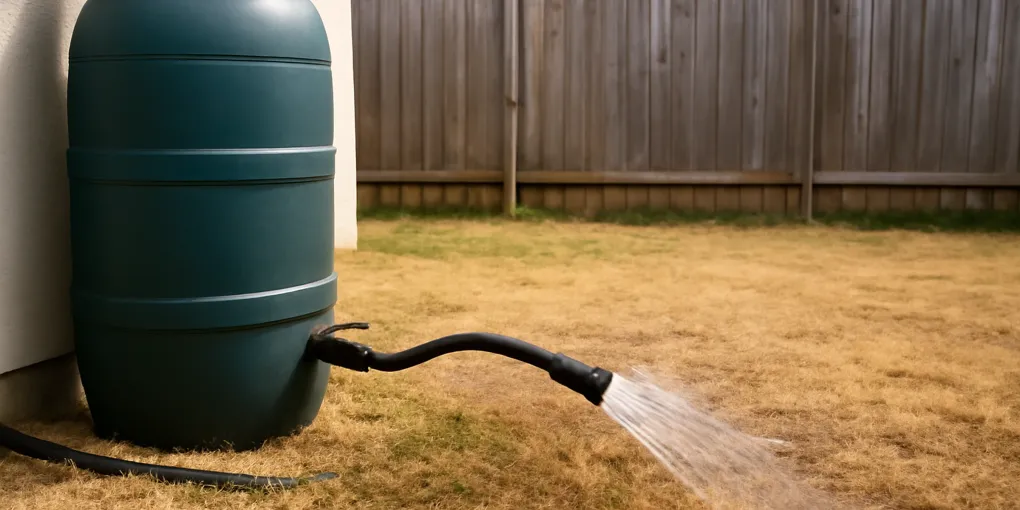
A 50-gallon rain barrel can disappear surprisingly fast on a lawn. One inch of water over 100 square feet uses about 62 gallons, so a single full barrel cannot replace a whole-yard irrigation system. It can, however, keep a few vulnerable places from becoming the first casualties of a dry spell: a newly planted tree, fresh sod repair, grass beside hot pavement, or the narrow strip that never receives much roof shade.
Treat stored rainwater as a limited reserve, not as a reason to chase every brown patch. The useful decision is which square feet will actually recover from a slow soaking and which areas can wait for rain, dormancy recovery, or a broader irrigation plan. For container beds and vegetables, use our rain barrel dry-spell watering plan instead; those plants often have a different urgency than established turf.
Quick picks for a small lawn-water reserve
- Open-top barrel beside the watering zone: See current FCMP Raincatcher 4000 options when its 24-by-24-inch footprint, screened intake, and overflow route fit the site. It is most practical for a small lawn repair or tree circle within a short hose run.
- Covered barrel placed away from the downspout: See current rain barrel diverter kit options when the barrel needs to sit to one side of the outlet. Confirm the downspout profile, the barrel inlet height, and how excess water returns to the downspout before ordering.
Neither setup supplies sprinkler pressure. A barrel is most efficient when its outlet delivers a controlled, low-flow soak close to the plant roots you selected.
Pick the patch before opening the spigot
Start with the lawn areas that have a recovery reason. New sod and recently seeded repairs have shallow roots and no established moisture reserve. A young tree set into turf competes with grass for the same surface moisture; its root zone is often a better use of limited water than the surrounding lawn. South- or west-facing strips beside a driveway or masonry wall also dry rapidly because they receive reflected heat.
Established grass that has simply gone tan across a large area is different. Many cool-season lawns slow growth or enter dormancy under heat and drought. Watering a few scattered spots may create uneven green islands without solving the whole-yard moisture deficit. EPA WaterSense recommends adjusting irrigation to weather and avoiding runoff; that supports using the barrel where a slow application can infiltrate, rather than trying to spray a wide area until the water runs down the curb.
Mark the priority zone with a hose, string, or a few small flags. Keep it small enough that water can move into the soil rather than across it. A circle around a new tree, a five-by-five-foot sod repair, or one sunny edge is a realistic barrel task. A 1,000-square-foot lawn is not.
Check the soil, not the grass color alone
Push a screwdriver or narrow trowel into the lawn at the edge of the priority zone. If it enters easily and the soil a few inches down is cool and moist, save the barrel for later. If it stops quickly in hard, dry soil, water has a clearer job to do.
Look for other causes before adding water. A dry brown strip under a mature tree may be shaded but still moisture-starved because roots take up rainfall first. A patch that stays wet while grass thins may have compaction, poor drainage, or disease rather than a shortage of water. Watering the second case more heavily will not repair it.
For new sod, lift one corner only if the installer permits it. Dry soil underneath means the sod needs a slow soak. For seed, avoid a forceful stream that cuts channels or carries seed away. A watering can or shower-style nozzle is easier to control than an unrestricted hose end.
Apply the barrel slowly enough to matter
Open the valve just enough to wet the soil without making a shiny moving sheet on the surface. Start at the outer edge of a tree’s planted root zone or at one side of a sod patch. Apply water for a short interval, close the valve, and wait several minutes. That pause shows whether the soil is taking in water or merely shedding it downhill.
Move the hose around the zone instead of holding it at the trunk, sod seam, or one bare spot. Turf and new roots benefit from an even wetting pattern. Water concentrated at a tree trunk can leave most feeder roots dry, while water pointed at one sod edge can make the other edge curl.
If water pools, stop. Check slope, soil compaction, and the volume coming out of the hose. A faster stream is not a deeper watering. A slower flow or two shorter rounds will usually use more of the barrel in the root zone.
Make the barrel last through the dry week
Do not empty the barrel because it happens to be full. A thunderstorm can refill it, but a forecast can also turn dry after the first hot day. Reserve some water when you have a new planting, freshly repaired sod, or a second priority area that dries faster than the first.
Reduce demand before increasing the flow. Mow at the recommended higher end of the grass type’s range during hot weather rather than scalping it. Keep mower clippings from smothering a new repair, and do not apply fertilizer to drought-stressed grass just because it is brown. Fertilizer can push growth when roots are short of water.
A barrel also works better when its inlet and outlet stay clean. Clear leaves from the screen, keep the lid closed, and flush grit before attaching a fine nozzle. If the barrel sits near a foundation, its overflow must still reach a stable, permitted area away from the house. The rain barrel overflow away from foundation guide covers that routing check.
When barrel water is the wrong tool
Skip lawn watering from stored roof runoff when the water has an unusual chemical or sewage-like odor, an animal has contaminated the barrel, the roof was recently treated or painted, or local rules limit roof-runoff use. Drain questionable water in a way that does not send it toward a foundation, neighbor property, or storm drain, then clean the barrel and reconnect only when the collection path is safe.
Also skip the barrel if the priority patch is already soft or waterlogged. Brown grass can coexist with poor drainage. In that case, investigate grade, downspout discharge, and soil structure rather than adding another source of water.
A small lawn plan that fits one barrel
For a dry week, list no more than two barrel priorities. Example: first, soak the root zone of a young tree; second, wet a fresh sod seam that has begun to lift. Check both areas the following day. If soil remains moist under the surface, leave the valve closed. If one needs another slow pass, use only the amount that infiltrates.
This approach gives stored water a measurable job. You are not trying to make every blade green from one barrel. You are protecting the plants and repairs most likely to lose ground before the next useful rain.
Sources
- U.S. EPA WaterSense: watering tips
- University of Minnesota Extension: rain barrels
- University of Maine Cooperative Extension: rain barrels
Rain barrel lawn FAQ
Can a rain barrel water an entire lawn?
Usually not for long. Use stored water for a small high-value area, such as new sod, a young tree root zone, or a hot edge beside hardscape. Whole-lawn watering requires far more volume than a typical barrel holds.
Should I water brown grass from a rain barrel every day?
Check moisture several inches down before watering. Newly seeded or sodded areas need closer attention than established grass that has gone dormant. Daily surface sprinkling can waste water without reaching roots.
Is rain barrel water safe for lawn grass?
Roof runoff is non-potable, but it can be used for appropriate outdoor irrigation where local guidance allows it. Keep the system covered, screen the inlet, and bypass collection after unusual contamination events.
How do I keep a rain barrel from emptying too fast on a lawn?
Use low flow, limit the zone, and pause for infiltration. If water runs across the surface or pools, close the valve and reduce the application rate rather than continuing until the barrel is empty.
Frequently Asked Questions
- Usually not for long. A barrel is best used to protect a small high-value area such as new sod, a young tree root zone, or a dry strip beside pavement instead of trying to replace lawn irrigation across a whole yard.
- Check the soil first. Established grass can go dormant in dry weather, while new seed, sod, and shallow-rooted edges need closer attention. Water slowly only when the root zone is drying rather than treating every brown blade as an emergency.
- Roof runoff is non-potable, but it is commonly used for appropriate outdoor irrigation where local rules allow it. Keep the barrel covered and maintained, and do not use stored water after an unusual roof contamination event.
- Use a low-flow nozzle or watering can, wet one small root zone at a time, and pause for infiltration. A fast open hose spreads water across the surface and spends the stored supply before roots benefit.