Best First-Flush Diverters and Downspout Pre-Filters for Cleaner Rain Barrel Water
Buyer's GuideRain Harvesting First Flush Diverter Kit
Best first-flush tubeUse Case: Diverting the dirtiest initial roof runoff before it reaches the barrel
Usually mid-range
Quick picks
| Product | Key Specs |
|---|---|
| See price on Amazon |
|
| See price on Amazon |
|
| See price on Amazon |
|
| See price on Amazon |
|
Product availability, certifications, and retailer details can change; check the current Amazon page before buying.
The best first-flush setup for a rain barrel is the one that removes the dirtiest water before it enters storage and still stays easy to clean after a storm. Roof runoff often carries pollen, leaves, bird droppings, shingle granules, dust, and organic film. A barrel screen catches some of that, but it is the last line of defense. A first-flush diverter or downspout pre-filter works earlier, where the mess is easier to bypass or dump.
For most homes, the smart purchase is not one magic filter. It is a short chain: leaf separation at the downspout, a first-flush or bypass path for the first dirty gallons, a screened barrel inlet, and an outlet filter if drip irrigation is involved. The product you buy first depends on the failure you see now. If the top screen mats over with leaves, start with a leaf separator. If the water looks tea-colored after every dry spell, a first-flush tube may help. If drip emitters clog, add a cleanable inline outlet filter after fixing the inlet.
This guide focuses on residential non-potable garden use. Stored roof runoff should not be treated as drinking water without a professionally designed system and appropriate treatment. Follow local rules for rainwater collection, keep overflow away from foundations, and use product labels and installation manuals as the final authority.
Quick picks
Use the quick picks as the product comparison: match the part to the failure you see first, then check the fit notes before buying.
- Best overall water-quality upgrade: Check Amazon results for Rain Harvesting first-flush diverter kits when you have room for a vertical tube and can empty it easily.
- Best fix for leaf-heavy roofs: Check Amazon results for downspout leaf separator pre-filters before adding a finer barrel screen.
- Best compact option: Check Amazon results for rain barrel diverters with built-in filters when wall space is tight and the barrel sits beside the downspout.
- Best drip-irrigation protection: Check Amazon results for cleanable inline hose filters when emitters clog even after inlet debris is controlled.
For related setup choices, see our guides to rain barrel filters and screens, rain barrel overflow and linking kits, and low-pressure drip kits for rain barrels. Cleaner inlet water makes every downstream part easier to maintain.
What a first flush actually does
A first-flush diverter sends the initial roof runoff away from the storage barrel. That first portion is often the most contaminated because it rinses dry roof surfaces, gutters, and downspouts. After the diverter fills, later runoff can flow toward the barrel. Many residential diverters use a vertical pipe, a floating ball, and a slow drain or cleanout cap. The first water fills the pipe; cleaner later water passes onward.
A first-flush diverter is not a purifier. It cannot remove dissolved contaminants that continue to wash from roofing materials, and it does not make roof water potable. What it can do is reduce the visible load of grit, pollen, droppings, and organic material that would otherwise settle in the bottom of the barrel. Extension rainwater-harvesting guides from programs such as Texas A&M AgriLife Extension and North Carolina State Extension commonly describe first-flush devices as part of a broader collection design, not as a stand-alone treatment system.
For garden barrels, that distinction matters. Cleaner incoming water usually means fewer clogged spigots, less sludge, fewer odors, and better performance from soaker hoses or drip filters. It also means the barrel is more pleasant to inspect and maintain.
First-flush tube vs downspout pre-filter
A first-flush tube and a downspout pre-filter solve different problems. The tube diverts the first dirty water volume. A pre-filter or leaf separator catches larger debris continuously. If your roof has overhanging trees, the leaf separator often comes first because leaves can clog a first-flush inlet, barrel screen, or overflow path. If your roof is relatively clean but water quality drops after long dry periods, the first-flush tube may be the better first upgrade.
A compact diverter with a built-in filter is a compromise. It may fit where a separate first-flush tube does not, and it can stop coarse debris before water reaches the barrel. The tradeoff is that compact filters can require frequent cleaning and may not dump a measured first-flush volume. Read the product diagram carefully. The important questions are where dirty water goes, how the filter is cleaned, and what happens when the barrel is full.
Inline hose filters belong downstream. They protect emitters and small valves after water leaves storage. They should not be asked to catch roof leaves or gutter sludge. If an outlet filter clogs every session, the inlet system is underbuilt or the barrel needs cleaning.
How much first-flush volume is enough?
There is no universal gallon number because roof area, dry weather, tree cover, roof material, gutter cleanliness, and water use all matter. A small shed roof after one dry week is different from a large house roof after a month of pollen and dust. Some rainwater design resources size first-flush devices by roof area and desired diversion depth, while many homeowners choose kits based on the pipe length that physically fits near the downspout.
A practical residential approach is to buy a kit that can be inspected, drained, and expanded. If the tube is too small but easy to modify, you can add length later. If the tube is hidden, hard to empty, or frozen in place every winter, it will become neglected no matter how good the sizing math looked.
Start with your observed problem. If the barrel bottom accumulates black sludge quickly, diverting more initial runoff may help. If the top screen is always covered with maple seeds, increase coarse debris separation first. If the outlet clogs only during drip use, add or clean the final screen. Measured maintenance outcomes are more useful than chasing a theoretical perfect first flush.
Rain Harvesting-style first-flush diverter kit
A vertical first-flush diverter kit is the most direct product for homeowners who want to keep the dirtiest initial runoff out of the barrel. Look for kits with known pipe size, a reliable sealing ball or bypass mechanism, a cleanout cap, and a drain path that does not drip against siding or the foundation. Wall brackets matter because a full vertical tube can be heavy.
Choose this when the downspout area has room for a vertical pipe and you can reach the cleanout. It is especially useful after dry spells, under dusty roofs, or where the first barrel fill tends to carry visible sediment. Avoid installing it where it blocks a walkway, freezes full of water, or sends dirty discharge toward the house.
Current options: Check Amazon results for Rain Harvesting first-flush diverter kits.
Downspout leaf separator or pre-filter
A leaf separator is the right first purchase when organic debris is the problem you can see. It intercepts leaves and larger solids before water reaches the barrel screen. Some models use angled screens; others use removable baskets or diverter bodies. The best design is the one you can clean without taking apart the whole downspout.
Choose this for roofs near trees, gutters that shed seed pods, or barrels where the inlet screen clogs during the first storm of the week. Check whether the model fits your downspout shape and whether bypassed water has a safe route. A pre-filter that dumps overflow beside the foundation can create a drainage problem while solving a barrel problem.
Current options: Check Amazon results for rain barrel downspout leaf separators.
Compact filtered rain barrel diverter
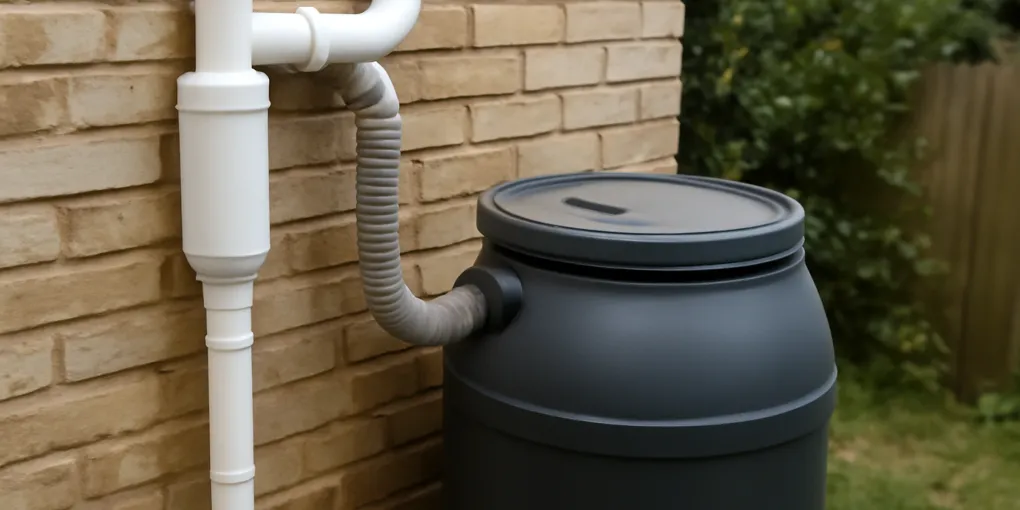
A compact filtered diverter cuts into the downspout and routes water through a hose to the barrel. Many homeowners choose this style because it is tidier than an open top and can send overflow back down the downspout when the barrel is full. Some versions include a coarse screen or sediment path.
Choose this when the barrel sits close to the downspout and you want a neater retrofit. Check hose diameter, winter removal instructions, and how the filter is accessed. A compact diverter can be a poor match if your roof drops heavy leaf litter, because the small body may need cleaning after every storm.
Current options: Check Amazon results for filtered rain barrel diverters.
Cleanable inline hose filter
An inline hose filter is the final protection for drip irrigation. It usually installs near the barrel outlet or at the start of a drip zone. For gravity systems, choose low-restriction, cleanable filters and avoid tiny passages that consume the limited pressure available from a raised barrel.
Choose this when emitters clog, the soaker hose wets unevenly, or the garden line contains small fittings. Do not choose it as the only roof-water filter. It should catch the fine material that slips past the inlet system, not the entire roof load.
Current options: Check Amazon results for inline hose filters for rain barrel drip irrigation.
Installation checks before you buy
Measure the downspout. Rectangular and round downspouts need different adapters, and some diverters assume a specific pipe diameter. Measure the wall clearance beside the downspout. A vertical first-flush tube needs brackets, room to drain, and access for cleaning. Measure the distance from the downspout to the barrel inlet. Long small-diameter fill hoses can reduce flow and collect sediment.
Plan the dirty-water discharge. The first flush, leaf bypass, and overflow should all move water away from the foundation. Do not create a new splash point beside a basement wall. If the barrel receives water from a large roof, make sure overflow capacity remains large enough for heavy rain.
Think about winter. In freezing climates, trapped water can split plastic housings and pipes. Choose parts that can drain, be removed, or be bypassed before hard freezes. Our winterizing guide covers seasonal steps that also apply to diverters and filters.
Maintenance schedule that keeps the system working
After the first storm, inspect the separator, first-flush tube, barrel screen, and outlet filter. New installations often reveal the true debris load. Clean the coarse screen before judging the barrel. Empty the first-flush chamber if the design requires manual draining. Flush the barrel spigot into a bucket and watch for grit.
During leaf drop or pollen season, inspect after every significant rain. During cleaner periods, a weekly check may be enough. If the barrel water starts to smell, the system is storing too much organic material; clean the barrel and improve upstream separation. The Centers for Disease Control and Prevention also recommends covering water containers and removing standing water where mosquitoes breed, so keep screens tight and overflow openings protected.
Keep a small brush, spare hose washers, and a bucket near the barrel. The easier cleaning is, the more likely it happens before clogs turn into a weekend project.
First-flush and pre-filter buying checks
Choose the filter by roof debris, maintenance tolerance, and whether the barrel is fed by a diverter. Check:
- Debris load: leaves and grit need different interception points.
- Cleanout access: a filter that is hard to empty will clog during the first storm.
- Water-use boundary: pre-filters reduce debris, but they do not make roof runoff drinkable.
Sources and further reading
- Texas A&M AgriLife Extension: rainwater harvesting guidance on collection, debris control, and first-flush concepts.
- North Carolina State Extension: residential rainwater harvesting and cistern design resources.
- University of Maryland Extension: rain barrels, stormwater management, and non-potable garden use guidance.
- CDC mosquito prevention guidance for covered water containers and standing-water control: https://www.cdc.gov/mosquitoes/prevention/index.html
- EPA Soak Up the Rain resources for residential stormwater practices: https://www.epa.gov/soakuptherain
FAQ
Do I need a first-flush diverter if my rain barrel already has a screen?
A screen catches larger debris at the barrel inlet, but it does not divert the dirtiest first runoff or keep fine sediment out by itself. If your barrel accumulates sludge quickly, a first-flush diverter or upstream pre-filter can reduce the load before water reaches that screen.
Is a leaf separator better than a first-flush diverter for tree debris?
Usually yes as the first purchase. Leaves and seed pods can overwhelm a barrel screen and clog a first-flush path. Catching coarse debris first often makes a later first-flush diverter work better.
Can I use first-flush water on vegetables?
Treat first-flush discharge as dirty roof runoff and route it to a safe drainage area, not directly onto edible leaves. For stored rain barrel water, follow local extension guidance, avoid potable-use claims, and consider applying water to soil rather than spraying edible plant surfaces.
Why does my inline drip filter clog even after adding a barrel screen?
The barrel may already contain settled sludge, the inlet screen may be too coarse, or organic material may be growing inside the tank. Clean the barrel, improve upstream debris separation, and use a low-restriction cleanable inline filter matched to the drip kit.