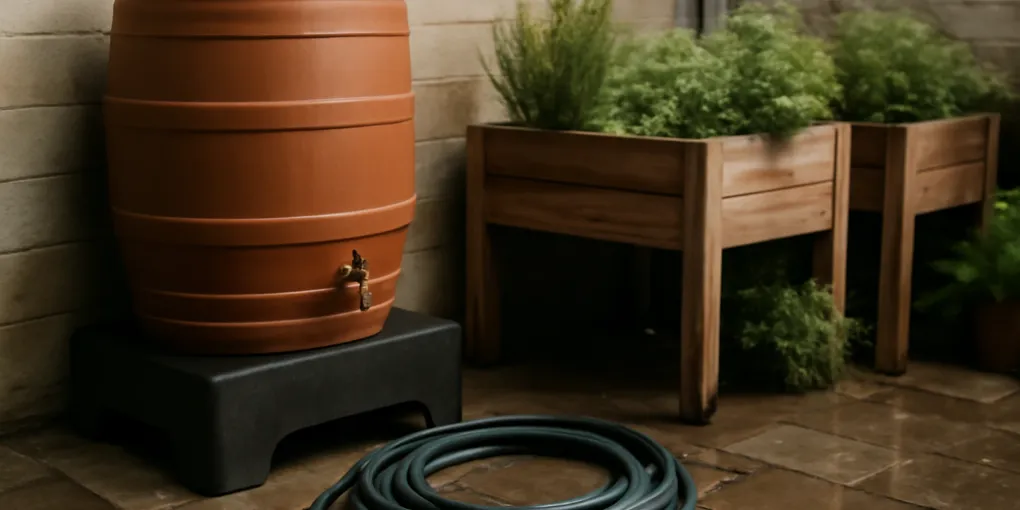
Manufacturer-matched rain barrel stand
Best fit-first choiceUse Case: Raising a common 40- to 65-gallon barrel without improvising the footprint
$45-$120 typical
Quick picks
| Product | Key Specs |
|---|---|
| See price on Amazon |
|
| See price on Amazon |
|
| See price on Amazon |
|
| See price on Amazon |
|
Product availability, certifications, and retailer details can change; check the current Amazon page before buying.
A full 55-gallon rain barrel weighs roughly 450 pounds before you count the barrel, stand, hoses, or wet debris. On a small patio, the best stand is not the tallest one you can buy. It is the lowest stable base that gives enough spigot clearance for your watering method, keeps all feet fully supported, and does not invite a heavy barrel to tip toward a walkway or foundation.
For most compact patios, start with a manufacturer-matched stand or a broad resin riser. Use pavers as the level pad underneath, not as a wobbly afterthought. If you need a DIY base, keep it low and wide with cap blocks or a continuous platform. Avoid skinny stacks of blocks, decorative plant stands, and anything that only supports the center of the barrel.
Quick picks
Use the quick picks as the product comparison: match the part to the failure you see first, then check the fit notes before buying.
- Best fit-first choice: Search Amazon for matched rain barrel stands when your barrel brand has a compatible base and you want the footprint to match the tank.
- Best small-patio riser: Search Amazon for heavy-duty resin rain barrel risers if you only need hose clearance and want to keep the water weight close to the ground.
- Best base prep: Search Amazon for interlocking patio paver base materials when the barrel will sit on soil, mulch, gravel, or a sloped slab edge.
- Best budget utility setup: Search Amazon for concrete block base materials only if you can build a short, broad, level platform with full barrel support.
If you are still deciding how high to raise the barrel, read our rain barrel stand-height guide and water-pressure explainer before buying a tall stand. For overflow safety near the house, pair the stand decision with foundation-safe overflow routing.
What matters most in a rain barrel stand
Start with loaded weight and footprint. A 50-gallon barrel can hold roughly 417 pounds of water before the tank, stand, fittings, and debris are counted, so the stand needs a broad, level contact area that matches the barrel bottom instead of only lifting the spigot. Check the listed weight rating, deck or patio surface, and whether the stand supports the whole base.
Height is useful only if the stand stays stable. Pick enough clearance for your watering can or hose shutoff, then favor weather-resistant materials, clear assembly photos, and a shape that does not wobble when the barrel is full.
How much height do you really need?
Height helps in two ways: it gives physical clearance under the spigot and it adds a little gravity pressure. The clearance benefit is usually more important. If you fill a watering can, measure the can before choosing a stand. If you attach a short hose, you may only need enough room for the hose end and shutoff valve to sit without kinking.
Extra height is not free. Every inch raises a heavy load and increases the consequence of a bad base. A small patio with foot traffic, pets, children, or a basement wall nearby should favor a modest riser plus a well-routed overflow over a tall platform built for pressure that the system will still not deliver like a household hose.
Manufacturer-matched stands: safest first look
A matched stand is usually the best starting point if you own a decorative or molded rain barrel. These stands are shaped to support the bottom profile instead of putting stress on a few ribs or feet. They also tend to preserve the spigot height the barrel maker expected.
Search Amazon for matched rain barrel stands
Best for: common 40- to 65-gallon barrels where the brand or product listing identifies a compatible base. Watch for: barrel model numbers, top diameter, loaded weight rating, and whether the stand raises the overflow port too high for the existing downspout layout.
Do not assume any round stand fits any round barrel. Decorative barrels often have molded feet, curved bottoms, or recessed centers. A stand that supports the wrong area can deform plastic over time. If the listing does not show your barrel shape or dimensions, measure before buying.
Heavy-duty resin risers: good for tight patios
A resin riser is useful when the goal is simple: lift the spigot, keep the barrel low, and avoid hauling blocks through a side yard. The best versions have a broad stance, thick ribs, and a top surface that supports the barrel evenly. They are not meant to make a rain barrel behave like a pressurized irrigation tank.
Search Amazon for heavy-duty resin rain barrel risers
Best for: narrow patios and small gardens where the barrel sits beside a wall or fence. Watch for: UV exposure, brittle plastic complaints, feet that do not sit flat on pavers, and risers that are narrower than the barrel base.
Before filling the barrel, place the empty barrel on the riser and push gently at shoulder height from several directions. If it rocks empty, it will not become safer when full. Fix the pad, stand, or barrel position before connecting the downspout.
Paver bases: the overlooked part of the stand
A stand is only as stable as the surface below it. Soil settles, mulch shifts, gravel can rut, and many patio slabs slope away from the house. A paver pad spreads the load, gives the stand feet full contact, and makes it easier to check level after storms.
Search Amazon for patio paver base materials
Best for: barrels on ground rather than a finished flat slab. Watch for: compacted base material, a pad wider than the stand, and drainage that moves spilled water away from the foundation. Do not set one stand foot half on a paver and half on soil.
Use the paver pad to solve slope, not to hide it. Dry-fit the stand, put a level across the top, and adjust the base before adding water. Recheck after the first heavy rain, because the loaded barrel may reveal settling that was invisible when empty.
Concrete block setups: keep them low and broad
Concrete blocks can work for a utility barrel, but the failure mode is obvious: a narrow stack can shift, crack, or tip. If you use blocks, build a short platform with a wide footprint and capstones that support the barrel bottom continuously. Two tall towers under a round plastic barrel are not a safe small-patio solution.
Search Amazon for concrete block base materials
Best for: inexpensive utility setups on compacted, level ground. Watch for: block orientation, freeze-thaw movement, sharp edges against plastic, and gaps that leave part of the barrel unsupported. If the setup looks narrow, improvised, or easy to kick out of line, rebuild it lower.
After filling halfway, check level again and look for stress points under the barrel. If a block edge touches one rib or foot more than the rest, drain and adjust. A rain barrel base should feel boring, not clever.
Small-patio safety checks before the first storm
Leave walking clearance. A barrel that forces people to squeeze between the stand and a railing will get bumped. Keep hose loops, watering cans, and overflow lines out of the path so the stand is not kicked every time someone waters plants.
Route overflow before judging the stand finished. A stable base still fails the setup if full-barrel overflow dumps onto the patio, under the stand, or toward the wall. Extension rain-barrel guides from Rutgers and Penn State emphasize covered storage and overflow control; the stand should support that whole system, not just the container.
Finally, test with water from a hose. Fill the barrel partway, inspect the base, then fill to the overflow level and watch where water goes. If the stand rocks, the pavers settle, or water pools under one edge, drain the barrel and fix the base before leaving it connected to a real storm.
Photograph the finished base before the barrel is hidden by plants or patio furniture. That picture makes seasonal inspection easier: you can compare whether blocks shifted, pavers sank, hose clips moved, or the overflow line started pulling the stand out of square. A small-patio barrel is easiest to maintain when the safe baseline is documented before it becomes part of the scenery.
FAQ
Can I put a rain barrel directly on a patio?
Sometimes. A flat, sound concrete or paver patio can support a barrel if it drains away from the house and the spigot is still usable. Many patios slope, settle, or leave the spigot too low, so a low stand on a level pad is usually more practical.
How tall should a rain barrel stand be for a small patio?
Use the shortest height that clears your watering can or hose connection. For many barrels, 8 to 18 inches is more useful and safer than a tall platform. If you need pressure for drip irrigation, solve that with layout and low-pressure parts, not by building an unstable tower.
Are cinder blocks safe under a rain barrel?
They can be safe only when the base is low, broad, level, and capped so the barrel is fully supported. Avoid skinny stacks, uneven blocks, and sharp edges. Recheck level after the first full storm because loaded barrels expose settling.
Should the stand sit against the house?
No. Leave space to inspect the back of the barrel, clean the inlet, and route overflow away from the foundation. A barrel pressed tight to siding or masonry makes leaks, algae, and overflow problems harder to see.
Sources
- EPA WaterSense, Outdoor Water Use in the United States
- Rutgers Cooperative Extension, Rain Barrels
- Penn State Extension, Rain Barrels