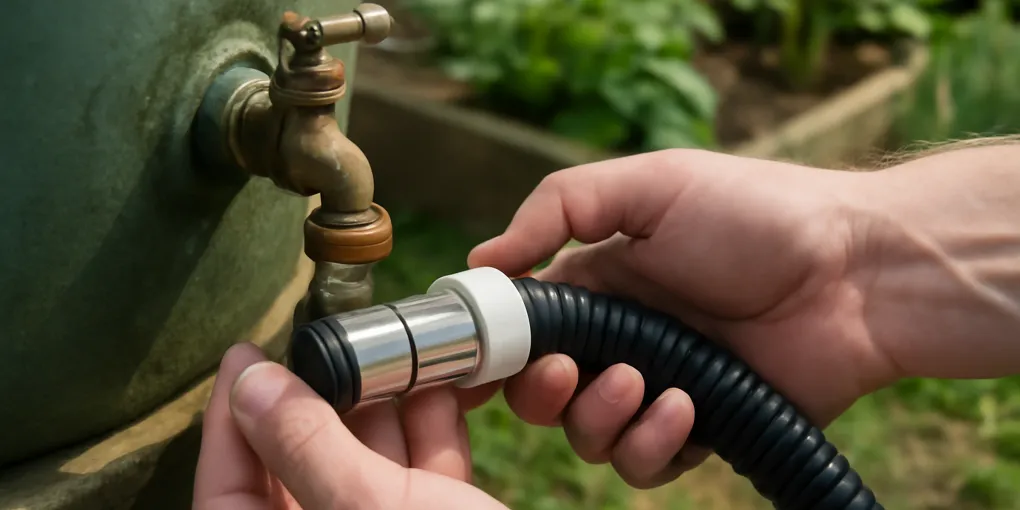
Rain barrel overflow hose kit
Simple overflowUse Case: Simple overflow route
Varies
Quick picks
| Product | Key Specs |
|---|---|
| See price on Amazon |
|
| See price on Amazon |
|
| See price on Amazon |
|
| See price on Amazon |
|
Product availability, certifications, and retailer details can change; check the current Amazon page before buying.
An overflow or linking kit is a drainage safety part first and a storage upgrade second. The best option moves excess water away from the foundation, connects barrels without leaks, and has enough diameter for real storm inflow.
What to compare before you buy
Capacity and destination matter most. A small hose may be fine for a modest roof section and frequent barrel drawdown, but it can be overwhelmed by a large roof plane in a thunderstorm. Route overflow to a splash block, drain, swale, or garden area that can accept water without sending it against siding, basement windows, walkways, or a neighbor.
Linking barrels also needs equal-height planning. Side-linked barrels fill and drain best when the ports are level, hoses do not sag, and the second barrel has its own overflow path. Top overflow from barrel one into barrel two can work, but it may not balance volume as evenly as a lower linking port.
Buying criteria
| Criterion | What to prefer | What to avoid |
|---|---|---|
| Discharge capacity | Large, smooth hose or fitting sized for roof inflow | Tiny hose used as the only storm relief |
| Seal quality | Bulkhead gaskets, washers, and flat mounting surfaces | Threaded parts forced through curved or rough plastic |
| Barrel balancing | Level ports and short hose runs between barrels | Sagging hoses that trap water and sediment |
| Safe outlet | Clear route away from foundation and foot traffic | Overflow aimed beside the house |
A strong listing gives enough detail to disqualify it before you order. That is useful. Rain barrel parts fail at the fit points: threads, hose slope, debris access, seal surfaces, and pressure assumptions. Favor products with diagrams, measurements, install photos, and replacement parts over listings that lean on garden lifestyle images.
Installation and setup checks
Test before a storm. Fill the first barrel with a garden hose until water enters the linking line, then keep filling until the final overflow runs. Watch for seepage at bulkheads, hose sags, and whether water exits where planned. Adjust supports before leaving the system unattended.
After delivery, dry-fit every washer, gasket, clamp, barb, and threaded connection before making permanent cuts. Run a controlled hose or bucket test and watch for slow weeping. Hand-tight plastic threads with the right washer usually beat wrench-tight parts that distort under load.
Sizing the overflow path
Overflow parts should be sized for the storm you do not want to troubleshoot in real time. Start by looking at the roof area feeding the barrel and where excess water would travel if the hose could not keep up. A small garden-hose overflow may be acceptable for a small shed roof, but a house downspout can deliver water faster than a narrow fitting can discharge. When in doubt, choose larger-diameter discharge parts and route them to a visible, safe outlet.
For linked barrels, make the second barrel part of the drainage plan, not just extra storage. Level the stands, keep linking hoses short, and give the final barrel its own overflow path. If the barrels sit at different heights, the lower one can fill first and spill while the higher one still has capacity. After installation, test with hose water before waiting for rain. Watch whether water balances between barrels, whether any hose sags into a trap, and whether the overflow outlet stays pointed away from the foundation when the hose becomes heavy. Recheck the outlet after mulch, leaves, or stored patio items move around it, because a clear discharge route in spring can become blocked by midsummer.
How we score this decision
| Criterion | Weight | How to apply it here |
|---|---|---|
| Research | 30% | Compare manuals, dimensions, included fittings, installation diagrams, and brand support before relying on star ratings. |
| Evidence Quality | 25% | Prefer listings with clear part photos, measured compatibility, manufacturer instructions, and owner reviews that match rain-barrel use. |
| Value | 20% | Reward serviceable fittings, standard replacement parts, and kits that reduce adapter purchases. |
| User Signals | 15% | Read recent low-star reviews for leaks, missing parts, brittle plastic, clogging, unclear instructions, and support problems. |
| Transparency | 10% | Penalize vague universal-fit claims, hidden pressure requirements, and listings that omit the one dimension your install needs. |
Common mistakes to avoid
- Treating a linking hose as a substitute for a final overflow.
- Pointing discharge at the foundation because the hose was short.
- Installing bulkheads on curved, dirty, or flexible barrel walls without support.
- Connecting barrels at different heights and expecting them to fill evenly.
Final pre-order checklist
Confirm the measured site conditions one more time before buying: downspout shape, barrel height, outlet thread, hose route, cleaning access, freeze-season plan, and where unwanted water will go during a storm or malfunction. If a part touches the house envelope or a walking surface, give safety and routing more weight than accessory count.
Check replacement-part availability too. Washers, hose clamps, screens, barbed fittings, and standard tubing are cheap when they are common sizes. Proprietary pieces can still be worth buying, but only when the kit clearly solves your specific problem and the listing explains how to maintain it.
Product notes by storage layout
A single barrel near a downspout usually needs safe overflow routing more than a linking kit. The hose should leave without kinks and discharge where water can spread safely. Two barrels side by side can be linked near the lower sidewalls to balance storage, but the ports must be level and the gaskets must seal clean drilled holes. A chain of barrels needs a final overflow sized for the whole system, not just the last barrel. Choose a basic overflow hose kit when the main goal is moving excess water away from the foundation. Choose an EarthMinded-style linking search for sealed barrel-to-barrel storage. Choose a bulkhead fitting kit for repairs or custom ports. Choose a larger discharge-hose search when roof area or intense storms make small tubing risky. After storms, check the discharge area for erosion, ponding, or water tracking back toward the house. Before freezing weather, drain exposed hoses and low pockets.
Field scenarios to think through
Single barrel beside a foundation: the safest buy is the kit that moves excess water away reliably. A short hose dumping beside the wall is not enough. Use a route that reaches a splash block, drain, swale, or planted area that can accept water without sending it back toward the house.
Two barrels on a shared platform: make the platform level before worrying about the linking kit. Equal-height ports and supported hoses let barrels balance. If one barrel sits lower, it may fill first and stress the connecting line.
Three or more barrels: think like a drainage designer. Each barrel adds storage, but once storage is full the same roof water still arrives. Use a final overflow with enough capacity, keep hoses accessible, and test the whole chain with a hose before storm season.
Narrow side yard: route overflow so it does not cross a walking path or neighbor boundary. A larger hose may be harder to hide, but a hidden undersized hose that floods a path is worse. Use supports to prevent flat spots where sediment can settle and freeze.
Troubleshooting after the first week
If the first barrel fills but the second stays low, the linking hose may be too high, kinked, airlocked, or clogged. Level the barrels, straighten the hose, and run water through the link before reinstalling. If both barrels fill but water still spills near the house, the final overflow is the weak point. Increase discharge diameter, shorten the route, or move the outlet to a safer place. If a bulkhead weeps, drain below the fitting, clean the wall, inspect the gasket, and retighten gently; overtightening can warp plastic and make the leak worse. If the overflow hose jumps or whips during heavy inflow, support it and reduce sharp bends. After a storm, inspect the soil where water exits. Erosion, mulch movement, or puddling means the route needs a diffuser or a different destination. In freezing climates, a low sag full of water can split even when barrels are drained, so remove or drain hoses before hard freezes. The system is ready only when a controlled fill test reaches the final outlet without leaks, backups, or unsafe discharge.
Buyer fit questions
- What is the final discharge point during the hardest storm you expect?
- Is the hose diameter large enough for the roof area feeding the barrel?
- Are linked barrel ports level and supported?
- Can you see and service every bulkhead after installation?
- Will the route still be safe when leaves, ice, or sediment reduce capacity? Use these questions to slow the purchase down before you compare prices. A rain-barrel product can look inexpensive until it needs extra adapters, a replacement hose, a new filter, or a second trip to the hardware store. It can also look overbuilt until it prevents one wet foundation corner or one failed irrigation week. Write the answers beside the product listing and reject any option that leaves the critical fit question unanswered. If two products both fit, choose the one with clearer instructions, easier cleaning, and more standard replacement parts. If neither product fits, change the system plan before ordering rather than trying to fix a mismatch with sealant and improvised fittings.
This step is especially useful for marketplace buying because photos, bundles, and seller descriptions can change. The product name may stay familiar while the included hose, fitting, or adapter set changes. A current listing check protects you from buying yesterday’s version of the kit.
A final sanity check is to read the lowest-rated current reviews for the exact pattern you are about to install. Repeated complaints about missing washers, confusing instructions, brittle fittings, or poor seller support matter more than a polished hero photo. Save the manual and order page until the part survives a storm and a normal watering cycle.
FAQ
Should barrels be linked at the top or bottom?
Lower side links balance storage better, but they require watertight bulkheads. Upper overflow links are simpler but may fill the second barrel later and still need a final discharge route.
How large should the overflow hose be?
Use the largest practical hose or fitting for the roof area feeding the barrel. If water can enter through a full downspout, a small garden-hose overflow may not be enough.
Can overflow water go into a garden bed?
Yes if the bed can absorb surge water without erosion or flooding nearby structures. Use a splash area or diffuser rather than one concentrated jet.
Why is the second barrel not filling?
The linking hose may be too high, kinked, airlocked, clogged, or sloped the wrong way. Level the ports and test with controlled water flow.
Bottom line
Choose overflow and linking kits by storm capacity, gasket quality, and discharge route. Extra storage is only useful when the final overflow path is safe.
Before purchasing, confirm the live listing details against your barrel size, outlet height, tubing layout, and maintenance needs.