Best Rain Barrel Hose Shutoff Valves and Splitters for Low-Pressure Watering
Buyer's GuideBrass inline garden hose shutoff valve
Best first add-onUse Case: Stopping flow at the hose end without walking back to the barrel
Varies
Quick picks
| Product | Key Specs |
|---|---|
| See price on Amazon |
|
| See price on Amazon |
|
| See price on Amazon |
|
Product availability, certifications, and retailer details can change; check the current Amazon page before buying.
A rain barrel hose shutoff valve is a small part, but it can change how usable the whole barrel feels. Without one, you may have to walk back to the barrel every time you want to pause flow, swap a watering wand, or move the hose between containers. With the wrong one, you can add so much restriction that an already-low-pressure gravity system barely runs.
The best choice is usually simple: a full-opening inline shutoff near the hose end, a sturdy Y-splitter only when you truly need two outlets, and drip valves sized for the tubing you actually use. If you are still fighting weak flow at the spigot, start with our guide to connecting a rain barrel to a garden hose and check whether the barrel height is realistic with the rain barrel pressure guide.
Mini chooser: put the shutoff where it solves the problem
| CTA | Choose this when | Compatibility check |
|---|---|---|
| Search Amazon for brass inline hose shutoff valves | You hand-water and need to pause flow at the wand or hose end. | Look for a full-port opening, replaceable washer, and a lever that opens fully with wet hands. |
| Search Amazon for brass garden hose Y-splitters | One barrel outlet must alternate between two nearby routes. | Support the splitter with a short leader hose and expect to run one branch at a time. |
| Search Amazon for low-pressure drip irrigation on-off valves | You need to isolate a short drip mainline or container line. | Match 1/2-inch or 1/4-inch tubing exactly and avoid tiny passages that clog with roof grit. |
Quick picks for low-pressure hose control
Use the comparison picks above as a shortlist, then choose based on where you need to stop water:
- Search Amazon for brass inline hose shutoff valves if you mainly hand-water and want flow control at the hose end.
- Search Amazon for brass garden hose Y-splitters if one barrel outlet needs to serve two short routes.
- Search Amazon for low-pressure drip irrigation on-off valves if the barrel feeds a short drip line and the valve must match small tubing.
What matters most with rain barrel pressure
Municipal hose bibs often have enough pressure to hide a restrictive fitting. A rain barrel does not. Gravity flow depends on water height, hose diameter, fitting openings, and how much debris is in the screen or spigot. A tiny valve opening, decorative splitter, or narrow quick-connect can make a barrel feel clogged even when the water is clean.
For barrel use, favor fittings with a straight, full-port path and a lever you can open completely. Brass is common because it handles outdoor threads and repeated twisting better than many lightweight plastic fittings, but the material does not matter if the passage is tiny. Check the washer too; a missing or crushed washer can leak at low pressure and tempt you to overtighten the fitting.
Pick 1: Brass inline hose shutoff valve
An inline shutoff valve is the most useful first add-on for hand watering. Put it at the end of the hose, just before a watering wand or nozzle, and you can pause flow while moving between beds. That saves water and keeps you from dragging a dripping hose back to the barrel.
Look for a lever handle that moves easily with wet hands and opens parallel to the flow path. Short, bulky handles can be hard to turn when the fitting is close to the ground. If you use a soft hose, support the valve so its weight does not kink the hose right before the outlet.
The caveat: many spray nozzles and watering wands are designed for pressurized taps. If flow drops too much after adding the valve, test the barrel with the valve fully open and the nozzle removed. If open-hose flow is fine, the nozzle is the restriction.
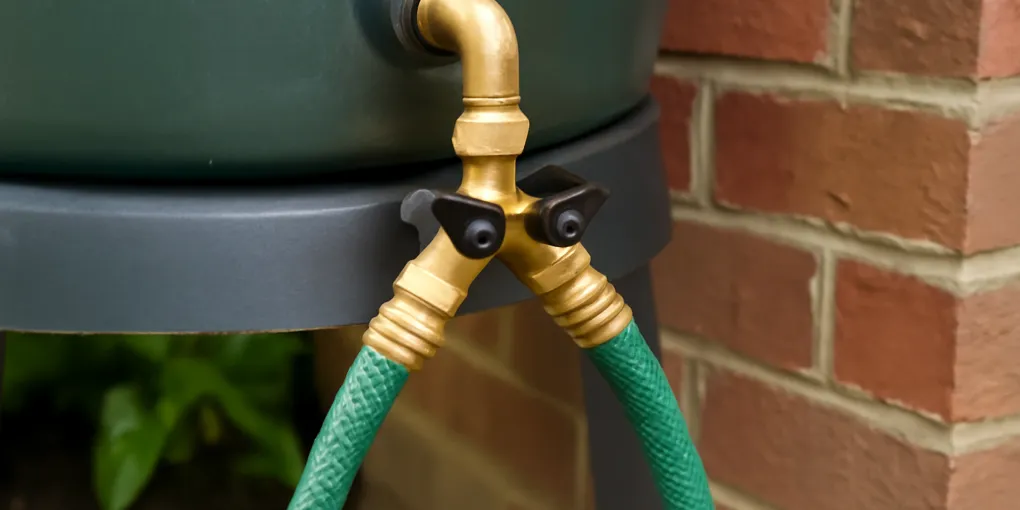
Pick 2: Brass Y-splitter with individual shutoffs
A Y-splitter is useful when one barrel alternates between two simple jobs, such as filling a watering can on one side and feeding a short hose to a raised bed on the other. Choose a splitter with a shutoff on each branch so one side can stay connected without stealing flow.
Do not add a splitter just because it looks convenient. Every split adds weight to the spigot and creates more threaded joints that can leak. If the splitter hangs directly from a plastic barrel spigot, use a short leader hose between the barrel and the splitter so the fitting weight is supported on the ground or a hook.
Open only one branch at a time unless both routes are very short. Two partly open hoses can make each line too weak to be useful.
Pick 3: Low-pressure drip on-off valve
Drip irrigation valves are the right shape for small tubing, but not every drip accessory likes gravity pressure. Choose valves and emitters advertised for low-pressure or gravity-fed use, and keep the run short. A simple on-off valve can work well for containers or one raised bed; a complicated timer, filter, pressure regulator, and long emitter network may not.
Match the valve to the tubing size, commonly 1/2-inch mainline or 1/4-inch distribution tubing. Tiny barbed valves can clog if the barrel inlet screen lets roof grit or leaf pieces through. If drip flow fades over time, clean the barrel screen, flush the line, and inspect the valve before blaming the barrel height.
For more complete kit selection, see our guide to low-pressure drip irrigation kits for rain barrels.
Where to install the valve
Place the first shutoff where it removes the most walking without adding strain. For hand watering, that usually means near the watering wand or hose end. For a short drip line, it may mean at the start of the tubing so the line can be isolated while you flush the barrel spigot. For a two-route setup, the splitter should be close enough to reach but not hanging unsupported from a plastic outlet.
A short leader hose is often the cleanest fix. Connect the leader to the barrel spigot, lay the splitter or valve where it is supported, then connect the longer hose or drip tubing after that. This protects the barrel threads and gives you room to turn the levers. It also makes winter removal easier because you can disconnect the whole control assembly without twisting the barrel spigot repeatedly.
If children, pets, or garden carts move through the area, keep valves out of the walkway. A lever that catches a foot can open the barrel accidentally or snap a fitting. Bright handle colors are useful only if they do not come with a narrow, weak internal passage.
Mistakes that make a good valve feel bad
The most common mistake is stacking too many small fittings: spigot adapter, quick-connect, splitter, timer, filter, pressure reducer, shutoff, wand. Each one may be fine on a house spigot, but together they can starve a rain barrel. Start with one valve, test flow, then add complexity only when the watering job needs it.
The second mistake is using a closed-style spray nozzle as the real shutoff and leaving the barrel spigot open under pressure. On a pressurized tap, that is normal. On a rain barrel, it can hide a slow leak at the spigot, hose washer, or splitter while the barrel sits full. Use the hose-end valve for short pauses, but close the barrel spigot when you are done watering for the day.
The third mistake is ignoring grit. Roof runoff can carry shingle granules, leaf pieces, pollen, and fine sediment. A valve with tiny passages may clog before the hose does. If the barrel has a screen or prefilter problem, fix that upstream rather than repeatedly replacing valves.
Buying checklist before you add a valve
- Confirm thread type: most hose-end valves use standard garden hose threads, while drip valves may use barbs, compression fittings, or pipe-thread adapters.
- Keep the flow path large: avoid decorative valves and narrow quick-connects when the barrel already has weak pressure.
- Support heavy fittings: splitters and brass adapters should not hang unsupported from a fragile plastic spigot.
- Plan cleaning access: a valve that traps grit should be easy to remove and flush.
- Test with the nozzle removed: open-hose flow tells you whether the restriction is the valve, nozzle, hose, or barrel outlet.
How we score hose shutoff choices
| Criterion | Weight | How to apply it here |
|---|---|---|
| Research | 30% | Match the valve to garden hose threads or drip tubing size, then account for gravity pressure rather than tap pressure. |
| Evidence Quality | 25% | Use open-hose flow tests before and after installation to identify the actual restriction. |
| Value | 20% | A single durable inline valve often helps more than a complicated splitter network on one small barrel. |
| User Signals | 15% | Watch for weak flow, lever stiffness, leaks at washers, and spigot strain from hanging fittings. |
| Transparency | 10% | Keep the setup simple enough that another person can see which valve shuts off which route. |
FAQ
Will a hose shutoff valve stop a rain barrel from dripping?
It can stop flow at the hose end, but it will not fix a leaking spigot, worn washer, cracked thread, or overfilled barrel. If water drips at the barrel outlet, inspect the spigot and bulkhead fitting first.
Is brass or plastic better for a rain barrel hose valve?
Brass usually tolerates repeated outdoor use and threaded connections better, while plastic can be lighter and less likely to stress a weak spigot. For low-pressure barrel use, the opening size, washer seal, and support matter as much as material.
Can I leave a Y-splitter on the rain barrel all season?
Yes, if it does not strain the spigot, leak, or trap water before freezing weather. Use a short leader hose or support hook if the splitter is heavy. Remove and drain it before winter storage in freezing climates.
Why did my rain barrel flow get worse after adding a valve?
The valve may have a narrow internal passage, a partly closed lever, a kink right after the fitting, or debris trapped at the washer. Remove the nozzle and valve, test open-hose flow, then add one fitting back at a time.
Sources
- U.S. EPA, WaterSense outdoor water use: https://www.epa.gov/watersense/outdoors
- University of Georgia Extension, rainwater harvesting for homeowners: https://extension.uga.edu/publications/detail.html?number=B1372
- Clemson Cooperative Extension, rainwater harvesting basics: https://hgic.clemson.edu/factsheet/rainwater-harvesting/
- Engineering Toolbox, pressure from water head: https://www.engineeringtoolbox.com/pump-head-pressure-d_663.html