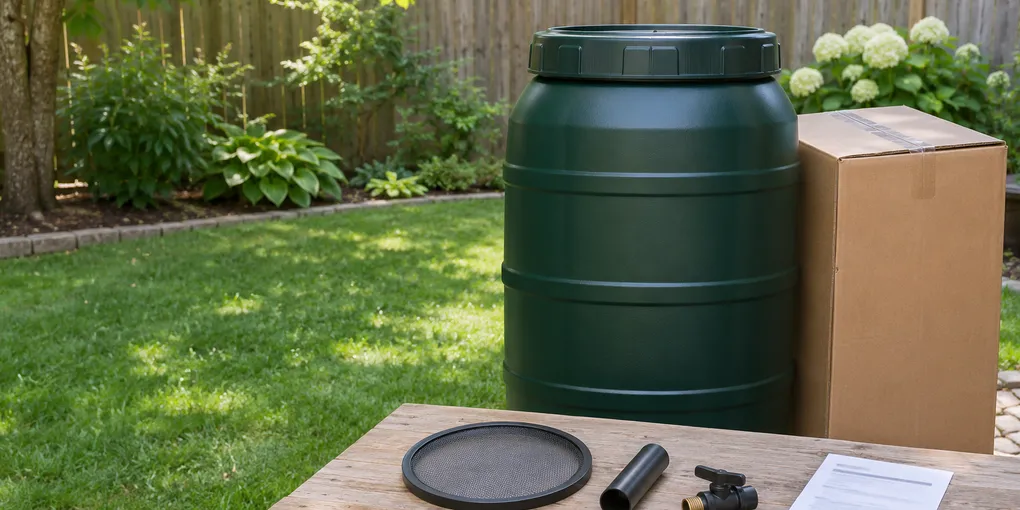
Check a New Rain Barrel Kit Against Its Packing Slip Before Installation
The best time to notice a missing rain-barrel part is before the box is recycled and before anything is put together. Spread the shipment out, put the packing slip beside it, and check the items named on that slip one by one. A screen, cover, inlet, outlet, and overflow piece do different jobs; finding that one is absent now is simpler than discovering it halfway through a project.
The goal is one clear answer: does this box contain what its own packing slip says it contains? A mismatch is the moment to save the packaging and ask the seller or manufacturer about that kit.
Start with the kit’s own list
Keep the packing slip, order confirmation, and all loose pieces together on a clean surface. Read the names on the slip first, then make one small group for each name as you identify it. A component may have a different shape or label from the one in another rain-barrel kit, so the slip is a better starting point than a general online checklist.
Mark each listed item as one of three things:
| Mark | Meaning | What to do next |
|---|---|---|
| Found | The part is present and recognizable from the kit’s own wording | Keep it with its matching group |
| Unclear | The name is on the slip, but the loose item is hard to identify | Set it aside with the packaging for the seller or manufacturer to identify |
| Missing or damaged | The named item is absent, broken, or visibly incomplete | Photograph the item area and contact the kit’s seller or manufacturer |
That short record is clearer than a vague memory that the box “looked complete.” If a customer-service conversation is needed, it gives you the order information, the slip, and the line that needs an answer.
Separate the four jobs before counting
The University of Minnesota Extension advises checking a rain barrel’s packing slip for a hose system, overflow tube, and screen. University of Nebraska–Lincoln Extension likewise identifies a cover, screen or filter, inlet, outlet, and overflow outlet as parts of a storage container. Use the wording on the slip to match those common jobs to this shipment.
Use those jobs to make sense of the packing-slip list:
- Cover or screen: the piece that closes or screens the top opening.
- Inlet: the point or part associated with water entering the container.
- Outlet: the point or part associated with taking stored water out.
- Overflow: the point or part that handles water once the container is full.
Some kits combine two jobs in one molded component; others ship separate parts. Let the slip and instructions name the item when a loose fitting does not fit one of these labels. The count on one kit is its own record.
Keep small pieces with their named part
A screen may arrive with clips, an outlet may have a washer, and an overflow piece may come with a short connector. If the packing slip treats those as one assembly, place them in one tray, bag, or section of the box until the kit instructions show how they belong together. A spare washer or fitting from another project belongs in a separate group until its compatibility is documented.
This is also a good moment to look for obvious shipping damage. A cracked fitting, torn screen, or crushed threaded end can be as important as a missing item. Photograph the item next to the relevant packing-slip line and keep the original packaging until the question is resolved.
Make a simple missing-parts note
If the shipment does not match the slip, write down only what you can support from the box:
- The kit name or order number from the packaging or order record.
- The packing-slip line for the missing, unclear, or damaged item.
- A photo of the grouped parts and, when helpful, the item’s packaging.
- The condition you can see: absent, cracked, torn, or unclear.
Record measurements, thread types, or replacement names only when they appear on the kit materials. A photo and the seller’s own part name give customer service a solid starting point.
Pause before installation when the list does not match
If a listed screen, hose, overflow piece, fitting, or hardware packet is absent, save the packing slip and ask whether the part is packaged separately, omitted in error, or described under a different name for that kit.
The same pause applies when an extra piece appears in the box. Keep it with the shipment and ask about it when the current instructions leave its role unclear. Keep a similar-looking connector separate until the kit documentation identifies it.
Evidence boundary
This check compares a shipment with its own packing slip and identifies the common roles of a cover or screen, inlet, outlet, and overflow. Kit contents vary, and installation, drainage, overflow sizing, water quality, and mosquito treatment need the current documentation for the kit and local requirements.
Sources
- University of Minnesota Extension: Rain barrels in the home landscape
- University of Nebraska–Lincoln Extension: Rainwater Harvesting
Frequently Asked Questions
- Compare the named parts in the shipment with the slip, including the cover or screen, inlet, outlet, overflow piece, and any hardware the slip lists. Keep the kit’s own terminology rather than assuming another model uses the same parts.
- Set the shipment aside, save the packing slip and order information, and contact the seller or manufacturer for that kit before substituting a similar-looking part.
- It identifies what the shipment says it contains. Use the current instructions for that kit for installation, care, and compatibility questions.