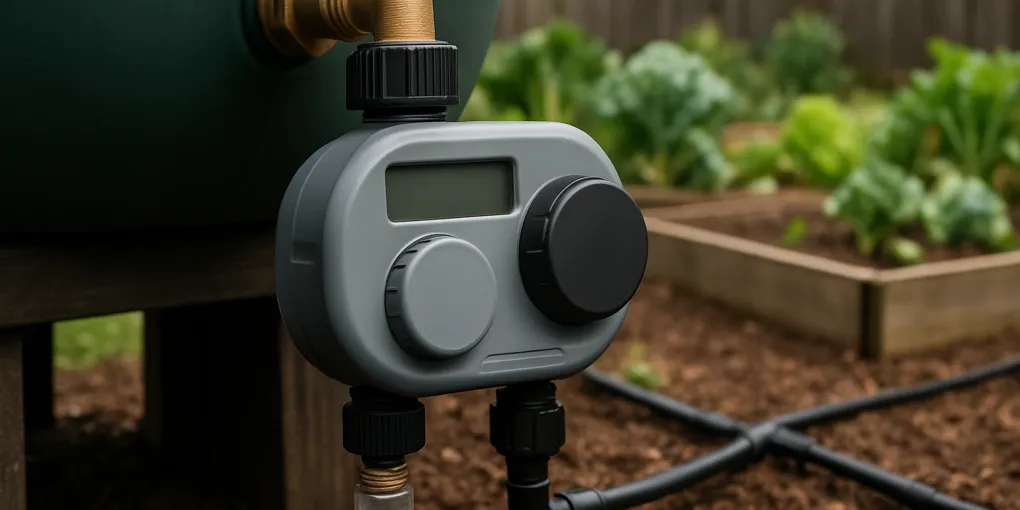
Orbit battery hose faucet timer
Best if you use a pump or raised barrelUse Case: Timed watering when the barrel has enough pressure from a stand or transfer pump
$30-$55 typical
Quick picks
| Product | Key Specs |
|---|---|
| See price on Amazon |
|
| See price on Amazon |
|
| See price on Amazon |
|
| See price on Amazon |
|
Product availability, certifications, and retailer details can change; check the current Amazon page before buying.
A rain barrel irrigation timer sounds simple: attach it to the spigot, choose twenty minutes, and let the garden water itself. The catch is pressure. A roof-fed barrel usually has far less pressure than a hose bib connected to household plumbing, so some ordinary hose timers will chatter, fail to open, close halfway, or restrict flow enough that drip emitters at the end of the bed stay dry.
The best timer depends on how the barrel supplies water. A tall stand and a short drip line may work with a low-pressure battery controller. A longer run, uphill bed, or multiple zones usually needs a small pump and a timer that controls either water flow or pump power. If you are only trying to avoid forgetting an open spigot, a mechanical shutoff timer can be more dependable than a smart valve that was designed for municipal pressure.
Use this guide after you have already confirmed that the barrel outlet, filter, and tubing can move water by gravity. If the system barely flows by hand, a timer will not fix it. Start with our guides to connecting a rain barrel to a garden hose and rain barrel height and pressure before buying a timed controller.
Quick picks
Choose the timer around the pressure source, not the app features.
- Best familiar hose-timer path: Search Amazon for Orbit battery hose timers when the barrel is raised high, the zone is short, or a pump supplies pressure.
- Best gravity-drip path: Search Amazon for DIG low-pressure battery controllers for small raised-bed zones where low operating pressure is the main constraint.
- Best longer-run path: Search Amazon for rain barrel pump timer setups when water must travel uphill, through a filter, or across several beds.
- Best forgetfulness guard: Search Amazon for mechanical hose timers if you start watering by hand but want the valve to close before the barrel empties.
For the rest of the watering hardware, compare low-pressure drip kits, rain barrel pumps, and hose shutoff valves.
What makes a timer rain-barrel friendly
A rain-barrel-friendly timer has three traits: it opens at low pressure, it does not choke a small drip zone, and it has a screen or filter you can clean. Roof runoff carries grit, pollen, roof granules, and algae flakes even when the inlet screen looks clean. A tiny valve port that works fine on municipal water can clog quickly on stored rainwater.
Check the minimum operating pressure before buying. Many faucet timers are built for household hose bibs, not a barrel sitting two feet above the garden. Some product pages list minimum PSI; others only say the timer fits a garden hose. When the minimum pressure is unclear, assume you need either a low-pressure irrigation controller or a pump-assisted layout.
Also check how the timer fails. Battery units should fail closed, not open. The battery compartment should face a place you can reach without tipping the barrel or stepping into wet soil. If freezing weather is part of your climate, the timer must be removed, drained, and stored with the rest of the barrel fittings.
Standard battery hose timer: good only with enough pressure
A common battery hose timer is convenient because it uses hose threads, familiar schedules, and replaceable batteries. It can work on a rain barrel when the barrel is high enough, the run is short, and the timer’s valve opens fully at the available pressure. It is even more reliable when a small transfer pump supplies pressure between the barrel and the timer.
Search Amazon for Orbit battery hose timers
Best for: raised barrels, short garden-hose runs, and pump-assisted systems. Watch for: minimum PSI, internal filter access, thread compatibility, and whether the timer narrows the flow path. If the timer makes a clicking sound but no water moves, the valve may not be opening under gravity pressure.
Test it with the barrel half full, not only full. A full barrel has the most head pressure. If the timer works only during the top third of storage, the garden may stop watering just when you expected the schedule to run.
Low-pressure battery controller: better for small drip zones
Low-pressure irrigation controllers are closer to what many rain barrel owners actually need. They are meant to open a valve for a low-flow zone, usually with drip tubing rather than a sprinkler. The best versions have a cleanable inlet screen, clear pressure/flow limits, and enough scheduling control to run short cycles.
Search Amazon for DIG low-pressure battery irrigation controllers
Best for: one or two raised beds, container rows, and gravity-fed drip line with low-flow emitters. Watch for: thread adapters, filter placement, battery sealing, and whether your barrel outlet is high enough above the emitters. Low pressure still means some pressure; a barrel on the ground may not feed the zone evenly.
Keep the zone modest. A low-pressure controller cannot make ten long drip lines behave like a pressurized irrigation system. Shorten tubing, reduce emitter count, keep the bed level, and use a clean filter before blaming the controller.
Pump plus timer: best for distance, slope, and multiple beds
A pump changes the timer question. Instead of asking a small valve to open under weak gravity flow, the pump gives the timer a steadier supply. This is the better path for long hose runs, uphill beds, multiple raised beds, or drip tubing that needs more uniform pressure.
Search Amazon for rain barrel pump timer outlet setups
Best for: gardens too far from the barrel for gravity to water evenly. Watch for: dry-run protection, pump priming, electrical safety, GFCI-protected outlets, and tubing pressure limits. A pump can overpressurize delicate low-pressure drip parts if you skip a pressure regulator or choose incompatible tubing.
If a timer controls pump power, make sure the pump is allowed to be cycled that way and that it will not run dry when the barrel empties. If a water timer sits after the pump, make sure the pump has a safe bypass or shutoff behavior. Follow the pump manual rather than improvising with extension cords and unprotected outdoor outlets.
Mechanical shutoff timer: useful when you stay nearby
A mechanical hose timer is not a full irrigation controller. It is a spring-style or dial-style shutoff that closes after a set amount of time. That limitation can be an advantage on a rain barrel because the valve path may be simpler, the cost is lower, and the main job is preventing a forgotten open spigot.
Search Amazon for mechanical hose timers
Best for: hand-started watering, filling a watering can station, or running a short hose while you work nearby. Watch for: whether the valve opens fully at low pressure, whether the dial is easy to read, and whether the timer restricts flow more than your spigot already does.
Use this style when failure would be annoying but not catastrophic. It is not a substitute for overflow routing, pump dry-run protection, or a real irrigation schedule.
Setup test before trusting a schedule
Run the first test with the barrel half full, the filter cleaned, and the farthest emitter visible. Start with a short five- or ten-minute cycle. Confirm that water reaches the end of the line, the timer closes completely, and the barrel level drops by an amount you can afford.
Then repeat the test after a few days of normal debris. Rain barrel systems often work perfectly on clean water and then slow down when roof grit reaches the timer screen. If the timer has a tiny inlet filter, make cleaning it part of the same routine as cleaning the barrel lid screen.
Do not schedule more water than the roof can replace. EPA WaterSense notes that outdoor water demand can be significant in warm months, and extension rain-barrel guides emphasize using stored water thoughtfully rather than treating a barrel like an unlimited hose. A timer helps you use water consistently, but it can also empty a barrel faster than you notice.
FAQ
Will a normal hose timer work on a rain barrel?
Sometimes. Many hose timers need more pressure than a barrel on a short stand can provide. They are more reliable with a pump, a taller stand, or a very short low-flow zone. Check the timer’s minimum pressure and test it with the actual barrel before leaving it unattended.
What timer style is safest for gravity-fed drip irrigation?
A low-pressure battery irrigation controller or a simple manual shutoff timer is usually safer than a standard faucet timer. The valve should open at low pressure, include an accessible screen, and fail closed when batteries die.
Can a timer drain the whole barrel?
Yes. Set the first run short, measure how much water leaves, and keep the spigot or zone small enough that the barrel retains reserve water. A timer does not know whether the next rain is coming.
Should the timer go before or after a pump?
For most small systems, the pump should supply pressure to the timer or the timer should control power to the pump. Do not force a standard timer to operate from weak gravity flow unless its specs allow that use.
Sources
- EPA WaterSense, Outdoor Water Use in the United States
- Penn State Extension, Rain Barrels
- Rutgers Cooperative Extension, Rain Barrels