Gilmour Flat Weeper Soaker Hose
Short raised-bed runsUse Case: One or two compact beds close to a raised barrel
Quick picks
| Product | Key Specs |
|---|---|
| See price on Amazon |
|
| See price on Amazon |
|
| See price on Amazon |
|
| See price on Amazon |
|
Product availability, certifications, and retailer details can change; check the current Amazon page before buying.
A rain barrel can feed a soaker hose, but only when the hose is short, clean, and matched to weak gravity flow. The best rain barrel soaker hose for raised beds is not the longest coil in the box. It is the shortest layout that wets the root zone evenly when the barrel is only half full.
This guide focuses on non-powered raised-bed watering. If your garden is uphill or far from the barrel, compare this with our rain barrel pump setup guide before buying more hose.
Quick picks
- Start with a Flexon 25-foot soaker hose search for one raised bed. Search Amazon for Flexon 25-foot soaker hose and reject listings that only describe high-pressure hose-bib use.
- Use a Gilmour-style flat hose for straight bed loops when possible. Search Amazon for Gilmour flat soaker hoses if your bed is straight and close to the barrel.
- Compare Melnor-style fitting bundles before adding length if you have multiple beds. Search Amazon for Melnor flat soaker hose so one barrel can water beds in separate passes.
What makes a soaker hose rain-barrel friendly
Gravity pressure is the hard limit. A barrel raised a few feet above a bed produces far less pressure than a household outdoor faucet, and that pressure drops as the barrel drains. Long hose runs, skinny hose, uphill beds, and clogged pores all make the far end weaker.
Prefer short hose, visible fittings, and a layout you can test with a bucket. A soaker hose that needs a minimum pressure rating near hose-bib territory is a poor fit even if it is marketed for gardens. Look for plain seepage, standard hose threads, replaceable washers, and an end that can be opened or flushed.
Filtration matters because a soaker hose has many tiny exit points. University Extension rain-barrel guidance commonly emphasizes screens and clean storage because debris and standing water create maintenance problems. Put a screen at the barrel inlet, then use a cleanable filter between the spigot and hose.
How to compare products
| Criterion | Prefer | Avoid |
|---|---|---|
| Length | 25-foot sections or shorter zones | One 50- or 100-foot coil from a single barrel |
| Diameter | 1/2-inch hose where it fits the bed | Very narrow tubing used as the full main run |
| Cleaning | Removable end cap, standard washer, separate filter | Sealed ends and no way to flush grit |
| Layout | Mostly level bed, gentle curves, mulch cover after testing | Uphill runs, tight kinks, buried hose before the first test |
| Listing detail | Clear diameter, length, fitting photos, and owner reviews about low flow | Only lifestyle photos and vague universal-fit claims |
A good listing should help you disqualify it. If the photos hide the fitting, the reviews repeatedly mention uneven wetting, or the hose smells strongly enough that gardeners avoid it around edible beds, pick a simpler option.
Product notes by raised-bed layout
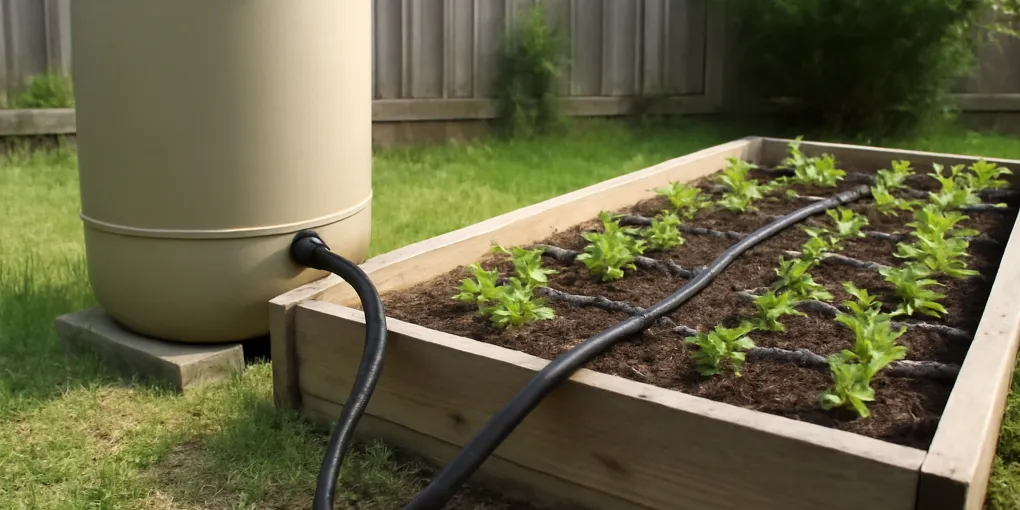
A short flat soaker hose fits one rectangular bed where the barrel sits nearby and higher than the soil. Lay it in a gentle S pattern, keep bends wide, and open the end cap after the first storm-fed run to flush grit.
A round rubber soaker hose is easier to curve around tomatoes, peppers, and trellises. It can be a better choice when you move crop spacing each season, but it still needs a short run. Read recent reviews for cracking, stiff coils, and uneven seepage.
A 25-foot hose is the safest first buy because it teaches you what the barrel can actually support. If it wets evenly at half-barrel height, you can duplicate the same zone. If it does not, a longer hose will not fix the pressure problem.
A flow-control valve kit helps when two beds have different needs. Water the tomato bed first, close that valve, then water herbs or greens separately. Do not treat valves as a way to run every hose at once from one low barrel.
Installation protocol before mulch
- Raise and level the barrel before attaching the hose. See the stand height guide if the barrel base is not settled yet.
- Install a cleanable filter after the spigot.
- Lay one soaker hose on bare soil in the real bed shape.
- Fill the barrel at least halfway and open the valve fully.
- Watch the first ten minutes. Mark dry sections with garden flags.
- Shorten the zone, reduce bends, or split the bed if the far end barely sweats.
- Cover with mulch only after the whole hose wets evenly.
Mulch is useful after testing because it slows evaporation and reduces splash. It is a mistake before testing because it hides dry sections and leaks at fittings.
Bed-by-bed buying examples
For a 4-by-4-foot salad bed, one short hose loop is usually enough. Put the barrel on the side where you can reach the valve, snake the hose between rows, and use a watering can for new seed rows until plants are established. A flat hose is easy to pin under mulch, but it can crease at tight corners. Buy the shortest length that completes the loop without doubling back.
For a 4-by-8-foot tomato bed, use one hose run for each side of the row instead of trying to soak the whole bed from one center line. Tomatoes have deeper roots than lettuce, and a weak barrel may need a longer session to wet the bed. If the far end stays dry, split the bed into two watering passes with a valve rather than adding another 25 feet to the same run.
For mixed herbs and flowers, a round hose can be easier to curve, but hand watering may still be better for the smallest pots. Do not bury the hose in decorative mulch until you know which plants actually need the barrel. Rosemary and lavender can be damaged by the same schedule that keeps basil happy.
For a new raised bed with loose soil, expect the first watering sessions to behave differently after the soil settles. Check seepage again after the first week, after adding compost, and after the first heavy storm. Loose soil can channel water away from roots, while compacted soil can shed water sideways along the hose.
Accessories worth buying with the hose
A soaker hose often needs inexpensive support parts to work from a barrel. Keep spare hose washers, a short leader hose, a cleanable Y-filter, and an end cap that can be opened without tools. If the bed is more than a few steps from the barrel, a short larger-diameter leader hose can protect flow better than running the soaker hose all the way from the spigot.
A simple shutoff valve near the bed is useful when the barrel is tucked behind a planter or fence. It lets you stop the bed without walking back to the barrel and disturbing the hose. Choose valves with obvious open/closed positions and enough grip to turn with wet hands.
Avoid buying a timer before the hose has passed a manual test. Many hose timers assume household pressure, and a timer that opens unreliably at low pressure can leave herbs dry or a bed flooded. If you eventually add a timer, test it while you are home and keep overflow routing separate from the irrigation line.
Practical score
| Criterion | Weight | How to use it for this purchase |
|---|---|---|
| Research | 30% | Compare hose length, diameter, fitting photos, filter compatibility, and owner comments about gravity or low-flow use. |
| Evidence Quality | 25% | Give more weight to manuals, dimensions, and repeatable low-pressure reviews than to broad garden claims. |
| Value | 20% | Reward short serviceable hose, standard washers, and fittings you can replace locally. |
| User Signals | 15% | Read low-star reviews for cracking, clogging, odor, weak far-end seepage, and leaking couplers. |
| Transparency | 10% | Penalize listings that omit diameter, length, fitting type, or pressure assumptions. |
Source notes
- University of Minnesota Extension: rain barrels
- EPA WaterSense: watering tips
- Utah State University Extension: soaker hoses
FAQ
What length soaker hose works best from a rain barrel?
Start with a short hose, often about 25 feet or less for one raised bed. A long soaker hose may look efficient, but a half-full barrel has little pressure and the far end can stay dry.
Does a rain barrel need a filter before a soaker hose?
Yes. Use an inlet screen plus a cleanable filter before the hose. Roof grit, pollen, algae flakes, and mulch debris can clog seep holes and make the hose wet unevenly.
Should a soaker hose go on top of soil or under mulch?
Put the hose on the soil surface and cover it with mulch after testing. That lets you confirm seepage first, then reduce evaporation and splash once the pattern is right.
Can one barrel run several soaker hoses at once?
Usually not well. Run one short zone at a time, or use valves to split beds into separate watering sessions. Opening every hose at once can starve the farthest bed.
Bottom line
Buy the shortest serviceable soaker hose that matches one real raised-bed zone. Add filtration and valves before you add length, and judge the setup at half-barrel height instead of during a full-barrel first test.