Quick picks
| Product | Key Specs |
|---|---|
| See price on Amazon |
|
| See price on Amazon |
|
| See price on Amazon |
|
Product availability, certifications, and retailer details can change; check the current Amazon page before buying.
A full rain barrel is not a light garden accessory. A 50-gallon barrel can hold more than 400 pounds of water before you count the container, fittings, stand, or wet debris on top. Raising that weight helps gravity flow, but it also magnifies every weak point in the base: soft soil, tilted blocks, narrow stand legs, cracked plastic feet, and hose pulls that tug the barrel sideways.
The safest stand is usually boring: low enough to stay stable, wide enough to support the full barrel bottom, level enough that the water load is not leaning, and strong enough that you would still trust it after the first storm has softened the soil. This guide shows how to set a raised barrel so the spigot is usable without building a wobbly tower.
If your main question is water pressure rather than stability, read the rain barrel height and pressure guide first. If your barrel is already in place but spills near the wall, pair this setup with the overflow-away-from-foundation guide.
Quick stand picks
Use the structured picks above to match the weak point in your setup:
- Search Amazon for heavy-duty rain barrel stands when you want a purpose-built platform with a footprint and rating that fit your barrel.
- Search Amazon for concrete pavers for a rain barrel base when mulch or soil is settling under the stand.
- Search Amazon for outdoor anti-tip straps when a tall barrel sits where hoses, wind, pets, or children can bump it.
Step 1: Size the weight before you size the stand
Start with the filled weight. Water weighs about 8.34 pounds per gallon, so a 40-gallon barrel holds roughly 334 pounds of water and a 55-gallon barrel holds roughly 459 pounds. Add the barrel, screen, lid, fittings, wet leaves, and any water in connected hose. A stand that sounds adequate for patio decor may not be adequate for a full rain barrel.
Look for a stand or platform that supports the full bottom area, not just a few plastic points. Many barrels are designed to sit on a flat surface. If the stand contacts only a small ring or a few ribs, check the barrel manufacturer guidance before loading it. Plastic can deform where a heavy barrel rests on narrow edges in summer heat.
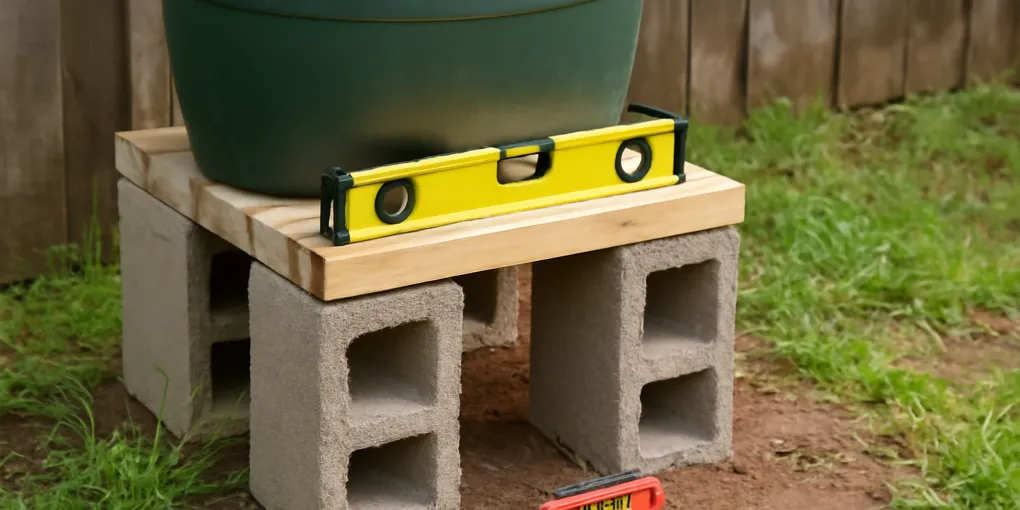
Do not use stacked loose cinder blocks as a tall tower. A single course on a prepared pad can be reasonable when the barrel bottom is fully supported, but several unbonded courses introduce tipping, rocking, and uneven bearing points. If the barrel has to be high for a specific watering job, a pump or shorter hose route is often safer than adding another block layer.
Step 2: Build the base before placing the barrel
The base has to handle both weight and water. A barrel often sits under a downspout where soil is already soft, mulch is deep, and roof runoff splashes during storms. Scrape organic mulch away from the stand footprint. Compact the soil or add a compacted gravel layer where local practice allows, then set concrete pavers or a continuous pad that is larger than the stand.
Use a level in two directions before the barrel is filled. A small lean at empty weight becomes more serious after hundreds of pounds of water are added. If the pavers rock, lift and reset them rather than shimming one stand leg with scrap wood. Wood shims rot, compress, and hide movement after rain.
Keep the base out of the overflow path. If overflow water lands on the pavers and runs under the stand, it can undermine soil at the exact place carrying the load. Route overflow to a downhill outlet and keep the first discharge point visible during storms.
Step 3: Keep the center of gravity low
The higher the barrel sits, the easier it is to tip. Raise it only enough for the real task: filling a watering can, clearing a hose fitting, or adding a short gravity-fed line. For many yards, 12 to 24 inches of lift is more useful than a tall platform because the hose, spigot, and overflow stay reachable.
A narrow barrel on a narrow stand is less forgiving than a squat barrel on a broad platform. If your barrel is tall and round, choose a stand with a wide footprint and consider an anti-tip restraint to a structural point. Do not anchor to thin siding, a loose fence board, or a downspout strap that was never intended to hold a water load.
Hose management matters too. A stiff garden hose connected to a raised spigot can act like a lever when someone trips over it or drags it around a corner. Add a short flexible leader hose, route it along the ground, and avoid pulling sideways on the spigot. The garden hose flow guide covers low-pressure hose choices after the barrel is secure.
Step 4: Fill-test in stages
Do not discover stand movement during the first thunderstorm. Fill the barrel in stages with a hose or during light rain. Check the base at one-quarter, half, and full water levels. Look for paver rocking, leg indentation, soil squeezing out, barrel lean, bulging at contact points, and fittings that begin pulling against the stand.
Mark the barrel position on the paver with a pencil or tape before the first fill. If the barrel creeps or rotates, something is moving. Drain it before fixing the base. Trying to shove a partly full barrel back into position can crack fittings or topple the stand.
After the first heavy storm, repeat the level check. The first wet cycle is when soft soil, mulch pockets, and loose gravel show themselves. If the stand settles more on one side, drain the barrel and rebuild the base rather than accepting a permanent lean.
When a low stand plus pump is safer
Some gardeners raise a barrel because they want sprinkler-like pressure or long drip runs. Stand height helps gravity, but one foot of elevation only adds about 0.43 psi. That means a dramatically taller stand still may not run a demanding irrigation setup. For long tubing, elevation changes, or emitters that need consistent pressure, a rain barrel pump may be safer and more effective than a high platform.
Choose the low, stable stand first. Then solve flow with shorter hose, larger diameter tubing, low-pressure emitters, or a pump if the watering job needs it.
How we score a stable stand setup
| Criterion | Weight | How to apply it here |
|---|---|---|
| Research | 30% | Start with filled water weight, barrel manufacturer guidance, and local freeze/soil conditions before choosing a height. |
| Evidence Quality | 25% | Trust level checks, staged fill tests, and post-storm settlement more than a product photo showing a barrel on a decorative riser. |
| Value | 20% | Spend first on a flat base and rated stand; avoid paying for height that creates a tipping problem. |
| User Signals | 15% | Treat leaning, paver rocking, hose tugging, base erosion, and spigot strain as early failure warnings. |
| Transparency | 10% | Keep the base, overflow route, and restraint visible enough that seasonal setup can be inspected quickly. |
FAQ
Can I put a rain barrel on cinder blocks?
A low, level block base can work when the barrel bottom is fully supported and the blocks sit on a prepared pad. Avoid tall loose stacks, narrow contact points, and blocks placed directly on soft mulch. Fill-test before leaving the barrel unattended.
How high should a rain barrel stand be?
Raise it only as high as the job requires. For a watering can or short hose, modest lift is usually enough. If you need pressure for a long irrigation run, a pump or low-pressure drip design is often safer than building a very tall stand.
Should a rain barrel stand be anchored?
Anchoring is worth considering for tall narrow barrels, exposed windy corners, decks, and places where kids, pets, or hoses may bump the barrel. Anchor only to a structural point that can handle the load, not to loose trim or a thin downspout strap.
Why did my stand sink after rain?
The base probably rested on soft soil, mulch, uncompacted fill, or an overflow route that wets the stand footprint. Drain the barrel, remove organic material, reset a larger compacted base, and reroute overflow away from the support area.
Sources
- Clemson Cooperative Extension, rainwater harvesting basics: https://hgic.clemson.edu/factsheet/rainwater-harvesting/
- University of Georgia Extension, rainwater harvesting for homeowners: https://extension.uga.edu/publications/detail.html?number=B1372
- U.S. EPA, Soak Up the Rain stormwater education: https://www.epa.gov/soakuptherain
- Penn State Extension, rain barrels overview: https://extension.psu.edu/rain-barrels