Rain Barrel Water Testing: What pH, Sediment, Smell, and Color Can Actually Tell You
Evidence ExplainerQuick picks
| Product | Key Specs |
|---|---|
| See price on Amazon |
|
| See price on Amazon |
|
| See price on Amazon |
|
Product availability, certifications, and retailer details can change; check the current Amazon page before buying.
Testing rain barrel water is useful when it answers a practical garden question: can this water go on ornamental beds, should I avoid edible leaves, do I need to clean the barrel, or is a filter needed before a hose attachment clogs? It is less useful when it pretends to turn roof runoff into drinking water. A few simple checks can help you manage stored rainwater, but they do not replace laboratory testing or local public-health rules.
Start with the source. Rain barrel water usually passes over roofing, gutters, screens, stored sediment, and a plastic or wooden tank before it reaches a plant. That route can add leaves, pollen, shingle granules, bird droppings, algae, mosquito debris, and metals from roof or gutter materials. For vegetable gardens, that is why many extension programs recommend using roof-collected rainwater carefully, keeping it off edible leaves when possible, and maintaining clean screens and first-flush habits.
If your question is whether rain barrel water is appropriate for edible crops, also read rain barrel vegetable garden safety. If your issue is odor after storage, this guide helps you decide whether to flush, clean, filter, or stop using the barrel until the next safe collection cycle.
Quick testing kit for gardeners
You do not need a lab kit for every routine check. Start with three low-cost tools:
- Search Amazon for garden water pH strips when plant stress or unusual water color makes you wonder whether the water is far outside the normal range.
- Search Amazon for clear sample jars, or use a clean glass jar you already own, so sediment and sheen are visible.
- Search Amazon for cleanable inline hose sediment filters only after you confirm grit is clogging wands, soaker hoses, or drip emitters.
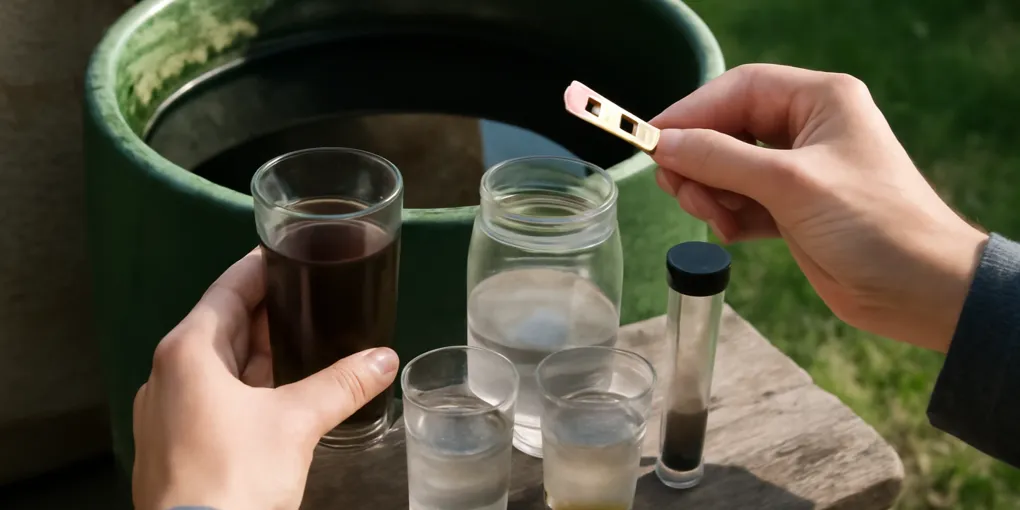
The jar is the most important tool. A clear sample gives you information that a strip cannot: whether particles settle fast, whether an oily film appears, whether larvae are moving, and whether smell changes after the water sits open for a few minutes.
Step 1: Take the sample from the water you actually use
Do not scoop only from the clean-looking top if your hose draws from the lower spigot. Run a little water from the spigot first, then fill a clean jar from that same outlet. If you normally water through a hose, sample after the hose as well. Old hose water can smell or discolor a sample, and that distinction matters.
Label the sample with the date, recent weather, and barrel condition. A barrel after the first roof-washing storm of spring is different from a barrel refilled after several clean rains. A sample from the bottom after you stirred sediment is different from a sample drawn gently from a raised outlet.
Let the jar sit in bright light for 30 minutes. Heavy grit drops quickly. Fine organic material can stay cloudy longer. A floating film, gasoline-like rainbow sheen, or chemical odor is not a normal garden-use signal; stop and investigate the roof, gutter, barrel, and nearby contamination sources before using that water.
Step 2: Read pH as a warning light, not a complete diagnosis
A pH strip can tell you whether water is unusually acidic or alkaline, but it cannot tell you whether water is safe, fertile, or balanced for every plant. Rainwater is often mildly acidic, and barrel water may shift as it contacts roofing materials, debris, and stored sediment. The useful question is not “Is this perfect?” It is “Is this surprisingly far from what my plants and soil can handle?”
Use a wide-range strip, follow the timing instructions, and compare the color immediately. Old strips and wet storage can give poor readings. If you get a surprising result, repeat with a fresh strip and a second sample. Do not add garden amendments to the barrel based on one strip. It is usually safer to improve barrel maintenance, dilute with another water source, or address soil pH separately with a proper soil test.
For acid-loving ornamentals, mildly acidic water may not be a problem. For sensitive container plants, seedlings, or hydroponic-style setups, pH swings can matter more. Rain barrel water belongs in ordinary soil-based garden use unless you have a specific testing and treatment plan.
Step 3: Use sediment to diagnose maintenance, not panic
A little sediment is expected. Roof runoff carries dust, pollen, leaf fragments, and grit. The concern is pattern and amount. If every jar sample has a thick layer after settling, the inlet screen, gutter cleaning schedule, or barrel bottom needs attention. If dark flakes appear after roof work, a new roof, wildfire smoke, or heavy tree debris, be more cautious around edible crops.
Sediment also matters mechanically. Grit clogs watering wand faces, soaker hoses, drip emitters, and small shutoff valves. If your goal is hand-watering a bed with a simple hose, a small amount of settled grit may be manageable. If your goal is drip irrigation, add a cleanable screen or sediment filter and expect to rinse it often.
Do not ignore mosquito larvae or moving organisms. Check that the inlet is screened, the overflow is protected, and the lid is tight. If larvae are present, stop using the barrel in a way that spreads them, empty and clean as local guidance allows, and fix the opening that let mosquitoes breed.
Step 4: Treat smell and color as stop-or-clean signals
Musty water usually points to organic debris: leaves, pollen, algae, or stagnant storage. That is a cleaning and circulation problem, not a reason to perfume the barrel. Drain the barrel away from foundations, rinse sediment, clean screens, and restart collection after the next roof-washing rain if conditions are otherwise safe.
Rotten-egg, sewage-like, petroleum, solvent, or sharp chemical odors deserve a harder stop. Do not use that water on food crops or tender plants. Look for gutter contamination, roof treatments, nearby spraying, dead animals in gutters, or a barrel that has been repurposed from an unknown container. When the source is uncertain, retire or thoroughly replace the suspect component rather than trying to mask the odor.
Color can come from tannins, algae, soil, roofing particles, or rust. Green water suggests algae and light exposure. Brown tea-colored water often suggests leaves or organic staining. Black grit may be shingle granules or decomposed debris. The right fix is source control: clean gutters, cover openings, shade the barrel, and flush the bottom sediment.
When to filter, dilute, flush, or stop
Filter when the water looks otherwise normal but particles are clogging tools. Use a cleanable mesh filter before a wand, soaker hose, or drip system. Put the filter where you will actually clean it; a hidden filter becomes another clog.
Dilute when pH or odor is only mildly off and you are watering established ornamental soil, not edible leaves or seedlings. Mixing with municipal or well water may reduce the practical effect, but it does not erase contamination concerns.
Flush when sediment, mustiness, algae, or mosquito signs point to poor maintenance. Drain the barrel to a safe area, clean the screen and bottom, and restart collection. Avoid sending dirty flush water toward basements, neighbor lots, or storm drains where local rules prohibit it.
Stop when you see oily sheen, chemical odor, unknown barrel history, dead-animal contamination, sewage-like smell, or runoff from treated roof materials. Home strips cannot clear those conditions. Use another water source until the collection system is corrected.
How we judged a useful test
| Criterion | Weight | What it means for rain barrel water testing |
|---|---|---|
| Research | 30% | Start with roof-runoff source risk, garden use, and maintenance history before buying tests. |
| Evidence Quality | 25% | Treat jar settling, repeated pH checks, odor source, and extension guidance as stronger signals than one strip color. |
| Value | 20% | Buy filters or strips only when they change a decision: clean, dilute, avoid edible leaves, or protect emitters. |
| User Signals | 15% | Watch for recurring sediment, clogging, mosquito larvae, oily sheen, and smells that return after cleaning. |
| Transparency | 10% | Keep the conclusion honest: garden-use screening is not a drinking-water safety certification. |
FAQ
Can I make rain barrel water safe to drink by testing it?
No. Home pH strips and visual checks are not drinking-water safety tests. Rain barrel water collected from roofs should be treated as non-potable unless a qualified local program specifies otherwise.
What pH should rain barrel water be for gardens?
Many garden plants tolerate mildly acidic to neutral irrigation water, but a single pH strip does not diagnose soil health. Use pH testing as a warning sign for unusual water, then check soil and plant needs before adjusting anything.
Is smelly rain barrel water always dangerous?
A musty smell can come from leaves or algae, but rotten, sewage-like, oily, or chemical odors are stop signs. Do not use questionable water on edible leaves, and flush or clean the barrel before collecting again.
Why is there black sediment in my rain barrel?
Dark sediment is often roof grit, organic debris, algae, or dirt washed from gutters. Let a jar sample settle, clean the inlet screen and barrel bottom, and avoid using gritty water through small emitters until it is filtered.
Sources
- Rutgers New Jersey Agricultural Experiment Station, rain barrels and water conservation: https://njaes.rutgers.edu/fs1198/
- University of Georgia Extension, rainwater harvesting for homeowners: https://extension.uga.edu/publications/detail.html?number=B1372
- CDC, drinking water safety and testing context: https://www.cdc.gov/drinking-water/about/index.html
- U.S. EPA, Soak Up the Rain stormwater education: https://www.epa.gov/soakuptherain