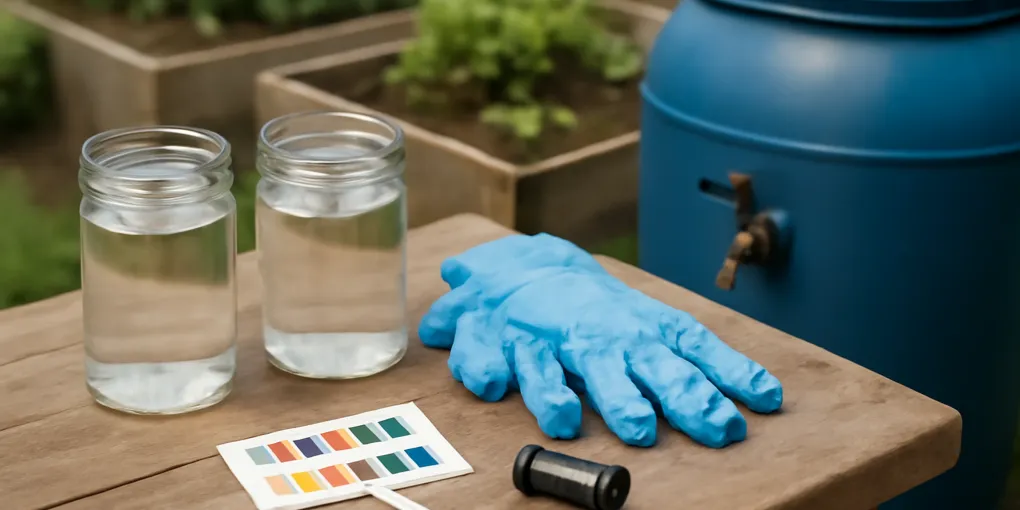
Best Rain Barrel Test Strips and Water-Quality Kits for Garden Decisions
Buyer's GuideGarden water pH test strips
Best quick pH checkUse Case: Checking whether stored runoff is unusually acidic or alkaline before watering sensitive plants
$6-$15 typical
Quick picks
| Product | Key Specs |
|---|---|
| See price on Amazon |
|
| See price on Amazon |
|
| See price on Amazon |
|
| See price on Amazon |
|
Product availability, certifications, and retailer details can change; check the current Amazon page before buying.
Rain barrel test strips can answer small, practical questions. They can show whether water is far outside a normal garden pH range, whether sanitizer remains after a barrel cleaning, or whether sediment is settling out after a dirty storm. They cannot certify roof runoff as drinking water, prove vegetables are safe, or replace local public-health guidance.
That distinction matters because many test kits are marketed for pools, aquariums, wells, or drinking water. A backyard rain barrel is different. It collects roof runoff that may include pollen, bird droppings, leaves, shingle grit, metals from flashing, and gutter sludge. The useful goal is not to create a false sense of safety. The useful goal is to decide whether the water belongs on ornamentals, soil around fruiting crops, drip irrigation, or nowhere until the barrel is cleaned.
If your question is whether barrel water can touch food crops, start with our vegetable garden safety guide. If the water already smells bad or looks slimy, use the algae and odor cleaning protocol before spending money on more tests.
Quick picks for rain barrel water checks
- For pH curiosity and plant troubleshooting: Search Amazon for garden water pH strips. Compare barrel water with tap water and fresh rain rather than treating one strip as a complete diagnosis.
- For post-cleaning rinse checks: Search Amazon for chlorine test strips. Use them only when you intentionally sanitized a barrel or fitting and need to know whether rinse water still shows chlorine.
- For sediment and algae: Search Amazon for clear water sample jars. A clean jar tells you whether grit settles, green tint remains, or floating film returns after the barrel sits.
- For bacteria screening: Search Amazon for home water bacteria test kits. Treat these as educational screens, not permission to drink or spray stored roof water onto salad greens.
What a test kit can and cannot decide
A pH strip can help explain why acid-sensitive plants look stressed, especially if your roof runoff is very different from your tap water. A chlorine strip can confirm that a cleaned barrel has been rinsed before water goes to plant roots. A clear sample jar can reveal the issue that clogs drip filters: fine sediment that does not look dramatic at the spigot but settles after an hour.
None of those tools measures the full risk profile of roof runoff. They do not identify every pathogen, metal, pesticide, asphalt residue, bird-dropping contaminant, or chemical picked up from the roof and gutter. For edible crops, the safer decision is about contact: keep stored roof water on soil, avoid splashing edible parts, and wash produce with potable water.
pH strips: useful for comparison, not safety
Rainwater is often slightly acidic, and roof surfaces or stored debris can shift pH. A garden water pH strip is useful when you want to compare three samples: tap water, fresh rain if you can collect it cleanly, and barrel water after it has sat. If the barrel sample is much different from the others, investigate the roof material, gutter sludge, algae, or cleaning residue before using that water on sensitive plants.
Search Amazon for garden water pH test strips
Choose strips with a color chart you can read in daylight and a range that covers normal garden water, not only pool chemistry. Store strips dry and sealed. Old strips can give muddy colors that are worse than no test because they tempt you to make a precise decision from a weak reading.
Chlorine strips: mainly for after cleaning
Most rain barrels do not need chlorine testing during ordinary use. Chlorine strips make sense when you used a sanitizer during seasonal cleaning and want to confirm the barrel has been rinsed before reconnecting a drip kit or watering plants. Follow the sanitizer label and local guidance first. The strip is a rinse check, not the cleaning plan.
Search Amazon for pool and spa chlorine test strips
Use a fresh sample from the spigot after the barrel has been refilled and mixed. If chlorine remains, drain to an appropriate location away from waterways and sensitive plants, rinse again, and retest. Do not use scented household products or mix cleaners in the barrel.
Clear jar or turbidity tube: the most practical sediment test
A clean, clear jar is often more useful than a strip. Fill it from the spigot after a storm, cap it, and let it sit undisturbed for one to two hours. Look for sand at the bottom, floating leaf fragments, green tint, oil-like film, or a rotten smell when opened outdoors. If a visible layer settles, the barrel and inlet path need cleaning before you blame the drip kit.
Search Amazon for clear water sample jars
This check helps with irrigation parts. Fine grit can clog filters, emitters, watering wands, and small pumps. If the jar shows sediment after every storm, improve the gutter cleaning routine, inlet screen, first-flush diverter, or barrel cleaning schedule before buying a more expensive pump.
Bacteria kits: avoid false confidence
Home bacteria kits can be interesting, but they are easy to overread. A negative result from a small home kit does not make roof runoff potable. A positive result tells you to be more conservative, but it may not identify the source or the right correction. If someone needs water-quality assurance for a health-sensitive use, use a certified laboratory and local public-health guidance.
Search Amazon for home water bacteria test kits
For most homeowners, the better rule is simpler: rain barrel water is non-potable. Use it for ornamentals, trees, shrubs, and careful soil-level irrigation. Do not use it for drinking, cooking, handwashing, pet bowls, or washing harvested produce.
When testing should trigger cleaning instead of more testing
Stop using the water and clean the system if the barrel smells rotten, shows green slime, has floating film, sends dark sediment from the spigot, or repeatedly clogs drip filters. Also pause after roof work, pesticide application near the roof, animal contamination, a dead animal in the gutter, or a long dry spell followed by dirty first runoff.
In those cases, a strip can describe one symptom, but cleaning fixes the system. Drain the barrel to a safe location, remove sludge, clean the inlet screen, check the downspout, and reset the overflow route. After cleaning, test only the thing you changed: chlorine if sanitizer was used, sediment if sludge was the problem, or pH if plant stress was the clue.
Buyer checklist before you choose a kit
| Check | Why it matters for rain barrels |
|---|---|
| Intended water type | Pool, aquarium, drinking-water, and garden kits measure different things. Buy for the question you actually have. |
| Expiration date | Old strips can produce weak colors and false confidence. |
| Sample instructions | Dipping directly into the barrel can contaminate the strip or miss sediment near the spigot. |
| Decision limit | Know what you will do with the result before testing. If every result still means “clean the barrel,” clean first. |
| Food-crop caution | No consumer strip should be treated as permission to spray non-potable runoff on edible leaves. |
How we score a rain barrel testing setup
| Criterion | Weight | What earns the score here |
|---|---|---|
| Research | 30% | The test choice follows extension and public-health advice that treats roof runoff as non-potable. |
| Evidence Quality | 25% | Results answer a narrow question, such as pH comparison, chlorine rinse status, or visible sediment. |
| Value | 20% | Low-cost strips and jars are bought only when they change a maintenance decision. |
| User Signals | 15% | Odor, slime, sediment, and repeated clogs override a reassuring strip reading. |
| Transparency | 10% | The household understands that test strips do not certify drinking water or produce-washing safety. |
FAQ
Do pH strips tell me if rain barrel water is safe for vegetables?
No. pH strips only estimate acidity or alkalinity. They do not measure bacteria, metals, pesticides, roof residue, or whether the water is safe to drink or wash produce.
What is the most useful rain barrel water test for gardeners?
A clear jar settling test and a pH comparison with tap water are often the most practical first checks. They help you spot sediment, algae, odor, and unusual acidity before you decide where to use the water.
Can a home bacteria kit prove rain barrel water is potable?
No. Treat roof runoff as non-potable unless a qualified lab and local guidance say otherwise for the exact intended use. Home kits can miss problems or be used incorrectly.
Should I test rain barrel water before every watering?
Not for normal ornamental use. Test when the water smells bad, looks cloudy, follows a long dry spell, comes from a changed roof surface, or will be used near edible crops.
Sources
- Rutgers Cooperative Extension, rainwater harvesting and rain barrel safety notes: https://njaes.rutgers.edu/fs1218/
- University of Minnesota Extension, collecting and using rainwater safely: https://extension.umn.edu/water-wisely-start-your-own-backyard/rain-barrels
- EPA, private drinking water wells and water testing context: https://www.epa.gov/privatewells
- FDA, selecting and serving produce safely, including washing with clean running water: https://www.fda.gov/food/buy-store-serve-safe-food/selecting-and-serving-produce-safely