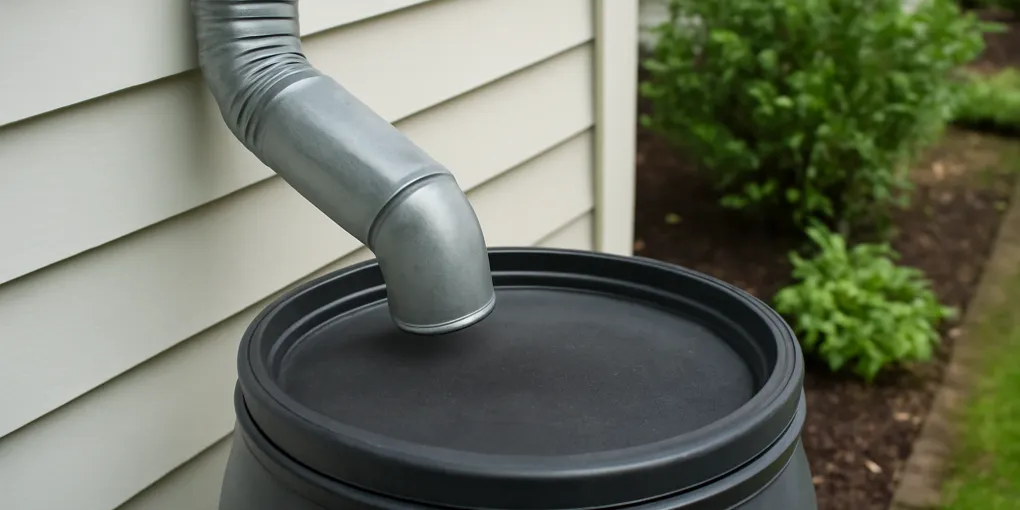
Best Rain Barrel Downspout Elbows and Offset Parts for Cleaner Inlets
Buyer's GuideAmerimax Home Products 2x3 A-style aluminum elbow
Best basic offsetUse Case: Moving a vertical downspout a few inches toward a barrel inlet
$6-$18 typical
Quick picks
| Product | Key Specs |
|---|---|
| See price on Amazon |
|
| See price on Amazon |
|
| See price on Amazon |
|
| See price on Amazon |
|
Product availability, certifications, and retailer details can change; check the current Amazon page before buying.
A rain barrel can have the right capacity, stand, and screen and still miss water because the downspout elbow is wrong. A short offset that points half an inch off the inlet can splash against the lid. A flexible extension that sags can hold leaves and freeze. A mismatched 2x3-to-3x4 connection can leak at the wall before water reaches the barrel.
This guide focuses on the small gutter parts between the cut downspout and the barrel inlet: elbows, short offsets, adapters, fastening hardware, and temporary flexible extensions. If you still need the main capture device, start with the rain barrel diverter kit guide. If your problem is a tight corner or unusual wall clearance, compare this with the downspout adapter guide for tight spaces.
Quick picks
- Search Amazon for Amerimax 2x3 A-style elbows when the barrel inlet is close to the wall and only needs a short rectangular turn. Skip if your downspout size, outlet direction, or wall clearance is uncertain.
- Search Amazon for Flex-Drain 85010 extensions when you want a reversible test before cutting metal. Skip if the extension must cross a walkway, sag unsupported, or stay full of water in freezing weather.
- Search Amazon for Amerimax rectangular adapters when two otherwise useful parts do not share the same shape or size. Skip if the reducer would choke a large roof section during heavy rain.
- Search Amazon for Malco screws and OSI gutter sealant when the offset fits but rattles, lifts, or leaks at a seam. Skip if you need joints to come apart often for leaf cleaning.
How to measure before buying
Measure the downspout size before choosing any elbow. Most residential rectangular downspouts are 2x3 inches or 3x4 inches, but older gutters, round outlets, and decorative systems can vary. Measure the outside width and depth of the downspout, then measure the horizontal distance from the wall to the center of the barrel inlet.
Next, check turn direction. An A-style elbow usually turns water forward or backward from the wall, while a B-style elbow turns it left or right along the wall. Listings and store labels are not always clear, so compare the seam position and outlet direction in the photos before ordering. If you need both directions, a two-elbow offset with a short straight section between them is often cleaner than bending one part into a strained angle.
Leave room for the inlet screen. The elbow should aim at the screened opening without pressing on the lid. A metal edge scraping a plastic lid can widen a gap for mosquitoes and leaf fragments. If the barrel has a domed or recessed top, mock up the route with cardboard or a flexible extension before cutting the downspout.
Best basic offset: matching aluminum elbows
A matching aluminum elbow is the cleanest permanent part when the barrel sits close to the downspout. It keeps the profile compact, handles normal gutter flow, and can be fastened with small sheet-metal screws. Use the same size as the downspout, and buy the direction you actually need.
Search Amazon for Amerimax Home Products 2x3 A-style elbows
The common mistake is using an elbow as a funnel rather than as a fitted gutter part. A 3x4 elbow loosely shoved over a 2x3 downspout may catch some water during light rain, then leak or twist during heavy flow. A too-short elbow can also point water against the lid rim instead of onto the screen.
For a stable offset, overlap metal joints in the direction of flow, use two corrosion-resistant screws where the joint can vibrate, and keep at least one joint removable for cleaning. Do not bury a permanent clog point behind trim or a decorative barrel screen.
Best temporary fit: flexible downspout extension
A flexible extension is useful when you are still deciding where the barrel belongs. It lets you test whether the inlet gets clean flow, whether splash leaves the lid, and whether the overflow route still clears the foundation. It is also helpful when a renter or seasonal user wants to remove the barrel before winter without rebuilding the downspout.
Search Amazon for Flex-Drain 85010 extendable downspout extensions
Use flexible parts as supported parts, not as hanging hoses. A sagging extension can trap water, grit, shingle granules, and leaves. In cold climates, that trapped water can freeze and block the next thaw. In hot sun, thin plastic can become brittle. Keep the run short, support it, and inspect it after the first hard storm.
Flexible extensions are also splashier than fitted elbows. Aim the outlet at the center of the screened inlet and keep the last few inches lower than the cut downspout. If water jumps over the screen, shorten the run or replace the final section with a rigid elbow.
Best size match: adapters and reducers
Adapters solve shape and size problems: 2x3 to 3x4, rectangular to round, or downspout to a diverter kit collar. They are most useful when the rest of the layout is good but one joint is wrong. The adapter should reduce leakage without creating a small throat that backs up water during storms.
Search Amazon for Amerimax rectangular downspout adapters
Be cautious when reducing from a larger roof-fed downspout to a smaller inlet. The rain barrel only stores part of the storm. Once the barrel fills, the system must still pass or bypass overflow safely. If an adapter slows flow enough to make water spill at the gutter or cut downspout, it is the wrong part for that roof area.
Adapters are also not a substitute for a screened inlet. If a reducer lets leaves enter an open barrel, you have traded a fitting problem for a mosquito and maintenance problem. Use an inlet basket, lid screen, or diverter design that keeps the barrel closed.
Best finishing parts: screws, straps, and sealant
Small hardware makes a big difference. Sheet-metal screws keep elbows from sliding apart when water pulses through the downspout. A short strap can keep a flexible extension from pulling down. A bead of outdoor gutter sealant can reduce seam drips where a wall stain or splash path would be a problem.
Search Amazon for Malco zip-in screws and OSI gutter sealant
Do not seal every joint permanently. Rain barrel inlet parts need cleaning. Leaves, seed pods, roof grit, and insect debris collect at direction changes. A joint you can remove with a driver is usually better than a joint you have to cut apart later.
Fit checks after the first storm
After installation, watch a real storm or run a hose into the gutter if local water restrictions allow. Look for four problems: water missing the screen, drips at the cut downspout, splash off the lid, and vibration that walks the elbow apart. Also check the overflow route. A perfect inlet still needs a safe outlet when the barrel is full.
If water sheets over the lid, lower the outlet slightly or add a short final elbow. If a seam leaks at the wall, correct the overlap or add a proper adapter. If debris piles up at the bend, shorten the offset and improve the upstream gutter screen.
What to avoid
Avoid aiming a bare downspout into an open barrel. Open tops collect leaves, invite mosquitoes, and make it harder to control overflow when the barrel fills. Also avoid placing the final elbow so low that it blocks lid removal. You need enough room to lift the screen, clean grit, and disconnect the barrel for winter.
Do not buy decorative elbows before confirming the ordinary gutter size. The prettiest offset is still a bad purchase if it cannot pass storm flow or if it forces water against siding. Start with fit, cleanability, and screened capture; appearance comes after those basics work.
Source notes
Penn State Extension rain barrel guidance emphasizes using screens, overflow, and maintenance rather than leaving barrels open: https://extension.psu.edu/rain-barrels. EPA Soak Up the Rain describes rain barrels as a stormwater capture tool that still needs correct placement and overflow planning: https://www.epa.gov/soakuptherain/soak-rain-rain-barrels. Clemson Carolina Clear’s rain barrel guide discusses downspout connection, mosquito screening, and overflow basics: https://www.clemson.edu/extension/carolinaclear/files/rain-barrel-guide.pdf.
Downspout elbow FAQ
Can I use a dryer vent elbow or HVAC duct part for a rain barrel?
Use gutter/downspout parts when possible. Thin duct parts may not match downspout sizes, may have sharp edges, and may not tolerate outdoor gutter movement as well as exterior downspout elbows.
Should I cut the downspout above or below the barrel lid?
Cut only after confirming the diverter or elbow instructions. For a direct screened inlet, the outlet should sit above the screen with enough clearance to remove the lid or clean the basket. For a diverter kit, follow the kit height because the return path depends on it.
Why does my rain barrel inlet splash even with the right elbow?
The outlet may be too high, pointed at the rim, or dumping onto a clogged screen. Lower the final turn, clean the screen, or add a short rigid section that directs flow to the center of the inlet.
Do I need sealant on every downspout joint?
No. Use sealant only where a small drip matters and the joint does not need frequent cleaning. Screws and proper overlap usually matter more than caulk for a short rain barrel offset.
Frequently Asked Questions
- Most rectangular downspouts use a matching A-style or B-style elbow in the same 2x3 or 3x4 size. The right choice depends on which direction the outlet must turn and how far the barrel inlet sits from the wall.
- It can work for testing or seasonal setups, but it needs support so it does not sag, kink, splash over the screen, or pull loose in a storm.
- It should send water onto a screened inlet or into a compatible diverter, not into an open barrel. The screen keeps leaves and mosquitoes out while letting you inspect flow.
- Only with an adapter or reducer that keeps the joint stable and does not create a major bottleneck. Loose size mismatches tend to leak and vibrate apart.