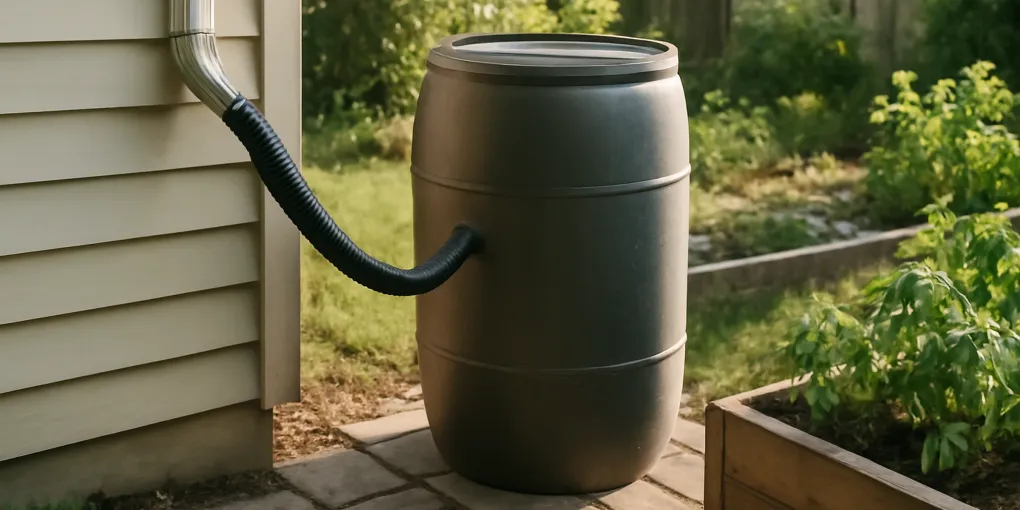
Best Rain Barrel Fill Hoses and Remote Downspout Extensions for Offset Setups
Buyer's GuideEarthMinded FlexiFit diverter-style hose kit
Best first searchUse Case: Moving water from a downspout diverter to a barrel 1 to 4 feet away
Quick picks
| Product | Key Specs |
|---|---|
| See price on Amazon |
|
| See price on Amazon |
|
| See price on Amazon |
|
Product availability, certifications, and retailer details can change; check the current Amazon page before buying.
A rain barrel does not always fit directly under the best downspout. Patio doors, narrow walkways, air-conditioning pads, garden steps, and foundation plantings can push the barrel a few feet away from the gutter. A remote fill hose solves that layout problem only if it keeps water moving downhill, keeps leaves out, and still lets you clean the inlet.
This guide focuses on short offset setups, not long buried drainage runs. The useful shopping question is simple: how will roof runoff leave the downspout, travel a short visible path, enter the barrel through a screened or sealed inlet, and still bypass safely when the barrel is full?
If your barrel can sit directly below the downspout, start with our guides to rain barrel diverter kits and downspout elbows and offset parts. Use this page when the barrel needs a side step.
Quick picks for offset barrel filling
- Use an EarthMinded FlexiFit-style diverter hose kit when the downspout has a purpose-built diverter outlet and the barrel inlet is nearby. Search Amazon for EarthMinded FlexiFit hose kits and check that the hose diameter matches the diverter, not just the barrel opening.
- Use a Flex-Drain-style corrugated extension for a simple shed or garage roof where the hose can slope into a screened top inlet. Search Amazon for Flex-Drain style extension hoses and avoid long runs that sag between supports.
- Use a Banjo-style bulkhead fitting with a hose barb when you want a cleaner side or lid connection with less splash. Search Amazon for Banjo-style bulkhead hose barbs and confirm the drill size before cutting the barrel.
Choose the shortest visible path
A fill hose should be easy to see and easy to clean. A one- to four-foot offset is usually manageable. A ten-foot run around a corner becomes a leaf trap, a tripping hazard, and a hidden overflow problem. The University of Minnesota Extension rain barrel guidance emphasizes secure covered storage, screens, and overflow planning; a remote hose does not remove those basic requirements.
Keep the hose above grade where you can inspect it. If it crosses a walkway, reconsider the barrel location instead of accepting a hose people step over. If it must pass behind shrubs, leave enough clearance to remove the hose after storms and before freezing weather.
The fill path should slope toward the barrel the whole way. Low spots hold roof grit and warm standing water. High spots can back water up in the diverter and send runoff down the original downspout instead of into the barrel.
Flexible diverter hose kits
Flexible diverter hoses are the cleanest choice when the downspout already uses a rain barrel diverter. EarthMinded FlexiFit-style kits are the common reference point for this layout: a downspout diverter, a short fill tube, and a barrel inlet positioned close enough that the hose can run without sagging. The diverter meters flow from the downspout into the hose, and many kits let excess water continue down the downspout when the barrel is full. That is a better starting point than cutting a large open trough into the downspout.
Before buying, measure the diverter outlet, the barrel inlet height, and the real offset distance. The hose should reach without stretching, but extra coils are not useful. Coiled hose collects debris and makes the fill path harder to rinse.
Look for a hose that can disconnect without destroying the seal. You will want to rinse it after heavy pollen, leaf drop, or roof work. If the kit uses proprietary fittings, check whether replacement hoses or gaskets are sold separately.
Corrugated downspout extensions
A corrugated extension can work when the barrel has a screened top opening and the roof is small, such as a shed, greenhouse, or detached garage. Flex-Drain-style extensions are useful because they compress, bend around a short offset, and fit common residential downspout elbows, but they are not precision rain barrel parts. The tradeoff is cleanliness. Corrugations catch grit, seed pods, and shingle granules, so this style needs more rinsing than a smooth hose.
Support the extension so it does not sag. A sagging middle section becomes a tiny gutter full of wet debris. Keep the outlet close to the screen, not aimed across an open lid. Splash wastes water and can push dirty runoff onto the barrel top. If the extension has a crimped end, check that the outlet cannot bounce away from the inlet screen during the first hard rain.
Do not use a corrugated extension as a sealed overflow substitute. When the barrel is full, water still needs a planned bypass or overflow route. Our overflow away from the foundation guide covers that separate decision.
Bulkhead inlet and hose-barb fittings
A Banjo-style bulkhead inlet with a hose barb gives a DIY barrel a more controlled entry point. Instead of draping a hose across the lid, you drill a fitted opening, install a gasketed connector, and push the fill hose onto the barb. This can reduce splash and keep the barrel lid easier to secure.
The fit matters. Match the barb to the hose inner diameter and the bulkhead to the barrel wall or lid thickness. A fitting that seals on a flat lid may not seal on a curved drum side. If the product listing does not show the required hole size, keep shopping.
A sealed inlet still needs screening upstream or at the inlet. EPA mosquito-control guidance starts with removing or managing standing water where mosquitoes can breed. A hose entering through a fitting should not create an unscreened gap where insects can enter the barrel.
Measure the hose run, inlet height, and fitting size before ordering
Measure from the diverter outlet to the barrel inlet with a tape measure, then add only enough slack to remove the hose for cleaning. A hose that is barely long enough pulls on fittings when the barrel shifts. A hose with several extra feet becomes a debris pocket.
Check inlet height next. Some diverter kits assume the barrel inlet sits near the same height as the diverter outlet so water can move across without backing up. If the barrel inlet is much higher than the diverter outlet, the hose may never fill well. If it is much lower, the hose may run fast but splash unless the inlet is screened and controlled.
Also inspect the downspout shape. Rectangular downspouts, round outlets, and flexible adapters do not all use the same connection. Do not buy a hose only because the listing says rain barrel. Buy the connection that matches the diverter, elbow, or bulkhead you already use.
Remote fill-hose mistakes that cause clogs, splash, or unsafe overflow
Avoid clear vinyl tubing that kinks in sun, mystery hose sizes that do not match the diverter, and hidden runs you cannot rinse. Avoid making the fill hose the only overflow path. Avoid routing roof runoff across a deck, stair, or narrow walkway where the hose becomes a trip point.
Avoid permanent glue-ups for the first season. Early storms may show that the barrel needs to move, the hose needs support, or the inlet screen clogs faster than expected. Removable clamps, threaded collars, and accessible hose clamps make adjustments easier.
Also avoid using a remote hose to excuse a poor barrel location. The barrel still needs a stable base, cleaning access, usable spigot height, and safe overflow route.
Buyer checklist by setup type
For a patio barrel beside a house wall, prioritize a purpose-built diverter hose, a sealed or screened inlet, and a hose route that does not cross the walking path. For a shed or garage roof, a simple corrugated extension may be enough if the run is short, visible, and easy to lift out for rinsing. For a reused food-grade drum, a bulkhead inlet with a hose barb is often worth the extra measuring because it keeps the lid cleaner and reduces splash.
The best product makes cleaning obvious. If you cannot tell how to remove the hose, open the filter, or check the inlet screen from the listing photos, expect maintenance to be annoying during leaf season.
Setup checklist before the first storm
- Measure the downspout outlet, diverter outlet, barrel inlet height, and offset distance.
- Dry-fit the hose with a continuous downhill slope into the barrel.
- Add or confirm an inlet screen before water enters stored volume.
- Run a hose or watering can test before relying on roof runoff.
- Watch the first real storm and check for splash, leaks, sagging, and bypass behavior.
- Remove and rinse the hose after the first debris-heavy storm.
The first storm is part of installation, not proof that the job is finished. Stand nearby if conditions are safe, and watch where water goes after the barrel starts to fill.
Source notes
- University of Minnesota Extension: rain barrels
- EPA: Soak Up the Rain, rain barrels
- EPA: mosquito control
FAQ
Can a rain barrel sit away from the downspout?
Yes, if the fill hose slopes continuously toward the barrel, stays short enough to inspect, and still leaves overflow routed safely away from the building. Long flat runs collect leaves and grit.
Is a corrugated downspout extension good enough for a rain barrel fill hose?
It can work for a simple screened top inlet, but it should not sag, hold standing water, or dump water across an open lid. A diverter hose or sealed inlet fitting is cleaner for tighter patios.
What size hose should a rain barrel fill line use?
Match the diverter outlet or inlet fitting rather than forcing a random hose size. A narrow hose can slow filling and clog faster, while an oversized loose hose can splash or disconnect.
Should the fill hose be removable?
Yes. A removable hose is easier to rinse, disconnect before freezing weather, and inspect after leaf season.