Best Rain Barrel Leaf Guards and Gutter Screens for Cleaner Inlets
Buyer's GuideStainless gutter guard mesh for rain barrels
Best first line of defenseUse Case: Keeping leaves, seed pods, and roof debris out before water reaches the downspout
$15-$45 typical
Quick picks
| Product | Key Specs |
|---|---|
| See price on Amazon |
|
| See price on Amazon |
|
| See price on Amazon |
|
| See price on Amazon |
|
Product availability, certifications, and retailer details can change; check the current Amazon page before buying.
Leaves are not just a gutter problem when the downspout feeds a rain barrel. Wet leaf mats slow the first storm, grit collects in diverter hoses, and small fragments can settle at the spigot where they clog hose washers, drip emitters, and watering wands. The best rain barrel leaf guard is a layered setup: keep large debris out of the gutter, catch smaller pieces before the diverter, and make the barrel inlet easy to inspect.
For most homes, start with the lowest-maintenance piece that solves the real problem. If a tree drops leaves directly into the gutter, a gutter guard or removable mesh strip matters more than a fancy barrel basket. If the gutter is already clean but the diverter hose clogs, add a downspout strainer with tool-free cleanout. If the barrel has an open top, use a tight inlet screen that also blocks mosquitoes.
Quick picks
Use the quick picks as the product comparison: match the part to the failure you see first, then check the fit notes before buying.
- Best before the downspout: Search Amazon for stainless gutter guard mesh when leaves sit in the gutter above the barrel connection.
- Best for diverter hoses: Search Amazon for downspout leaf strainers if small debris jams the cut-in diverter or side hose.
- Best at the barrel lid: Search Amazon for rain barrel inlet screen baskets when water drops into a lid opening or recessed basket.
- Best maintenance buy: Search Amazon for gutter cleaning scoops and hose-flush kits if the gutter run still needs seasonal hand cleaning.
For related setup details, see our guides to first-flush diverters and pre-filters, rain barrel filters for clogged emitters, and mosquito screens and dunks.
Leaf-guard buying checks
The best filter depends on where debris enters the system. Use these checks before buying:
- Tree load: heavy leaves are better intercepted at the gutter or downspout before they reach the barrel.
- Mesh size: very fine mesh can clog fast; use it as a final inlet barrier rather than the only filter in a leafy roofline.
- Material: stainless or UV-resistant plastic usually survives wet outdoor exposure better than flimsy screen scraps.
- Water use: screens reduce debris but do not make roof runoff potable or safe for edible leaves.
Choose the first filter by where debris collects
Look at the system after a rain before buying anything. If leaves sit across the gutter outlet, the first filter belongs on or inside the gutter. If the downspout flows well but the diverter hose spits brown grit, the first filter belongs at the downspout or diverter. If the barrel lid catches fragments and pollen, the final filter belongs at the inlet basket.
This order matters because every screen creates a maintenance point. A fine mesh basket on the barrel can stop mosquitoes and grit, but it cannot fix a gutter outlet packed with maple seeds. A gutter guard can reduce leaf volume, but it does not replace a removable barrel screen if the lid opening is exposed.
Gutter guard mesh: best when trees feed the problem
A short run of gutter guard mesh above the barrel downspout can reduce the biggest debris load. Stainless or coated metal mesh usually holds shape better than flimsy plastic under wet leaves. It should be easy to lift for cleaning because no guard is maintenance-free under heavy tree cover.
Search Amazon for stainless gutter guard mesh for rain barrels
Best for: gutters under maples, oaks, pines, or seed-heavy trees. Watch for: mesh that is too fine for roof grit, fasteners that trap debris, and guards that send heavy rain over the gutter lip. After installing, watch the first hard storm. Water should enter the gutter, not sheet past it and miss the barrel entirely.
Downspout strainers: best for diverter protection
A downspout strainer or leaf separator sits between the gutter outlet and the barrel connection. It is most useful when a diverter has a narrow side hose or internal gate that clogs easily. The best versions have a visible basket, screen, or cleanout door so you can remove debris without disassembling the downspout.
Search Amazon for downspout leaf strainers for rain barrel diverters
Best for: cut-in diverters, side-hose fills, and tight spaces where you cannot see the barrel inlet. Watch for: downspout size, splash at the cleanout opening, and whether the strainer can handle a heavy storm without backing water up. If the strainer is above a walkway, confirm that overflow will not create a slippery splash zone.
Inlet screen baskets: best final barrier at the barrel
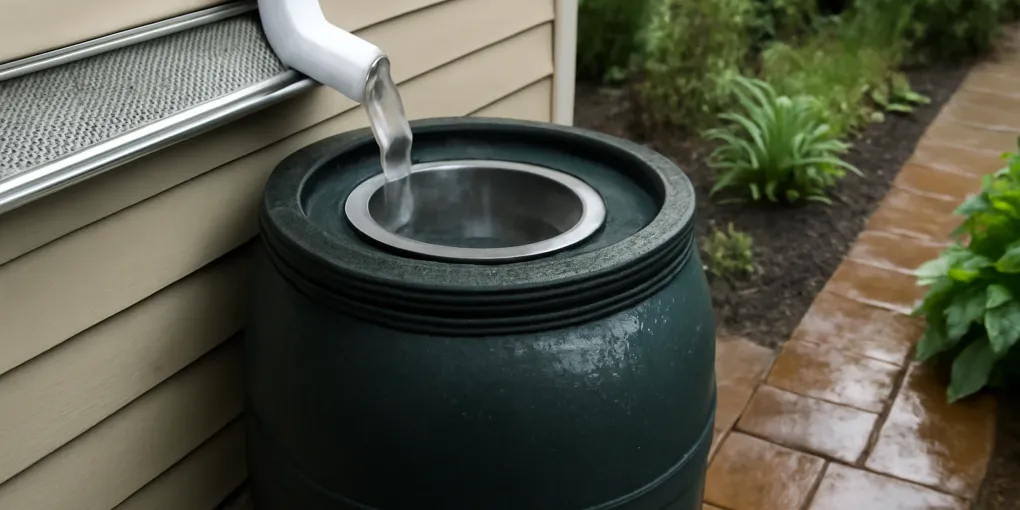
A rain barrel inlet screen basket catches the last debris before water enters storage. It should fit the lid opening snugly and lift out for rinsing. A tight screen also helps mosquito control, but only if gaps around the lid, overflow, and diverter hose are also closed.
Search Amazon for rain barrel inlet screen baskets
Best for: open-lid barrels, recessed top baskets, and DIY drums with a cut inlet. Watch for: a basket that sits so high it splashes out during storms, a screen that bows under wet leaves, or a lid opening that leaves mosquito gaps around the basket rim. Rinse the basket before it becomes a compost plug.
Do not make the mesh too fine everywhere
Fine mesh catches more debris, but it also clogs faster. A good setup often uses coarse control first and fine control last: gutter guard for leaves, downspout strainer for twigs and shingle grit, and inlet mesh for small particles and insects. If every layer is ultra-fine, the first pollen storm may send water over the gutter instead of into the barrel.
Match the mesh to the job. Pine needles need narrower openings than oak leaves. Roof grit needs a cleanable basket rather than a hidden screen. Mosquito protection needs tight, continuous coverage at the barrel, not just a coarse gutter guard upstream.
Match the screen to the water you plan to use
Leaf control is also a water-use decision. If the barrel only fills a watering can for shrubs, a cleanable inlet basket and normal gutter cleaning may be enough. If the barrel feeds a pump, soaker hose, or drip irrigation kit, small debris becomes more expensive because it can clog washers, emitters, and pump strainers. In that case, spend more attention on the downspout strainer and final inlet screen before buying irrigation add-ons.
For vegetable beds, debris control does not make roof runoff potable or food-safe by itself. Use stored rainwater at soil level, avoid spraying edible leaves, and be cautious with roofs that may shed metals, asphalt residue, or bird droppings. A screen removes leaves and insects; it does not sanitize the water. For edible-garden boundaries, read our rain barrel vegetable garden safety setup guide.
Installation mistakes that cause overflow
Do not block the original downspout path unless the barrel overflow can handle the same storm. A screen that clogs during leaf drop can back water up into the gutter, pour water beside the wall, or send water over a patio edge. Leave a visible bypass path, keep cleanouts reachable from the ground when possible, and never hide the only screen behind a fixed barrel or fence panel.
Also check slope after adding a gutter guard. Some guards lift the front edge of wet leaves and change how water enters the gutter. If runoff starts skipping over the gutter during heavy rain, remove or reposition the guard. Capturing slightly less debris is better than sending uncontrolled roof water toward siding, steps, or a foundation.
Maintenance schedule that actually works
Clean the gutter and screens before leaf drop, after the first heavy leaf storm, and before the main watering season. If the barrel feeds drip irrigation, check again whenever emitters slow down. A five-minute screen rinse is easier than flushing a plugged soaker hose later.
Use a hose test after cleaning. Water should move through the gutter, past the diverter or strainer, through the inlet screen, and into the barrel without backing up. Then fill to the overflow level and confirm that excess water leaves through the intended route. A clean inlet does not matter if the full barrel sends water toward the foundation.
FAQ
Should the leaf guard go on the gutter or on the rain barrel?
Use both if the roof has heavy debris. Put coarse protection on the gutter to stop leaf mats and a removable screen at the barrel lid to block smaller fragments and mosquitoes. If you can only add one part, fix the point where debris is visibly collecting.
Are fine mesh gutter guards better for rain barrels?
Not always. Fine mesh catches pollen and shingle grit, but it can clog and shed water over the gutter lip. Under heavy trees, a sturdier medium mesh plus a cleanable barrel inlet screen is often easier to maintain.
Will a downspout strainer reduce water flow into the barrel?
It can if it is too small or not cleaned. Choose a strainer sized for the downspout, keep the cleanout accessible, and watch the first heavy storm. Water should not back up, spill at the wall, or bypass the diverter.
Do leaf guards replace mosquito screens?
No. Leaf guards reduce debris before water reaches the barrel, but mosquitoes only need a small opening at the lid, inlet, overflow, or hose. Keep the barrel itself screened and covered.
Sources
- EPA WaterSense, Outdoor Water Use in the United States
- Rutgers Cooperative Extension, Rain Barrels
- Penn State Extension, Rain Barrels