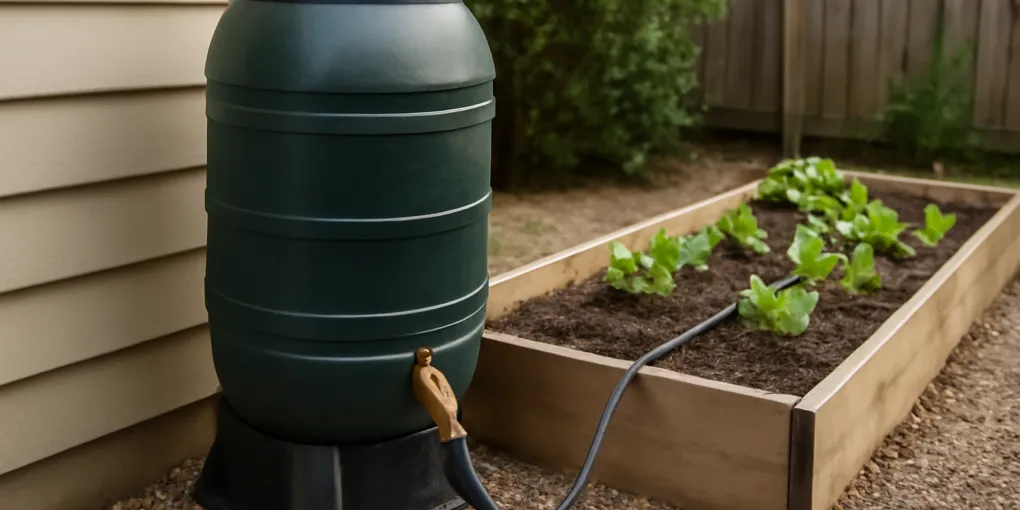
Rain Barrel Raised Bed Watering Layout: How to Split Low-Pressure Water Without Starving Beds
ProtocolQuick picks
Short low-pressure soaker hose zone
★ Top pick Best first zone- Best for: One or two nearby beds where the hose can stay short and level
- Check first: Long runs and uphill beds can leave the far end dry.
Two-way hose splitter with full-port valves
Best manual control- Best for: Watering one raised-bed zone at a time without moving the main hose
- Check first: Opening every valve at once usually drops flow too much.
Inline hose filter for barrel sediment
Best emitter protection- Best for: Keeping grit out of small hoses, drip rings, and narrow shutoff valves
- Check first: Filters need rinsing; they do not fix algae or dirty inlet screens.
A rain barrel can water raised beds, but it does not behave like a hose bib. The pressure is low, the water volume is limited, and flow changes as the barrel drains. A raised bed layout works best when the barrel sits close to the beds, the hose runs are short, and each bed or pair of beds can be watered as its own zone.
The common mistake is building a miniature sprinkler system from one 50-gallon barrel. That usually starves the farthest bed, clogs small emitters, and empties the barrel before the soil is evenly wet. Treat the barrel as a slow, stored-water source. Use it for targeted bed watering after storms, not as a full replacement for planned irrigation during a long dry spell.
Quick picks
- Best simple starting point: Search Amazon for low-pressure soaker hoses for one short raised-bed zone near the barrel.
- Best zone control: Search Amazon for full-port hose splitters when you want to switch between beds without moving the main hose.
- Best clog prevention: Search Amazon for inline hose filters before small tubing, drip rings, or narrow valves.
For related setup decisions, compare our rain barrel height and pressure guide, soaker hose setup guide, and dry-spell watering plan.
Start with the water budget
A 50-gallon barrel sounds large until you divide it across raised beds. One inch of water over a 4-by-8-foot bed is roughly 20 gallons. Two beds can use most of a standard barrel if the soil is dry. That does not mean you should pour 20 gallons at once every time; it means the barrel cannot support many beds indefinitely without new rainfall.
Use the rain barrel for the beds closest to the downspout first. If the garden has four or more beds, decide which beds get stored rainwater and which get municipal water, a pump-assisted line, or a separate barrel. EPA WaterSense guidance notes that outdoor water demand can be significant in warm months, so stored water works best when paired with mulch, soil moisture checks, and realistic expectations.
Step 1: place the barrel before choosing parts
Put the barrel where a short, direct hose can reach the first raised bed without crossing steps, doors, or mowing paths. The base should be level and compacted because a filled barrel is heavy. A taller stand can improve flow, but a wobbly stand is not an irrigation upgrade.
Keep overflow separate from the bed hose. The overflow should move full-barrel water away from the foundation even when the watering line is closed. If the barrel sits beside a house wall, solve the overflow route before adding splitters or soaker lines.
Step 2: divide beds into short manual zones
A practical low-pressure layout is one barrel, one main hose, and two or three manual zones. Each zone should be a short soaker hose or drip loop serving one bed or two adjacent beds. Open one zone, water slowly, then close it before opening the next. This keeps the available pressure focused instead of spreading weak flow across the entire garden.
Search Amazon for full-port hose splitters
Choose splitters with large passages and easy-turn handles. Tiny valves and decorative brass manifolds can become bottlenecks. Label the zones if someone else waters the garden. A simple tag that says “Bed 1 only” or “Open one side at a time” prevents the all-valves-open problem.
Step 3: keep the first zone short and level
Build the first zone as the test. Use a short low-pressure soaker hose laid on the soil surface under mulch, not buried where clogs are hard to find. Keep the run level when possible. If one end of the bed is uphill, start at the uphill end and watch whether the far end wets evenly.
Search Amazon for low-pressure soaker hoses for raised beds
Run the zone long enough to see a wet band in the soil, then dig a small check hole with a trowel. If only the first few feet are wet, shorten the run, raise the barrel safely, clean the screen, or use a watering wand instead. Do not keep adding hose length to a zone that already wets unevenly.
Step 4: filter before narrow parts
Rain barrel water carries pollen, roof grit, leaf fragments, and algae film. Rutgers and Penn State rain barrel guidance both emphasize covered barrels and screened inlets, but small irrigation parts still need protection. Put a rinseable screen filter before drip tubing, small valves, or emitters.
Search Amazon for inline hose filters for rain barrel irrigation
A filter is not a substitute for cleaning the barrel. If the filter clogs every watering session, inspect the inlet screen, bottom sediment, and algae growth. Our cleaning tools guide covers brushes, wet-dry vacs, and replacement screens for that problem.
Step 5: water by soil response, not by timer promises
Many battery timers and drip kits expect household pressure. Some low-pressure timers work, but even then, the barrel’s flow changes as the water level drops. For raised beds, a manual routine is usually more reliable: open one zone, check the soil, close the zone, then move to the next bed.
If you want automation, read the timer’s minimum pressure and flow requirements before buying. A timer that works from a hose bib may not open or close reliably from a half-empty barrel. Use our low-pressure timer guide if automation is part of the plan.
When a pump makes sense
A pump can help when raised beds are far away, uphill, or connected to parts that need more pressure. It also adds failure points: power, priming, filters, pressure limits, and the risk of overpressuring fittings. If you add a pump, keep the barrel screened, put a filter before the pump or as the pump manual recommends, and verify that the discharge pressure is safe for the tubing.
For a small garden beside the barrel, a pump is often unnecessary. Spend first on stable barrel placement, clean screens, short hose runs, and mulch. Those changes improve the system even if you later add a pump.
First-week test plan
Test the layout after a real fill, not only with a hose. Water the first zone for 10 minutes and check the soil depth. Repeat with the second zone. Note how much the barrel level drops. If one bed stays dry, reduce that zone’s length or move it closer to the barrel before adding more parts.
After the first week, rinse the filter, lift the soaker hose to check for clogged sections, and look around the barrel base for leaks or overflow scars. A good raised-bed layout should be boring: short hoses, visible valves, clean screens, and no mystery puddles.
FAQ
Can one rain barrel water several raised beds at the same time?
Sometimes, but the layout has to be short, level, and low demand. Most 50-gallon barrels work better when you water one raised-bed zone at a time through a short hose or soaker line.
How high should a rain barrel be for raised bed watering?
Higher gives more head pressure, but stability matters more than chasing pressure. Use a level, compacted base and a stand rated for the filled barrel weight before adding height.
Should I use drip emitters or a soaker hose from a rain barrel?
A short low-pressure soaker hose is usually more forgiving. Small drip emitters can clog or underperform unless the barrel is clean, filtered, elevated, and split into short zones.
Do raised beds need a pump with a rain barrel?
Not for nearby manual watering, but a pump may help if the beds are uphill, far from the barrel, or connected to pressure-sensitive drip parts. Use a pump only with overflow and backflow precautions.
Sources
- EPA WaterSense, Outdoor Water Use in the United States
- Rutgers Cooperative Extension, Rain Barrels
- Penn State Extension, Rain Barrels