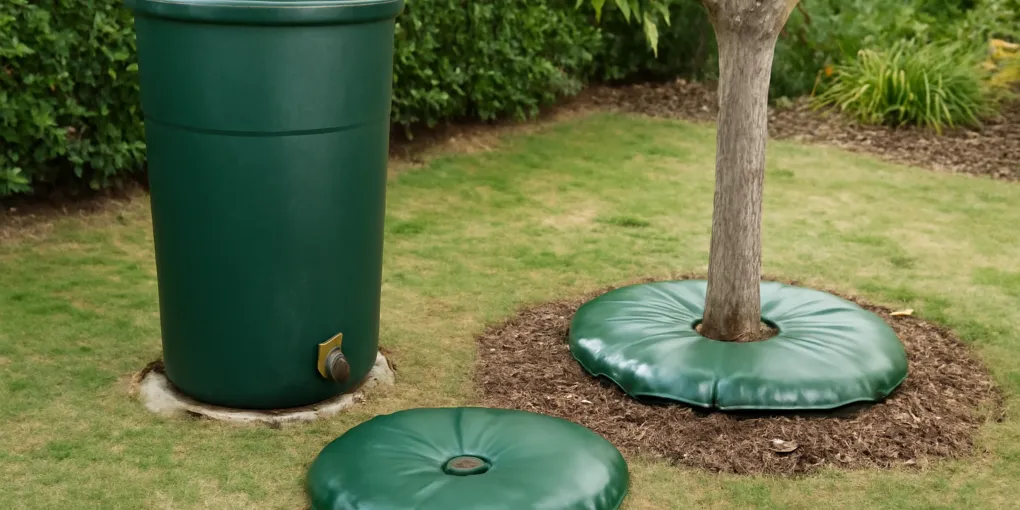
Treegator Original Pro slow-release watering bag
Best for new shade treesUse Case: Deep watering one young tree from a barrel or hose
$18-$45 typical
Quick picks
| Product | Key Specs |
|---|---|
| See price on Amazon |
|
| See price on Amazon |
|
| See price on Amazon |
|
| See price on Amazon |
|
Product availability, certifications, and retailer details can change; check the current Amazon page before buying.
A rain barrel can be a good source for slow tree watering, but the product has to match the reality of stored roof runoff: low pressure, limited gallons, debris risk, and a barrel outlet that may sit only a few feet above the ground. A tree watering bag that works perfectly from a pressurized hose can be frustrating if it has a tiny fill port, needs fast flow, or sits uphill from the barrel.
The best rain barrel tree watering setup is usually simple: a raised barrel, a short hose with a shutoff, a screen that keeps grit out of the bag, and a slow-release bag or ring sized for one tree at a time. If the tree is far away, add a small transfer pump rather than leaving a long flat hose to dribble for hours.
Quick picks for tree watering from a rain barrel
- Best for new shade trees: Search Amazon for Treegator Original Pro bags when the trunk fits the bag and you can remove or dry it between uses.
- Best low-profile soak: Search Amazon for TreeDiaper watering rings for small ornamentals, patio trees, or trunks that should not be wrapped.
- Best control part: Search Amazon for Flexzilla lead-in hoses with shutoff so low-pressure barrel water goes into the bag instead of spilling at the stand.
- Best for distant trees: Search Amazon for WAYNE PC2 transfer pumps only when gravity cannot fill the bag in a practical time.
If you are still deciding whether stored water should go to trees, pots, or beds first, see the rain barrel dry-spell watering plan and the container garden watering layout. For pressure problems, start with the rain barrel height and pressure guide.
How a tree bag changes rain barrel watering
Extension tree-care guidance usually emphasizes slow, deep watering during establishment rather than a quick splash at the trunk. A watering bag or ring helps because it releases water over time near the root zone. That slow release is the same reason the product can pair well with a rain barrel: you are not trying to run sprinklers or high-pressure emitters.
The constraint is volume. A typical residential rain barrel may hold about 50 gallons. One large tree bag can use a meaningful share of that storage. If you have two new trees, a vegetable bed, and patio containers, the bag is not a magic multiplier. It is a way to place scarce stored water more carefully.
Before buying, decide which problem you are solving:
- The tree needs slow delivery. Choose a bag or donut ring.
- The barrel is hard to control. Add a short hose, shutoff, and good washer.
- The tree is too far or uphill. Use a small transfer pump or move the barrel closer.
- The water is dirty. Fix inlet screening before sending grit through a bag or pump.
Slow-release tree watering bag: best for new shade trees
A zip-around tree watering bag wraps around the trunk and drains through small holes at the bottom. It is useful when you have a young tree with enough trunk shape for the bag to sit upright. From a rain barrel, the bag gives you a clear task: fill it, confirm it drains, then stop. You do not have to hold a hose at the root zone for half an hour.
Search Amazon for Treegator Original Pro bags
Check the fill opening before buying. A wide, accessible opening is easier to use with low-pressure gravity flow. Tiny caps, stiff fabric collars, or tall fill ports may need more pressure than a short barrel stand provides. Also check whether the product lists a trunk-diameter range, total gallon capacity, and cleaning instructions.
The main caution is bark moisture. A bag is not a permanent decoration. If it keeps the trunk wet between watering sessions, remove it or let it dry according to the product directions. In humid climates or shaded beds, a donut ring can be a better shape because it keeps more material off the trunk.
Donut ring: best when trunk contact worries you
A TreeDiaper-style donut watering ring lies around the base of the tree and releases water through small holes. It can be easier around multi-stem ornamentals, thin trunks, or trees where a zip bag would rub bark. It also stays lower, which helps in front-yard beds where a tall green bag would be visually intrusive.
Search Amazon for TreeDiaper watering rings
For rain barrel use, look for a ring that can be filled from a low hose angle. A ring with a small top cap may be awkward if the barrel is on the same grade and the hose barely flows. Place it on smooth mulch or soil, not sharp stone. If the ring sits unevenly, it may drain on one side and leave part of the root zone dry.
Do not bury the ring under mulch. You still need to see leaks, punctures, algae growth, and whether water is draining too quickly. After watering, move it occasionally so turf, mulch, and bark can dry.
Short hose and shutoff: the small part that prevents waste
A tree bag makes the water slow; a short hose with a shutoff makes the filling controlled. Long hoses waste time under gravity flow because every kink, uphill loop, and rough fitting steals pressure. A three-to-six-foot lead hose from a raised barrel to a nearby bag is much easier to manage.
Search Amazon for Flexzilla lead-in hoses with shutoff
Check the barrel spigot thread before ordering. Some decorative barrels use light-duty plastic outlets or nonstandard fittings that do not like heavy hoses hanging from them. Support the hose so it does not twist the spigot. Use a fresh washer, open the valve slowly, and close the shutoff before disconnecting so the remaining hose water does not dump at the stand.
If your barrel also feeds raised beds or a soaker hose, a splitter can work, but do not leave multiple branches open. Low-pressure systems punish tiny leaks and forgotten valves.
Transfer pump: best only when gravity is the bottleneck
A small transfer pump such as a WAYNE PC2-class utility pump is not necessary for a tree beside a raised barrel. It becomes useful when the tree is uphill, across a driveway, or far enough away that gravity flow turns into a trickle. Use a modest garden transfer pump rather than trying to force the barrel into sprinkler duty.
Search Amazon for WAYNE PC2 transfer pumps
The pump needs an intake screen and supervision. Roof grit, leaves, and algae can clog small impellers or bag drain holes. Do not run the pump dry, and do not pull so aggressively that a thin barrel wall flexes or collapses around the outlet. If you mainly need pressure for drip irrigation, read the rain barrel pump setup guide before buying.
Fit checklist before you buy
Use this checklist at the tree, not just at the product page:
- The tree is close enough to the barrel for gravity flow, or you have a pump plan.
- The bag capacity will not consume all stored water needed for other plants.
- The fill port is reachable with a low-pressure hose.
- The bag or ring can dry between uses and will not keep bark wet.
- The ground under the ring is smooth enough to avoid punctures.
- The barrel inlet screen is clean enough that grit will not clog drain holes.
- The overflow route still works while you are using the barrel for tree watering.
A watering bag is most useful when it replaces random splashing with a measured soak. It is less useful if it becomes one more plastic item you leave full, dirty, and pressed against the trunk.
Simple rain barrel tree-watering routine
Start with one tree. Fill the bag or ring halfway and watch for leaks, sagging, and blocked drain holes. If the water drains evenly and the barrel still has enough reserve, fill the rest. Mark the barrel level before and after the first use so you know how many gallons that tree actually takes from your setup.
During hot, dry periods, check soil moisture near the root zone instead of watering on a fixed calendar. Newly planted trees often need steady attention, but waterlogged soil is also a problem. If the bag empties onto compacted soil and runs away, widen the mulch ring, slow the release, or water in two smaller rounds.
Sources
- University of Minnesota Extension: Watering newly planted trees and shrubs
- EPA: Soak Up the Rain: Rain Barrels
- Rutgers NJAES: Rain Barrels Part IV: Installation and Maintenance
- Penn State Extension: Rain Barrels
Frequently Asked Questions
- Yes, if the barrel outlet is above the bag inlet or you use a small transfer pump. Gravity flow is slow, so a short, unkinked hose and a raised barrel make the job much easier.
- Choose a bag or ring you can fill without emptying every stored gallon at once. A common 50-gallon barrel may only fill one or two large bags before it is nearly empty.
- Use the product directions and check often. Bags can hold moisture against bark, so remove or dry them between uses when the manufacturer recommends it, especially in humid weather.
- No. They are a delivery tool. Mulch depth, soil moisture, drainage, and the tree's planting depth still decide whether the water reaches roots instead of running away.