Quick picks
| Product | Key Specs |
|---|---|
| See price on Amazon |
|
| See price on Amazon |
|
| See price on Amazon |
|
| See price on Amazon |
|
Product availability, certifications, and retailer details can change; check the current Amazon page before buying.
Clay soil changes the rain-barrel overflow plan. A sandy yard may absorb a modest discharge quickly. A compacted clay yard may hold water at the surface, send it sideways under mulch, or turn a buried dry well into a hidden bathtub. The barrel still helps capture the first water from a storm, but once it fills, the extra roof runoff needs a route that respects slow-draining soil.
This protocol is for yards that pond, smear, or stay wet after ordinary rain. If your yard drains well and you are comparing endpoints, read the rain barrel overflow endpoint guide. If overflow is already near the foundation, start with the rain barrel overflow away from foundation guide.
Quick protocol
| CTA | Use this when | Do not use it for |
|---|---|---|
| Search Amazon for flexible overflow hoses | You need to watch the real route before burying anything. | Permanent routes across walkways, mowing paths, or neighbor-side slopes. |
| Search Amazon for splash blocks and outlet rock | The hose outlet erodes mulch or cuts a channel in bare clay. | A low spot that already ponds for days. |
| Search Amazon for solid drain pipe cleanout kits | You need to carry overflow across clay to a legal visible outlet. | Flat routes with no cleanouts or uncertain discharge points. |
| Search Amazon for soil probes and hand augers | You want to check soil layers and compaction before digging. | Any excavation before utility marking where required. |
Step 1: watch the yard before installing permanent parts
Do not start with a dry well kit in clay. Start with observation. During a steady rain, look at where the existing downspout water travels, where the lawn shines with standing water, and which mulch beds form small channels. After the storm, note which spots are still wet the next day.
Use a flexible extension from the barrel overflow and test one route at a time. The outlet should be lower than the barrel, away from the foundation, away from walkways, and pointed toward a place where water can spread. If the temporary hose creates ponding, a buried pipe in the same direction will not magically solve the outlet problem.
Search Amazon for flexible downspout extensions for rain barrel overflow
Step 2: spread the discharge instead of drilling a hole in the clay
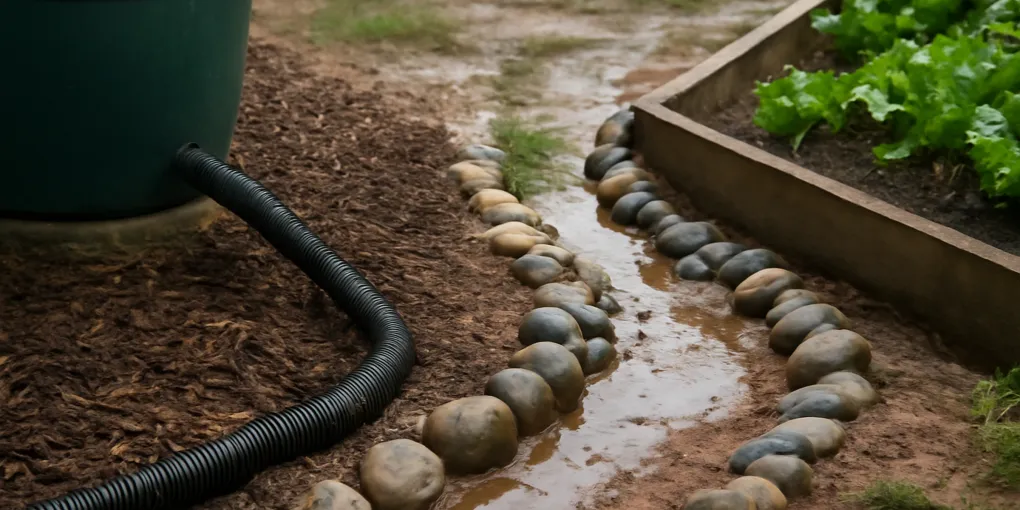
Concentrated water cuts channels. In clay, those small channels can carry water under mulch back toward the house or across a path. At the hose outlet, use a splash block, a flat rock apron, or a short rock-lined fan to slow the flow and spread it.
Search Amazon for downspout splash blocks and river rock drainage
The outlet still needs a safe destination. Rock does not make water disappear. It only reduces erosion at the first impact point. If water stands around the rock after ordinary storms, move the outlet or reduce the roof area feeding that barrel.
Step 3: be skeptical of small dry wells
A dry well works by storing water temporarily while surrounding soil absorbs it. In clay, absorption can be slow. A small buried container may fill quickly, sit full, and back water up through the pipe during the next storm. Because it is underground, you may not notice the failure until the barrel overflows at the top or the yard stays wet.
If you are considering a dry well, perform a local drainage test and check municipal rules, utility locations, setbacks, and overflow requirements. A dry well without a bypass is a risky endpoint for roof runoff in slow-draining soil. In many clay yards, a visible surface swale, longer overflow route, or properly designed rain garden is easier to inspect.
Search Amazon for soil probes and hand augers for drainage checks
Step 4: use solid pipe only to carry water somewhere visible
If a surface hose is unsafe or ugly, solid drain pipe can carry overflow across a clay section. It should have slope, cleanouts, and a daylight outlet you can inspect. Do not use perforated pipe when the goal is to transport water away from the barrel; perforations can leak water into the clay before it reaches the endpoint.
Search Amazon for solid downspout drain pipe with cleanouts
Avoid flat buried runs. A pipe that holds water can freeze, grow algae, trap roof grit, and stop flowing during the next storm. Keep a removable section near the barrel so you can flush sediment and leaves.
Step 5: keep neighbor and walkway risk in the test
Clay makes side-flow easy. Water may leave your hose outlet, follow a compacted path, and appear at a sidewalk, driveway edge, or neighbor’s fence line. Walk the route after the test storm, not just during it. Look for silt fans, mulch movement, shiny wet bands, and ice-prone pavement if the season is cold.
If the safe outlet is not on your property, do not force it. Check local drainage rules before sending concentrated roof runoff toward a lot line, ditch, street, or public right-of-way. A rain barrel is small compared with a roof, but the overflow can still be concentrated enough to cause erosion or disputes.
Step 6: consider a rain garden only with an overflow path
A rain garden can work in some clay yards, but it is not just a decorative hole. It needs correct sizing, amended soil where appropriate, suitable plants, inlet protection, and an overflow path for storms larger than the garden can hold. If the chosen spot already holds water for days, it may be the wrong place.
Use extension or conservation-district guidance for local soil and plant choices. For a simple barrel setup, a visible, protected surface outlet may be safer than an undersized rain garden that never drains.
Clay-yard maintenance checks
After leaf drop, flush the overflow route and clean the barrel inlet. Clay yards often show failures slowly: a little silt at the outlet, then a rut, then a pond. Fix those signs early by spreading the outlet, shortening the roof area feeding the barrel, or moving the route.
Before winter, remove or drain any hose or pipe that can hold water. A frozen low spot can block overflow and send the next storm over the barrel rim.
Source notes
EPA Soak Up the Rain materials describe rain barrels as one stormwater tool that still needs proper overflow routing: https://www.epa.gov/soakuptherain/soak-rain-rain-barrels. University of Minnesota Extension rain garden guidance notes the importance of soil, siting, and overflow design: https://extension.umn.edu/landscape-design/rain-gardens. Penn State Extension rain barrel guidance emphasizes safe overflow and regular maintenance: https://extension.psu.edu/rain-barrels.
Clay-soil rain barrel FAQ
How do I know if my soil is too clayey for a dry well?
If test holes drain slowly, the yard ponds after normal rain, or nearby clay stays slick and saturated, be cautious. A local extension office, stormwater program, or drainage professional can help interpret soil conditions before you dig.
Can I just drill holes in the overflow pipe?
Do not rely on perforations in slow-draining clay when the goal is to move overflow away. The water may leak out early and saturate the wrong area. Use solid pipe to carry water to a visible outlet, then spread it safely.
Is mulch enough to stop erosion?
Mulch helps, but concentrated overflow can float it away or cut under it. Use a splash block, rock apron, or broader vegetated outlet where the hose daylights.
Should I add a second barrel instead of routing overflow?
A second barrel adds storage, but both barrels will eventually fill during a long storm. You still need a safe overflow path sized for water after storage is full.
Frequently Asked Questions
- Often it is a poor choice unless a drainage test shows the soil can absorb water fast enough. In clay, an undersized dry well can become a hidden pond that backs up during long storms.
- Send it to a visible, lower, vegetated or rock-protected area that can spread the water without sending it back to the foundation, across walkways, or onto a neighbor's property.
- Sometimes, but clay rain gardens need careful sizing, soil preparation, overflow, and plant choices. Do not assume a small depression will soak roof runoff just because it is planted.
- Start with temporary overflow hose, marking flags, a splash block or rock outlet, and basic soil-check tools. Buy permanent pipe or dry well parts only after a storm test shows the route works.