Best Rain Barrel Overflow Alarms and Water-Level Sensors for Full-Barrel Warnings
Buyer's GuideMechanical float level indicator
Best no-battery status checkUse Case: Seeing whether the barrel is nearly full before a storm
$12-$35 typical
Quick picks
| Product | Key Specs |
|---|---|
| See price on Amazon |
|
| See price on Amazon |
|
| See price on Amazon |
|
| See price on Amazon |
|
Product availability, certifications, and retailer details can change; check the current Amazon page before buying.
A rain barrel overflow alarm is a backup, not the main safety system. The main system is still a screened inlet, a working overflow outlet, and a hose or bypass that sends water away from the foundation. A gauge or sensor helps because it tells you when the barrel is full, nearly full, or leaking in a place you would not notice until after a storm.
The right product depends on what you need to know. If you only want a quick fill-level check, a mechanical float or clear tube gauge is enough. If the barrel sits beside a basement wall or hidden side yard, a water alarm at ground level may be more useful because it warns when the overflow route has failed.
Quick picks
- Best no-battery fill check: Search Amazon for rain barrel float indicators if you want to know whether the barrel is nearly full before a storm.
- Best ground-level warning: Search Amazon for outdoor water leak alarms when a failed overflow would pool beside the house.
- Best visible level readout: Search Amazon for clear tube rain barrel gauges for opaque barrels where opening the lid is inconvenient.
- Best remote alert: Search Amazon for smart water sensors if phone notifications matter more than a loud local alarm.
Pair any sensor with our overflow routing guide and heavy-storm bypass protocol before relying on it during a large storm.
What an alarm can and cannot do
An alarm can tell you that water reached a point you care about. It cannot increase overflow capacity, unclog a blocked hose, or make a full barrel safe beside a foundation. Rutgers and Penn State rain barrel guidance both stress that barrels need covered openings and overflow control. A sensor is useful only after the physical water route is already planned.
Use the alarm to catch failures: a kinked overflow hose, a loose bulkhead fitting, water backing up at the inlet screen, or runoff pooling on a patio. If the barrel has no dedicated overflow hose, buy that before buying electronics.
Mechanical float level indicator
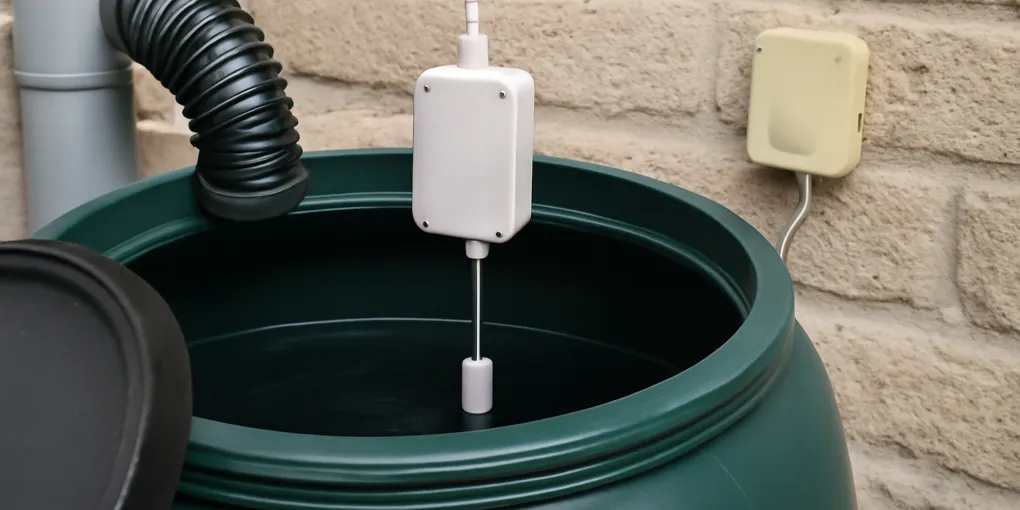
A float indicator is the simplest way to see barrel level without opening the lid. A float rises with the water and moves a small dial or stem above the lid. It is useful before a forecast because you can decide whether to drain some water to make storage room.
Search Amazon for rain barrel float water level indicators
Best for: opaque barrels, normal backyard setups, and owners who check the barrel in person. Watch for: lid thickness, float clearance, UV durability, and whether the installation creates a new mosquito gap. The float should move freely without scraping the lid, inlet screen, or barrel wall.
A float does not warn you from inside the house. It is a visual tool, so it works only if you actually look at it.
Outdoor water leak alarm
A water leak alarm sits where unwanted water would collect and sounds when its contacts get wet. For a rain barrel, that location might be a dry paver under the overflow fitting, a shallow tray beside the stand, or a low spot near a basement-adjacent barrel. The point is not to detect normal rain; it is to detect water where overflow should not be going.
Search Amazon for outdoor water leak alarms for rain barrels
Best for: barrels close to the house, patios where water can run toward a door, and setups that have already had overflow surprises. Watch for: weather resistance, alarm volume, battery access, and false alarms. If normal rainfall wets the sensor every time, move it to a sheltered low spot that only gets wet when the barrel or overflow route misbehaves.
Clear tube water level gauge
A clear tube gauge shows water level by connecting near the bottom and rising along the side of the barrel. It is easy to read and can be useful on tall or dark barrels. The tradeoff is that it adds fittings and a small water-filled tube that needs maintenance.
Search Amazon for rain barrel clear tube water level gauges
Best for: people who want a quick visual level from several feet away. Watch for: tight bulkhead seals, algae growth inside the tube, freeze damage, and a shutoff or drain option. In cold climates, a side tube can freeze before you think about winterizing it, so include it in the same shutdown routine as spigots and irrigation parts.
If the tube gets green or cloudy, clean it rather than assuming the reading is accurate. A clogged or air-locked gauge can lie.
Smart water sensor with phone alert
A smart water sensor is useful when the barrel is out of sight or when you travel during storm season. The sensor can send a phone notification if water reaches the probe. That helps if a barrel sits along a side wall, behind shrubs, or near a basement window where you do not inspect after every storm.
Search Amazon for smart water leak sensors
Best for: remote alerts and hidden overflow risk. Watch for: outdoor rating, hub requirements, Wi-Fi or radio range, battery life, and whether the sensor can tolerate damp air without nuisance alerts. Many smart leak sensors are designed for indoor plumbing. Do not assume one belongs outdoors unless the listing and manual support that use.
Where to place the sensor
Put a sensor where water should stay dry during ordinary rain. A dry paver beside the barrel stand is often better than bare soil because the sensor does not sink or get buried by mulch. If the barrel overflow hose runs to a splash block, place the sensor outside the normal splash zone but inside the area that would get wet if the hose disconnects.
Do not place the sensor inside the barrel as the primary full-level alarm unless the product is designed for that job. Stored water, algae, and debris can foul probes, and a sensor inside the tank does not tell you whether overflow is leaving safely.
Buy the drainage part first
If the barrel overflows toward the house, the first purchase should be an overflow hose, diffuser, diverter valve, or splash block that moves water away. The alarm comes after that. EPA Soak Up the Rain material treats rain barrels as part of a broader runoff-management setup; the stored water and the overflow path both matter.
Use a hose test after installation. Fill the barrel until water exits the overflow, then confirm the discharge point stays away from the foundation, does not erode mulch, and does not run across a walkway. Only after that should you tune the alarm location.
Search Amazon for rain barrel overflow hose kits
Sensor fit by barrel location
For a barrel on a level garden pad far from the house, a float indicator is usually enough. You mainly need to know whether the barrel has storage room before the next storm and whether it is worth opening the spigot for a watering session. A simple visual gauge also avoids batteries and app setup.
For a barrel beside a foundation, door threshold, basement window, or finished patio, choose a ground-level alarm first. The failure you care about is not just a full barrel; it is water going somewhere expensive. Put the overflow hose in the safe direction, then put the alarm in the place that would get wet if the hose popped off, clogged, or backed up.
For a side-yard barrel that you rarely see, a smart sensor can be worth the extra setup if the signal reaches the house. Test the notification while standing at the barrel before trusting it during a storm. If the sensor depends on a hub, confirm the hub still reports a low-battery warning and does not silently drop the device after a few weeks outdoors.
Installation checks before the first storm
After installing any gauge or alarm, run a controlled fill test. Add water until the barrel level rises near the overflow, then watch the gauge, float, or sensor response. Check every new drilled hole and fitting for drips. A level gauge that requires a lower bulkhead fitting can create a worse leak than the overflow problem you were trying to monitor.
Write the battery month on the sensor with outdoor tape or a paint marker. Outdoor alarms are easy to forget once they stop chirping. At seasonal shutdown, remove or protect electronics before freeze-thaw cycles, clean clear gauge tubes, and make sure the overflow hose is drained or disconnected according to your winter plan.
FAQ
Will an overflow alarm stop a rain barrel from flooding?
No. An alarm only warns you. The barrel still needs a correctly sized overflow hose or bypass that moves water away from the foundation after the barrel fills.
Is a float gauge better than a clear tube level gauge?
A float gauge is simpler and avoids water sitting in a side tube. A clear tube can be easier to read at a glance, but it adds fittings that must seal and may need cleaning or draining before freezes.
Where should I put a water sensor near a rain barrel?
Put it where unwanted water would collect, such as a dry paver beside the barrel stand or a low tray near the overflow path. Do not put it where normal rainfall will trigger constant false alarms.
Do I still need an overflow hose if I use a smart sensor?
Yes. The sensor is backup information, not drainage. The overflow hose or diverter bypass is the part that actually carries excess water away from the house.
Sources
- EPA, Soak Up the Rain: Rain Barrels
- Rutgers Cooperative Extension, Rain Barrels
- Penn State Extension, Rain Barrels