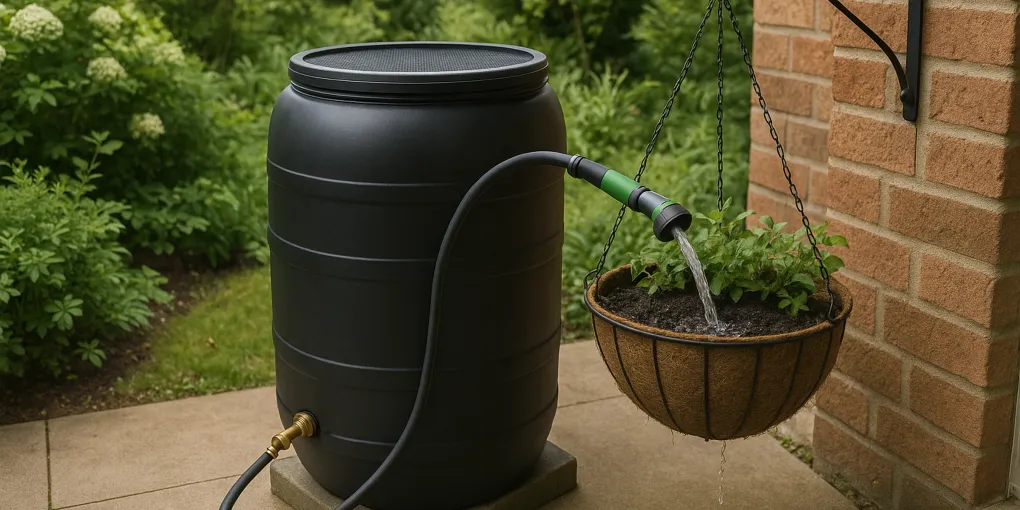
How to Water Hanging Baskets From a Rain Barrel
ProtocolQuick picks
Heavy-duty rain barrel stand
★ Top pick For an accessible spigot height- Use Case: Positioning a barrel where its spigot remains easy to reach from the basket route
- Best For: A stable, purpose-made barrel base with easier spigot access
- Watch For: Load rating, level footing, barrel footprint, and spigot clearance
Low-pressure drip irrigation kit for rain barrel
For a short tested branch- Use Case: Trying one short, accessible branch after the hand-watering route is clear
- Best For: One nearby basket with a route that can be observed while it runs
- Watch For: Thread compatibility, filter access, line length, and basket connection
A hanging basket changes the rain-barrel question from “where can the water go?” to “can I keep the water in the basket?” The useful setup is usually the simplest one: fill a can, use a short hand-held hose route, or test one short branch. This page is for one elevated basket near the barrel, not a whole-patio irrigation plan.
Choose the route before buying parts
Start with the option that gives you direct control over where water lands.
| Route | Use it when | Skip it when |
|---|---|---|
| Watering can | You can fill it at the spigot and reach the basket from the patio. | Carrying a full can makes the trip impractical. |
| Short hand-watering hose | The barrel spigot, hose, and basket are all within one easy-to-watch route. | The hose must cross a long patio run or you cannot keep the nozzle over the basket. |
| Short gravity branch | One nearby basket can be checked while the branch is open. | The route needs several baskets, a long line, or an out-of-reach connection. |
| Different setup | The basket is beyond the practical reach of the barrel route. | You are choosing it only to avoid testing the simpler options. |
For a broader patio layout, see rain barrel container garden watering layouts. For the height-and-route constraint behind a gravity setup, use the rain barrel height and pressure guide.
Set up one controllable path
Keep the barrel on its intended base with room to use the spigot. Then trace the route to the basket before opening the water: where the hose rests, where the nozzle will be held, and whether the basket can be reached without changing position halfway through.
The destination is the potting mix inside the basket. Hold the nozzle close enough to direct water into that mix, start with a modest stream, and pause if it begins to run around the basket edge. A slower second pass is more useful than trying to finish in one rushed pour.
If you are deciding between a hand tool and a hose-end attachment, the low-flow watering wand and nozzle guide covers that separate buying decision. This article’s job is narrower: getting water to one hanging basket with a route you can observe.
Test the highest basket with less water in the barrel
Do not judge the route only when the barrel is full. Check the farthest and highest basket again after the barrel level has dropped. Watch the nozzle at the basket, not just the spigot near the barrel.
If the route no longer gives you a usable stream at the potting mix, shorten the route or return to a watering can. Do not add more baskets to a run that has not worked for the first one. Readers who need a larger or more distant setup can compare the options in our rain barrel pump and drip irrigation guide.
Quick picks for a controllable route
These are compatibility choices, not a requirement for every basket. Check the current price on Amazon only after you know which route fits your patio.
- Purpose-made rain barrel stand: Check current price on Amazon for rain barrel stands when the barrel needs a base that matches its footprint and keeps the spigot accessible. Skip it if your barrel already has a suitable base.
- Low-pressure drip kit: Check current price on Amazon for low-pressure rain barrel drip kits only after a short, single-basket route has been tested. Skip it if the basket is easier to water with a can or hand-held hose.
For the overflow route around the barrel, use the separate rain barrel overflow away from foundations guide. Overflow management is not a substitute for a planned basket-watering route.
Keep the basket check separate from a calendar
Look at the potting mix before opening the spigot rather than treating the barrel as a timer. When the surface looks dry, direct water into the mix and pause long enough to see whether it stays in the basket. If it sheds water around the sides, make a slower follow-up pass rather than increasing the stream.
This page does not replace the broader container routine. For that, read how to use a rain barrel for patio containers, which covers container groups and root-zone checks rather than elevated-basket access.
Hanging-basket rain-barrel FAQ
Should I use a watering can or a hose for a hanging basket?
Choose the route you can hold over the potting mix from start to finish. A can works for a nearby basket; a short hose can work when the nozzle remains easy to control.
What if water runs around the side of dry potting mix?
Pause, then make another slower pass into the mix. A fast stream can travel around the edge instead of wetting the part of the basket you are trying to reach.
Why does a gravity route stop reaching my hanging basket?
The route can change as the barrel level falls. Test the highest basket with less water in the barrel; if the result is no longer usable, shorten the route or use a different method.
Can I run one branch to several hanging baskets?
Start with one basket. A multi-basket layout is a different planning task; use the container-layout guide before adding a longer branch.
Sources
- Iowa State University Extension: How often should I water plants in hanging baskets?
- Royal Horticultural Society: How to plant a hanging basket
- Toronto and Region Conservation Authority: How to set up a rain barrel and harvest rainwater
Frequently Asked Questions
- Start with the route you can control at the basket. A can is useful when the basket is close; a short hose can be practical when you can keep the nozzle over the potting mix.
- Pause and make a slower second pass at the potting mix. The goal is to wet the mix rather than send a fast stream around the basket edge.
- Check the route with the barrel partly depleted. If the farthest, highest basket no longer receives a usable stream, return to a can or choose a different setup instead of extending the run.