Rain Barrel Hose-Fill Air Gaps and Backflow Parts: What to Buy First
Evidence ExplainerQuick picks
| Product | Key Specs |
|---|---|
| See price on Amazon |
|
| See price on Amazon |
|
| See price on Amazon |
|
| See price on Amazon |
|
Product availability, certifications, and retailer details can change; check the current Amazon page before buying.
A rain barrel is supposed to stay separate from drinking-water plumbing. The risk starts when a hose from a house spigot is used to top off a barrel, rinse a screen, prime a pump, or feed an irrigation line that also touches stored roof runoff. If that hose end sits below the waterline and pressure drops in the potable system, dirty water can be pulled backward. That is the problem air gaps and backflow prevention parts are meant to prevent.
This guide is for hose-fill and hose-use parts, not permanent plumbing design. If your system is connected to an indoor supply line, automatic makeup water, irrigation valves, or a municipal requirement, get the local code answer before buying hardware. For a backyard barrel, keep a visible air gap, protect the hose bibb, and make nonpotable hoses impossible to confuse with drinking-water hoses.
For the setup sequence, read rain barrel backflow prevention. If the barrel also feeds drip irrigation, pair this with rain barrel pressure regulators for drip irrigation so flow-control parts do not get mistaken for safety devices.
Hose-fill parts worth considering first
Use these product categories to solve specific failure points without pretending a hose gadget replaces local plumbing rules:
- Search Amazon for hose bibb vacuum breakers when the outdoor faucet needs a listed anti-siphon device before any hose is used near nonpotable water.
- Search Amazon for air-gap fill fittings when a hose sometimes tops off the barrel and you want a fixed gap that is easy to inspect.
- Search Amazon for nonpotable hoses and hangers when the same patio has drinking-water hoses, rain barrel hoses, and garden hoses.
- Search Amazon for inline hose check valves only as a secondary garden-flow aid after the real separation points are handled.
What the parts prevent
The core hazard is back-siphonage: water moving the wrong direction because pressure on the supply side drops while a hose end is submerged or contaminated. Utility cross-connection programs commonly use hose ends in buckets, pools, tanks, or chemical sprayers as simple examples of preventable backflow risks. Rain barrel water is not a pesticide mix, but it is still nonpotable roof runoff with sediment, organic debris, and possible microbial contamination.
EPA cross-connection guidance uses the same principle: potable systems need protection from nonpotable sources, and an air gap is one of the most reliable separations because it is physical and visible. A valve can be installed wrong or clogged. A hose end held above the barrel rim is easy to check.
That is why the best purchase is rarely one magic valve. It is a small stack: a spigot device where required, a true air gap at any fill point, and hose storage habits that stop the dirty hose from being reused at the picnic cooler, pet bowl, or kitchen rinse job.
1. Hose bibb vacuum breaker: protect the outdoor faucet
A hose bibb vacuum breaker threads onto an outdoor faucet and vents under back-siphon conditions. Many homes already have anti-siphon hose bibbs, but older faucets, utility sinks, detached garages, and improvised garden spigots may not. If a hose from that faucet can reach a barrel, bucket, fertilizer sprayer, or puddled irrigation line, this is the first device to investigate.
Search Amazon for hose bibb vacuum breakers
Check the thread size, whether the device is listed for the use, and whether your area expects a set screw or tamper-resistant installation. In freeze climates, read the removal and drainage instructions. A vacuum breaker full of trapped water can crack, and a cracked device should be replaced rather than trusted.
Best for: outdoor faucets used near barrels, hose-end sprayers, wash buckets, or nonpotable irrigation gear. Watch for: plastic threads, bargain parts without clear markings, devices that leak continuously, and any setup that still leaves the hose end underwater.
2. Air-gap fill fitting: make the separation visible
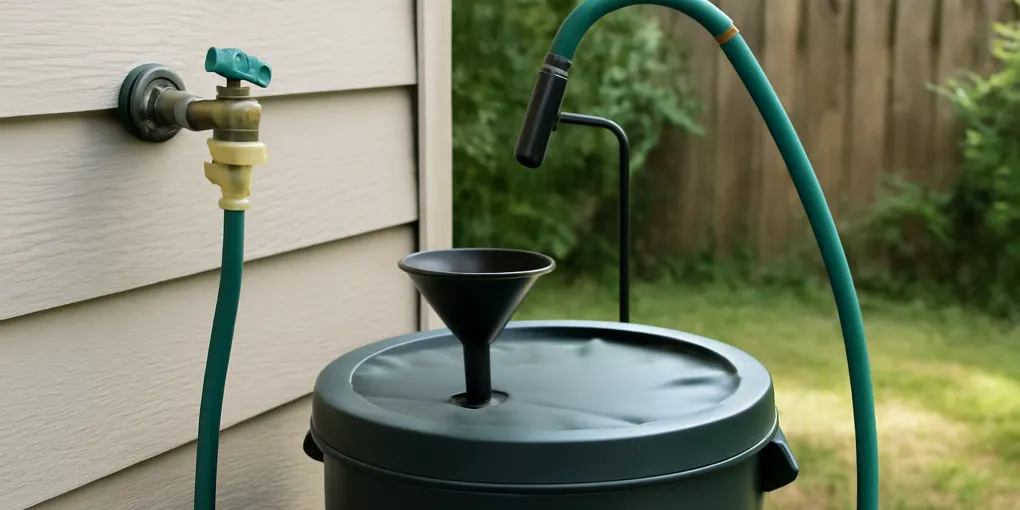
An air gap means the potable-water outlet is physically above the flood level of the receiving container. For a rain barrel, that can be as simple as a hose clipped high above the screened inlet, or as tidy as a mounted funnel or fill point that keeps the hose end fixed above the barrel opening.
Search Amazon for air-gap hose fill fittings
The gap has to remain a gap when the barrel is full. Do not tuck the hose through the lid, wedge it into the screen, or let it droop below the overflow level. If splash is the reason you keep pushing the hose deeper, solve splash with a wider funnel, a slower fill rate, or a fixed bracket, not by submerging the hose.
Best for: occasional top-offs before a dry week, rinsing after cleaning, or filling a new barrel for leak testing. Watch for: unsecured hose ends, blocked overflow paths, and fill points that send splash against siding or into the stand base.
3. Nonpotable hose and hanger: prevent mixups after the barrel is working
A dedicated hose is not a plumbing device, but it is one of the easiest ways to prevent bad habits. Once a hose has been connected to a rain barrel spigot, dragged through sediment, or used with stored roof runoff, keep it in the nonpotable category. Store it near the barrel and mark it clearly.
Search Amazon for nonpotable garden hoses and hose hangers
A bright hose, tag, or hanger helps visitors and kids avoid using the wrong line. Cap the ends if they sit near soil. Hang the hose high enough that the end does not rest in mulch, a saucer, or a puddle. This matters most when the same yard has a food garden, pet washing area, or outdoor kitchen.
Best for: households with more than one hose purpose. Watch for: vague labels, drinking-water-rated hoses being reassigned without markings, and hose ends stored below the barrel waterline.
4. Inline check valve: useful, but not the main safety device
A garden-hose check valve allows flow in one direction and resists reverse flow. It can help some nonpotable irrigation layouts, but it is not a substitute for required backflow prevention or a true air gap.
Search Amazon for inline garden hose check valves
Roof grit, algae, sand, and small plastic shavings can keep a check valve from sealing.
Best for: one-way convenience on nonpotable garden lines after the potable-water side is already protected. Watch for: hidden clogs, reversed installation, and assuming it makes a submerged hose safe.
Choose without overbuying parts
Start at the house spigot. If the faucet lacks a proper anti-siphon device, handle that before shopping for hose gadgets. Next, look at every place a potable hose could touch stored rainwater. If the hose can drop into the barrel, buy or build a fixed air-gap solution. Finally, label and store any hose that touches rain barrel water as nonpotable.
Do not buy a complicated valve stack to fix a habit problem. A visible gap and a dedicated hose are easier for a household to follow than a hidden part nobody remembers to inspect. Do not buy a tiny check valve and call the system protected if local rules require a vacuum breaker or other listed assembly. When the question involves public water supply rules, irrigation permits, or indoor plumbing, local authority beats product copy.
Practical score for rain barrel backflow parts
| Criterion | Weight | What it means at a rain barrel |
|---|---|---|
| Research | 30% | Choose parts based on cross-connection guidance, faucet type, and local plumbing expectations, not just hose-thread compatibility. |
| Evidence Quality | 25% | Prefer visible physical separation and listed faucet devices over unmarked inline valves with vague claims. |
| Value | 20% | Buy the part that fixes the actual weak point: spigot protection, air gap, hose labeling, or one-way garden flow. |
| User Signals | 15% | Treat submerged hose ends, muddy hose storage, and shared drinking-water hoses as signs that the setup needs simplification. |
| Transparency | 10% | Keep the protective part visible enough that another person can understand the safe way to fill or water. |
Source notes
- EPA WaterSense materials support outdoor water-efficiency setups while keeping irrigation choices separate from household drinking-water assumptions: https://www.epa.gov/watersense
- WSSC Water’s backflow and cross-connection guidance explains how nonpotable sources can be drawn into a potable system and why prevention devices matter: https://www.wsscwater.com/backflow
- CDC drinking-water prevention guidance reinforces keeping possible contamination sources out of drinking-water pathways: https://www.cdc.gov/drinking-water/prevention/index.html
Rain barrel backflow parts FAQ
Is an air gap better than a valve?
For a simple hose-fill point, a visible air gap is easier to inspect and harder to misread. A valve may still be required at the faucet, but it should not encourage you to leave a hose end submerged.
Where should the vacuum breaker go?
It belongs at the hose bibb or faucet when that is the required protection point. Follow the device instructions and local rules, and do not bury it behind the barrel where leaks or freeze damage will be missed.
Frequently Asked Questions
- It may be the required device at the outdoor faucet, but it should not be the only habit you rely on. Keep hose ends out of stored rainwater, use an air gap when topping off a barrel, and follow local plumbing rules for any connection near potable water.
- No. A submerged hose end is exactly the setup that can create a back-siphon risk if pressure changes. Keep the hose end above the barrel opening or use a fixed air-gap fill point.
- Not for code decisions. A simple check valve can help one-way garden flow, but it is not the same as a listed backflow prevention assembly required by many plumbing rules.
- Yes. Labeling and separate storage reduce mixups, especially when a hose has touched roof runoff, barrel sediment, mosquito-control products, or soil.