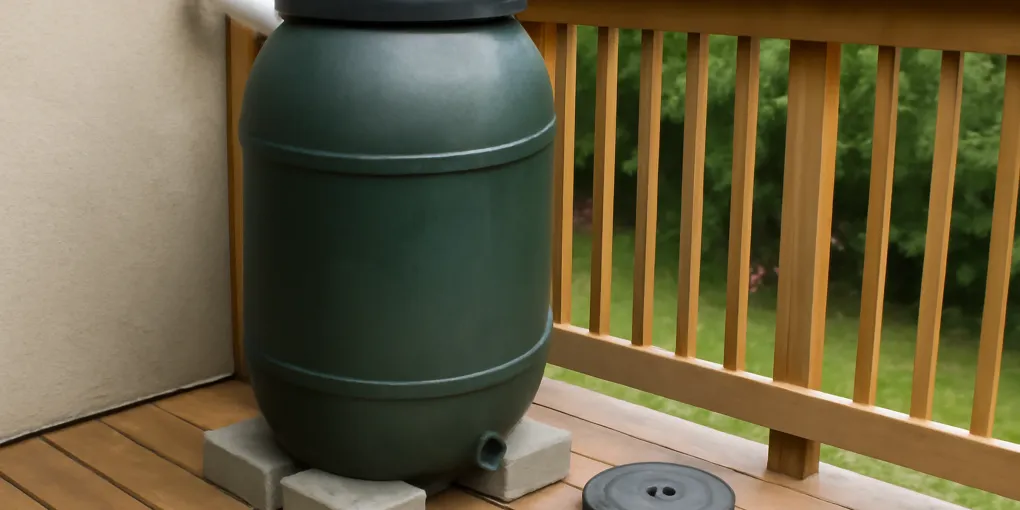
Can You Put a Rain Barrel on a Deck or Balcony? Weight and Drainage Checks
Evidence ExplainerQuick picks
Compact 25- to 40-gallon rain barrel
★ Top pick Safer small-capacity option- Best for: Ground-level or engineer-approved elevated locations where a full 50-gallon barrel is too heavy
- Check first: Smaller storage still needs a level base, overflow route, and filled-weight check.
Rain barrel downspout diverter kit
Best deck-adjacent fill control- Best for: Keeping the barrel near a deck while letting the original downspout handle excess flow
- Check first: The diverter height must match the barrel inlet and the kit instructions.
Rain barrel overflow hose kit
Best spill-control add-on- Best for: Routing full-barrel water away from deck footings, stairs, doors, and foundation walls
- Check first: Avoid uphill loops, crushed hose sections, and discharge points that erode soil under supports.
A rain barrel on a deck or balcony sounds convenient until you do the weight math. Water weighs about 8.34 pounds per gallon, so a full 50-gallon barrel holds roughly 417 pounds of water before adding the barrel, stand, fittings, wet leaves, or a person leaning over it. That concentrated load is very different from a few planters spread across a deck.
The safe default is simple: do not put a full-size rain barrel on a deck, balcony, elevated porch, or stair landing unless a qualified builder, structural engineer, property manager, or local authority has confirmed that specific location can handle the filled load and drainage. Most homeowners are better served by a ground-level barrel near the deck downspout, fed by a diverter or short downspout extension.
This guide explains the checks that matter before you buy hardware. For ground-level placement details, use our rain barrel location checklist and foundation-safe overflow guide.
Quick picks for deck-adjacent rain barrel safety
- If you need smaller storage: Search Amazon for compact 25- to 40-gallon rain barrels, then place the barrel on a verified base rather than assuming smaller means safe.
- If the downspout is deck-adjacent: Search Amazon for rain barrel diverter kits so the original downspout can keep working when the barrel is full.
- If overflow could hit posts or stairs: Search Amazon for rain barrel overflow hose kits and route the discharge before the first storm test.
The filled-weight math changes the decision
A small barrel can still be heavy. A 25-gallon barrel holds about 209 pounds of water. A 40-gallon barrel holds about 334 pounds. A 50-gallon barrel holds about 417 pounds. Add the empty barrel, stand, wet sediment, fittings, and dynamic movement as the barrel fills and drains, and the load becomes substantial.
Deck and balcony questions are not only about total pounds. They are about where those pounds sit. A barrel concentrates weight into a small footprint, often near a railing, wall, stair, or downspout corner. That may not match how the deck was designed, built, repaired, or inspected. Older decks, weathered joists, ledger-board problems, unsupported corners, and DIY additions make guessing especially risky.
If you cannot get a clear structural answer, keep the barrel off the elevated surface. A ground-level paver base is usually easier to inspect, adjust, and drain.
Deck versus ground-level barrel: the practical difference
A deck barrel seems attractive because height improves gravity flow. In practice, the gain rarely justifies the load risk. You can often get enough hose or watering-can function from a ground-level barrel by using a stable low stand, short hose, wide-bore fittings, or a small pump where appropriate. See the rain barrel height and pressure guide before solving a flow problem by moving hundreds of pounds overhead.
Ground-level placement also makes overflow easier to control. When an elevated barrel overflows, water can run across deck boards, stairs, doors, siding, joist pockets, and post bases before anyone notices. Repeated wetting can create slippery surfaces and send water into places the deck was not meant to drain.
A ground-level barrel is not automatically safe, but the failure mode is usually easier to see: tilting pavers, soft soil, a hose leak, or pooling near the wall. Those problems can be corrected before they involve a structure above head height.
When a deck-adjacent setup can make sense
A deck-adjacent setup can work when the barrel sits on the ground beside the deck and the downspout or gutter outlet is near enough to feed it. In that layout, the deck is not carrying the stored water. The important checks become inlet height, hose route, overflow direction, and whether the barrel blocks stairs or paths.
Use a diverter when the original downspout needs to keep draining after the barrel is full. The diverter should be installed according to the kit instructions, with the barrel inlet at the correct height. If the diverter depends on backflow into the downspout, a barrel that is too low or too high can defeat the intended full-barrel behavior.
If the gutter outlet is not near the barrel, do not improvise a long sagging fill hose across a walking route. A clogged or kinked fill line can send roof water back where it should not go. In some cases, it is safer to choose a different downspout or use a smaller ground-level barrel for hand watering only.
Balcony and rental situations need stricter rules
Balconies deserve an even more conservative answer. They may have explicit load limits, drainage rules, fire-access rules, homeowner-association restrictions, and lease limits on water storage. A balcony also exposes the barrel to wind, neighbor units below, railings, doors, and interior thresholds.
Do not place a rain barrel on a balcony without written approval from the property owner or building authority and a confirmed load capacity for the filled system. A small leak on a balcony can affect another unit, not just your garden. A loose barrel or stand can also become a hazard in high wind.
If you garden on a balcony, a watering can filled indoors, a small approved reservoir, or a ground-level shared rainwater system may be more realistic than a roof-fed barrel. The best solution is the one the building can safely support and drain.
Overflow is the second safety test
Even a structurally safe location can fail if overflow is wrong. Once the barrel is full, roof water keeps arriving. The overflow route must carry that water away from deck posts, stair footings, doors, siding, basement walls, and erodible soil. A tiny overflow fitting or uphill hose is not enough for a heavy storm.
Route overflow before the first rain. Then test with a hose or watch during a moderate storm. Look for water marks on the wall, wet steps, soil cutting near posts, pooling under stairs, and splashback around doors. If water runs toward the structure, disconnect the barrel or reroute the overflow before the next storm.
For deck-adjacent barrels, keep overflow visible. A hidden hose under a deck can clog, freeze, or disconnect without being noticed. If you cannot inspect the discharge point, it is not a good primary overflow route.
Safer setup checklist
- Calculate filled weight using 8.34 pounds per gallon, then add the barrel, stand, fittings, and wet debris.
- Keep full-size barrels off decks, balconies, stairs, and landings unless the exact location has been evaluated for that load.
- Prefer a compacted ground-level base with pavers or a purpose-built stand.
- Use a diverter or downspout extension that leaves the original drainage path functional.
- Route overflow away from posts, stairs, siding, foundations, and walkways.
- Test the fill and overflow behavior before relying on the barrel during a real storm.
- Drain or disconnect before freezing weather if the barrel, fittings, or overflow hose can trap water.
FAQ
Is a 50-gallon rain barrel too heavy for a deck?
Often, yes unless the deck was specifically evaluated for that concentrated load. Fifty gallons of water weighs about 417 pounds before the barrel, stand, and wet debris. Ask a qualified builder or engineer before placing that load on a deck or balcony.
Is a smaller rain barrel safe on a balcony?
Do not assume so. A 25-gallon barrel still holds about 209 pounds of water, plus the container and hardware. Balcony rules, structural capacity, drainage, wind exposure, and lease restrictions all matter.
What is the safer alternative to putting a rain barrel on a deck?
Put the barrel on a compacted ground-level base near the deck downspout, use a diverter or extension to fill it, and route overflow away from the foundation, stairs, and deck posts.
Can rain barrel overflow damage deck footings?
It can if repeated overflow saturates soil around posts, piers, stairs, or the house wall. Overflow should discharge to a safe downhill area, splash block, extension, or approved drainage route.
Sources
- EPA WaterSense, Outdoor Water Use in the United States
- University of Minnesota Extension, Rain barrels
- Rutgers Cooperative Extension, Rain Barrels
- International Association of Certified Home Inspectors, Deck Inspection Guide