Quick picks
| Product | Key Specs |
|---|---|
| See price on Amazon |
|
| See price on Amazon |
|
| See price on Amazon |
|
Product availability, certifications, and retailer details can change; check the current Amazon page before buying.
A food-grade rain barrel is a safer starting point than a mystery drum, but it is not a drinking-water guarantee. The phrase mostly helps you screen the container material and prior contents. It does not remove contaminants from roof runoff, gutters, fittings, hoses, stored sediment, insects, algae, or an unverified reused drum.
The safest default for a home garden is an opaque HDPE barrel or documented food-ingredient drum with a tight lid, screened inlet, replaceable spigot, overflow route, and enough access for cleaning. Treat the stored water as non-potable outdoor water unless you have a treatment and testing system designed for drinking water.
If you plan to water vegetables, also read the vegetable garden safety setup guide. If your stored water is already green or smelly, fix the storage conditions with the algae and odor cleaning protocol.
Quick answer: what to buy or avoid
Choose the barrel by what you can verify, not by color or seller shorthand:
- Best starting point: Search Amazon for food-grade HDPE rain barrels when you want a purpose-built barrel or documented food-contact container.
- Best storage feature: Search Amazon for opaque screened rain barrels when sunlight, mosquitoes, and leaf debris are your main risks.
- Best repair upgrade: Search Amazon for lead-free brass rain barrel spigots when the barrel body is acceptable but the tap is flimsy, leaking, or made from unknown metal.
Avoid any reused barrel with unknown contents, chemical odor, oily residue, pesticide/solvent/petroleum history, or a lid you cannot secure. A cheap drum is not a bargain if you cannot confidently explain what was in it and how it was cleaned.
What food-grade usually means
In rain barrel shopping, “food grade” usually points to a container made from plastic that was acceptable for food-contact use or previously held a food ingredient. High-density polyethylene, often marked as HDPE or resin code 2, is common because it is durable, widely used in containers, and easier to clean than porous materials. Some rain barrels are sold new for water collection; others are converted food-ingredient drums.
That label is useful, but it is not a complete water-safety promise. A used food-grade drum may still have residue, odors, dyes, or an unknown cleaning history. A new food-grade barrel may still receive runoff from asphalt shingles, metal flashing, bird droppings, pollen, and dirty gutters. Treat food grade as the starting material filter, not as permission to use the water for drinking, cooking, washing produce, or children’s play.
The safest buyer move is to choose a barrel with a known source and a purpose-built rainwater design: opaque walls, tight lid, screened inlet, overflow port, drainable bottom, and fittings you can replace. Avoid barrels that previously held pesticides, solvents, petroleum products, cleaners, or anything the seller cannot identify.
Material choices that matter in a yard
Opaque plastic is usually easier to manage than clear or translucent plastic because less sunlight reaches stored water. Less light means less algae pressure, especially when the barrel also has a tight lid and a screened inlet. If your barrel sits in full sun, opacity and lid fit matter as much as the “food grade” phrase on the listing.
| Barrel claim | What it can tell you | What you still need to verify |
|---|---|---|
| Food-grade HDPE | The plastic or prior container use may be suitable for food contact | Lid safety, previous contents, cleaning access, fittings, and non-potable use |
| Reused food drum | It may have held syrup, vinegar, olives, or another food ingredient | Written prior-use details, no lingering odor/residue, and safe conversion parts |
| Decorative resin barrel | It may be purpose-built and easier to place near the house | Interior access, outlet quality, overflow size, and whether the plastic is opaque |
| Metal or wood barrel | It may be durable or attractive | Coatings, corrosion, liners, band condition, and harder cleaning access |
Wood barrels can look attractive, but they bring different maintenance questions: swelling, liner condition, metal band corrosion, and cleaning access. Metal tanks can be durable, but fittings, coatings, and corrosion need closer attention. For a typical homeowner buying a compact residential barrel, an opaque HDPE barrel with replaceable fittings is the simplest material choice to inspect and maintain.
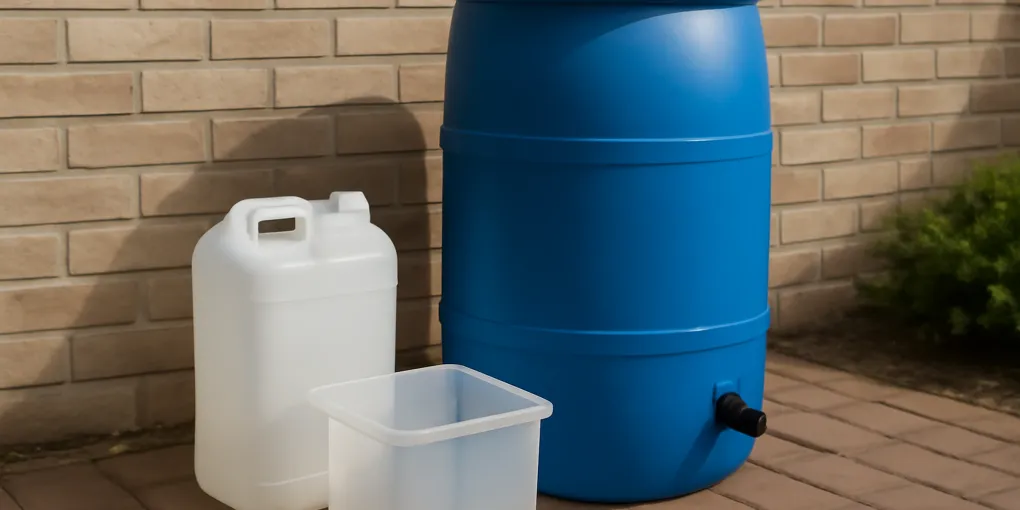
Color is not proof of safety. Blue food-ingredient drums are common, but a blue barrel can still have unknown prior use if the seller cannot document it. Black barrels block light well, but they may heat water more in sun. Decorative barrels can hide narrow lids or awkward interiors that are difficult to clean.
Fittings and hoses count too
The water does not only touch the barrel wall. It also touches the inlet screen, spigot, gasket, overflow fitting, hose, and any pump or drip tubing. If you are replacing parts, choose fittings intended for water contact and outdoor use. A lead-free brass spigot or a quality polypropylene fitting is often a better upgrade than a cheap mystery-metal tap.
Check the gasket and bulkhead connection before filling. A leak around the spigot can soak the stand base, attract mosquitoes, and keep the wall damp. If you need help choosing replacement fittings, see the spigot and bulkhead fitting repair guide.
Hoses deserve the same caution. Do not use collected rainwater as potable water because a hose is labeled drinking-water safe. Roof runoff and stored barrel water remain non-potable. Use hose and drip parts that match the irrigation job, then keep the outlet away from children’s water toys, pet bowls, and food-prep areas. If you are attaching a hose directly to the barrel, the rain barrel hose-flow setup guide explains why short, low-pressure runs work better than long sprinkler-style setups.
When not to use the collected water on edible crops
Use extra caution with edible gardens. Many extension resources recommend keeping rain barrel water off the edible portion of leafy greens, herbs, and low-growing crops, especially close to harvest. If you use roof runoff in a vegetable garden, apply it to soil near the plant base, avoid overhead spray on edible leaves or fruit, and stop using it when water smells bad or the barrel has visible contamination.
Do not collect from roofs treated with moss killers, fresh sealants, pressure-washing chemicals, or unknown coatings until you understand the product and runoff guidance. Avoid water from copper roofs, treated wood surfaces, and areas with heavy bird or animal contamination. If the barrel previously held anything non-food or unknown, do not use it around edible crops.
For households with immunocompromised people, young children, or anyone likely to touch produce before washing, be more conservative. Use municipal water for edible parts and reserve barrel water for ornamentals, trees, shrubs, or soil-only applications well before harvest.
Buyer checklist before you fill it
Before the first storm, inspect the barrel as if you will have to clean it later:
- Can you identify the barrel material and prior use?
- Is the lid tight enough to keep children, animals, leaves, and mosquitoes out?
- Does the inlet have a removable screen that can be cleaned after storms?
- Is the plastic opaque enough to limit algae in your sun exposure?
- Are the spigot, gasket, and overflow fitting replaceable?
- Can the barrel drain fully for cleaning or winter storage?
- Is the barrel clearly treated as non-potable water in your household routine?
If a listing cannot answer the material, lid, inlet, or fitting questions, keep shopping. A cheap barrel with unknown history can cost more in leaks, odors, mosquitoes, and garden uncertainty than a better-designed barrel costs upfront.
How we score food-grade barrel choices
| Criterion | Weight | How to apply it here |
|---|---|---|
| Research | 30% | Verify material, prior use, runoff source, and extension guidance for edible-garden use before relying on the barrel. |
| Evidence Quality | 25% | Prefer documented food-grade or purpose-built barrels over seller claims with no prior-use details. |
| Value | 20% | Pay for opaque walls, a tight lid, screened inlet, overflow, and replaceable fittings before decorative extras. |
| User Signals | 15% | Treat chemical odor, visible residue, algae blooms, mosquito access, brittle plastic, and leaking fittings as reasons to pause use. |
| Transparency | 10% | Label and handle the system as non-potable so family members do not confuse stored runoff with drinking water. |
FAQ
Is water from a food-grade rain barrel safe to drink?
No. A food-grade barrel does not make roof runoff potable. The water can pick up contaminants from the roof, gutters, air, animals, stored sediment, and fittings. Use collected rainwater as non-potable outdoor water unless it has been properly treated and tested under a system designed for drinking water.
Is HDPE a good rain barrel material?
HDPE is a common, practical rain barrel material because it is durable, widely used for containers, and available in opaque designs. The specific barrel still needs a known source, tight lid, screened inlet, safe fittings, and routine cleaning.
Can I reuse a food syrup drum as a rain barrel?
Often yes, if the prior contents were truly food ingredients, the drum can be cleaned thoroughly, and the lid and fittings can be adapted safely. Do not reuse drums that held chemicals, solvents, pesticides, petroleum products, or unknown contents.
Does a black rain barrel get too hot?
A black barrel can warm more in direct sun, but it also blocks light that feeds algae. In hot climates, place the barrel where it gets shade part of the day, keep the lid tight, and use stored water regularly so it does not sit warm for long periods.
Sources
- University of Minnesota Extension, rain barrels: https://extension.umn.edu/water-wisely-start-your-own-backyard/rain-barrels
- Rutgers New Jersey Agricultural Experiment Station, rain barrel use and maintenance: https://njaes.rutgers.edu/fs1118/
- University of Georgia Extension, rainwater harvesting for homeowners: https://extension.uga.edu/publications/detail.html?number=B1372
- Clemson Cooperative Extension, rainwater harvesting basics: https://hgic.clemson.edu/factsheet/rainwater-harvesting/
- U.S. EPA, Soak Up the Rain stormwater education: https://www.epa.gov/soakuptherain